
September is the third and final ecclesiastical eclogue, following Maye and Julye. It features two shepherds, Hobbinol and Diggon Davie, in a format of dialogue-and-fable first established in Februarie, which had used pastoral dialogue to distinguish between the merits of youth and age. Here, the conversation distinguishes between Hobbinol’s contentment with his pastoral retreat in the paradise of an Arcadian landscape and Diggon’s bitter return to this locale after his sojourn to a foreign country. At issue, then, is the pastoral protection of a sacred place, and the shepherd’s role in it.
The eclogue divides into four parts: 1) in lines 1-24, the shepherds greet each other and establish the terms of their different experiences; 2) in lines 25-171, Diggon dilates on his disillusionment over his trip, while Hobbinol provides consolation; 3) in lines 172-241, Diggon tells a tale that confirms his grim experience, in which the shepherd Roffy and his dog Lowder war against a crafty wolf; and 4) in lines 242-59, Diggon rejects the idea of catharsis that telling a tale can bring, while Hobbinol offers friendship in his cottage at home.
Two key source-texts inform the dialogue: Mantuan, Eclogues 9, which contrasts praise of the good shepherd with the corruption of the Roman curia; and Virgil, Eclogues 1 and 9, which tell a combined story about Roman land dispossession, exile, and wolves. In the intersection here of Arcadian and Mantuanesque pastoral (Cullen 1970; see introduction), figured respectively in Diggon and Hobbinol, Spenser can be seen to temper ‘Mantuan’s tone’ and recover ‘Virgilian pastoral’: he fuses ecclesiastical harshness and classical otium (Lindheim 1994: 18). Yet Diggon’s name derives more directly from Davy Diker (one who builds dikes, a digger) in Thomas Churchyard’s Davy Dycars Dreame (c. 1552) and, before him, the ‘radical ploughman’ from Langland’s Piers Plowman, ‘Dawe þe Dykere’ (B 5.320), in a tradition of radical reform (Brooks-Davies 1992: 141; see J.N. King 1990: 25). Diggon may even function as a Langlandian figure for Churchyard himself, whose biography resembles Diggon’s, and who controversially used poetry to indict public leaders obliquely (Fleay, Var 7: 353; see Lucas 2002: 157-8). Yet Diggon differs from his specifically literary ancestors in both Churchyard and Langland in that ‘his fall into poverty is not the result of others’ actions, namely, the greed of lords and the clergy’ (Little 2013: 159), but rather it is caused by his own bewitchment through their guile (lines 74-5).
Recalling Maye and Julye, September thus takes as its primary topic the spiritual life of the pastor in the face of ecclesiastical corruption. At issue historically is ‘the way in which prelatical or powerful secular patrons oppress lower clergy by means of financial exactions against which there is no appeal’ (Hume 1984: 37), as well as the threat of the Jesuit Mission (Cain in Oram 1989: 150). Yet once again it is not clear whether the ‘forrein costes’ (28) under scrutiny target Rome or England, and specifically Wales (J.N. King 1990: 44), or what Spenser’s own ecclesiastical polity might be, and whether he belongs to the Puritan or progressive Protestant faction (Hume 1984 vs King 1990). Equally at issue is the role that the poet plays in rehearsing the debate: is he ambivalent (Cullen 1970: 62-8), or does he express an agenda siding with the mournful Diggon (Hume 1984: 39-40)? Complementing the ecclesiastical concerns is a social dynamic regarding Elizabethan economics, including ‘such controversial issues as vagrancy, poverty, class exploitation, and internal security’ (Lane 1993: 132), but also, more particularly, the idea of a basically virtuous British ‘laborer’ becoming ‘bewitcht’ by the prospect of becoming ‘enricht’ (74-5)—in other words, of becoming inwardly complicit in his own outward ‘poverty’, and thereby advancing a distinctly Reformation emphasis on the inward life (Little 2013: 156-61).
More directly than any other eclogue, ‘September is . . . concerned with the failure of communication. . . . With its emphasis on saying and missaying, September paves the way for the October discussion of poetry. . . . [Diggon and Hobbinol] tend toward extreme positions of black-world invective and green-world idyllism’ (Berger 1988: 309, 313). In particular, the eclogue gives extreme articulation to the oppositions of religio-political engagement and pastoral withdrawal, preparing for the discussion of the responsibilities (and irresponsibilities) of poetry in the next eclogue. Finally, then, September qualifies as ‘a virtual primer for any future author of protest poetry: a work that exemplifies more clearly than any other poem of its time the most efficacious protective strategies available for poets who wished to voice publicly their opinions on dangerous subjects while minimizing the threat of punishment for those opinions’ (Lucas 2002: 161).
Metrically, September deploys the same rugged tetrameter couplets as Julye, inflected with a dialect aiming to be Welsh but in reality more indebted to Northern and Scots idioms (Brooks-Davies 1995: 141).
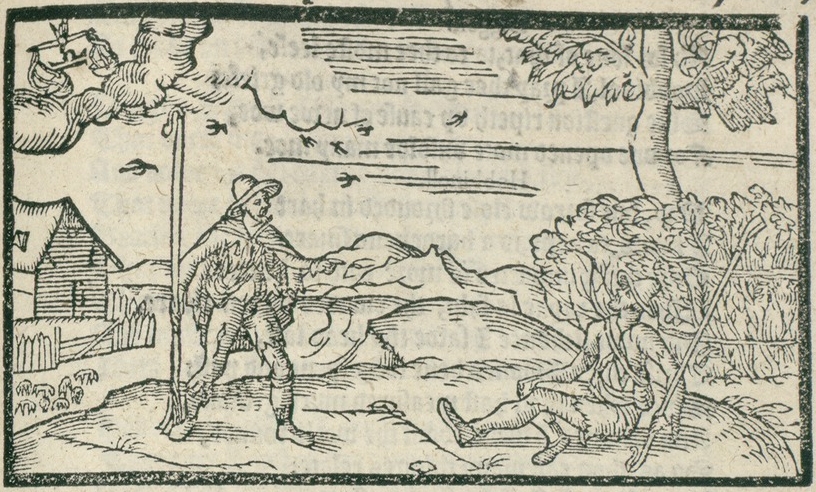
The woodcut is among ‘the least specific of all the cuts’, as well as the most straightforward (Luborksy 1981: 35). Hobbinol stands to the left with the comfort of his fenced house behind him, while to the right Diggon (identifiable by the scrip or pouch at his waist) sits sprawled on the ground, a shade-tree and foliage behind him. The depleted condition of the sheep outside Hobbinol’s house identifies them as Diggon’s (see line 25). Of all the other woodcuts that feature two speakers (Feb, March, June, Oct, Nov, and to an extent Maye), September joins only Julye in distinguishing between a shepherd who stands and one who sits. Unlike Thomalin and Morrell, however, who each use their hands to gesture to each other, here Hobbinol alone makes the gesture, while Diggon keeps his hands at his side, one firmly holding his sheep-hook, his head looking up: there is separation and loss, yet a beckoning toward union, and steadfastness amid misfortune.
At 259 lines, September is the second longest of the eclogues (after Maye), and is notable for its use of verse, dialect, narrative, and fable to reflect subtly on the poet-pastor’s use of free speech to write about matters of ecclesiastical and social concern in the developing Elizabethan state.

;)
;)
;)
;)
;)
;)
;)
;)
;)
;)
;)
;)
;)
;)
;)
;)
;)
;)
;)
;)
;)
;)
;)
;)
;)
;)
;)
;)
;)
;)
;)
;)
;)
;)
;)
;)
;)
;)
;)
;)
;)
;)
;)
;)
;)
;)
;)
;)
;)
;)
;)
;)
;)
;)
;)
;)
;)
;)
;)
;)
;)
;)
;)
;)
;)
;)
;)
;)
;)
;)
;)
;)
;)
;)
;)
;)
;)
;)
;)
;)
;)
;)
;)
;)
;)
;)
;)
;)
;)
;)
;)
;)
;)
;)
;)
;)
;)
;)
;)
;)
;)
;)
;)
;)
;)
;)
;)
;)
;)
;)
;)
;)
;)
;)
;)
;)
;)
;)
;)
;)
;)
;)
;)
;)
;)
;)
;)
;)
;)
;)
;)
;)
;)
;)
;)
;)
;)
;)
;)
;)
;)
;)
;)
;)
;)
;)
;)
;)
;)
;)
;)
;)
;)
;)
;)
;)
;)
;)
;)
;)
;)
;)
;)
;)
;)
;)
;)
;)
;)
;)
;)
;)
;)
;)
;)
;)
;)
;)
;)
;)
;)
;)
;)
;)
;)
;)
;)
;)
;)
;)
;)
;)
;)
;)
;)
;)
;)
;)
;)
;)
;)
;)
;)
;)
;)
;)
;)
;)
;)
;)
;)
;)
;)
;)
;)
;)
;)