
June is the central eclogue of The Shepheardes Calender. As the first eclogue in which Colin Clout appears in dialogue with another shepherd (Hobbinol), it rehearses the topic that organizes the work: the poet’s career and his role in society. The 120 lines (the same number as October, the other eclogue on the poet’s career) evoke the ‘maximum human life span between the Fall and the Flood’ (Brooks-Davies 1995: 102, citing Gen 6:3), bringing the ‘course’ of Colin’s career (33)—and specifically ‘the half-way topos of classical pastoral’ (Bernard 1981: 316)—front and center.
The dialogue itself is unusually complex, and its trajectory difficult to follow, filled not merely with ‘inconsistencies’ that baffle narrative expectations (cf. Hoffman 1977: 61-9; Berger 1988: 435-7) but with segments disjointed by apparently failed rhetorical transition. Nonetheless, the dialogue can be divided into three main parts. First, in lines 1-64 Hobbinol tempts the dejected Colin, who suffers from unrequited love over Rosalind, to abandon his high aspiration for the ‘hilles’ and ‘to the dales resort’ (19-21), while Colin rejects such a return to ‘carelesse yeeres’ because he has reached ‘ryper age’ (33-6), and Hobbinol persists, praising Colin’s youthful art for its Orphic potency to attract the dazed attention of ‘Calliope’, Muse of epic (57-64). Second, in lines 65-112 Colin refuses to ‘presume to Parnasse hyll’, preferring to ‘pype lowe in shade of lowly grove’ (70-1): he rejects ‘flying fame’ (75), praises ‘Tityrus’ for using his art to ‘slake / The flames’ of ‘love’ in his community of shepherds (85-6), and vaunts that, if he himself possessed Tityrus’ Orphic power to ‘teache the trees’ to cry (96), he would target Rosalind, who has betrayed his faith by taking up with the shepherd Menalcus. Finally, in lines 113-20 Hobbinol records that Colin’s art has affected him, and invites the disconsolate Colin ‘home’ to avoid the ‘stealing steppes’ of ‘night’ (119).
June features clear echoes of two Virgilian source-texts: Eclogue 1, which presents the dialogue between Tityrus, the poet figure who sits serenely in his pastoral landscape, and Meliboeus, the disaffected shepherd who has had his land dispossessed by the Roman authorities; and the Aeneid, which presents the hero Aeneas, lover of Queen Dido, as an exile wandering toward his epic destiny (cf. Lindheim 2005: 34). Yet in making Colin a hybrid figure of both Virgilian pastoral and epic, Spenser makes three adjustments to his precursor. First, he reverses the pastoral role that Virgil had assigned to his own poet-figure, the serene Tityrus, giving that role to Hobbinol, and making Colin the exiled Meliboeus, a poet of disaffection (cf. Bernard 1989: 57). Second, Spenser changes the rationale for the disaffection: not the politics of Roman land-displacement but the trauma of unrequited love. And third, Spenser evokes an epic role for a shepherd-poet who precisely abandons his epic destiny because of unrequited love. In particular, when Colin imagines his poetry vengefully to ‘pierce’ Rosalind’s ‘heart’ (100), Spenser may glance at Petrarch’s Rime Sparse 239 (one of Petrarch’s sestinas on poetry), where the poet imagines facendo a lei ragion ch’ a me fa forza (9 ‘bringing her [Laura] to account who overpowers me’): ’n quante note / ò riprovato umiliar quell’alma!’ (14-15 ‘in how many notes / have I attempted to humble that soul!’).
How do we interpret the poet-persona’s Petrarchan rejection of the literary forms making up the Virgilian progression that the Calender itself advertises for its author? The question is complicated, because ‘Spenser’s lines and phrases’—which tend toward positive evocations of an important national literary project—‘detach themselves from their sentences’ (Alpers 1985: 89), and this detachment helps advance the doubleness that has characterized Aprill (see headnote).
The difficulties of June thus raise important questions. First, does Colin ‘forsake the pastoral Paradise for a dedicated life’ (Hamilton 1968: 37), or does Colin ‘do . . . no such thing’ but instead simply reject Rosalind (Durr 1957: 284)? Second, does the eclogue rehearse a debate about the poet but refuse to resolve the issue (cf. Cullen 1970: 83-90; Hoffman 1977: 61), or does it critique certain features of Elizabethan society: its courtly poetry, with its commitment to delight, valuing instead the native tradition of Chaucer and Skelton, with their plain poetry of social complaint (Lane 1993: 152-8); or perhaps society’s misguided commitment to a ‘paradise principle’, in which Hobbinol’s naïve longing for paradise is as limiting as Colin’s putatively mature rejection of such escapism (Berger 1988: 432-41)? How, finally, are we to read Colin’s refusal to take Hobbinol’s advice: does Spenser use the ‘topos of inability or affected modesty’ as ‘an indirect tactic of self-assertion’ to ‘predict . . . Colin’s transformation into a poet of epic’ (Cain in Oram 1989: 107-8); or does Spenser feature the poet’s growing alienation from the society that the epic poet is meant to serve (cf. McCabe 1995: 21, 1999: 540; Nicholson 2008; Pugh 2016: 103, 105, 112, 181)?
One possibility is that June is central because it features a new Petrarchan space for the author’s Virgilian career. If looked at closely, the eclogue’s strange narrative disjunctions air a new idea for the English poet, one that is original to Spenser: that the Petrarchan erotic complaint can form a bridge between low pastoral and high epic (cf. P. Cheney 1993: 92-8). The role of love in the eclogue is indeed central. In the eclogue’s first part, Colin fails to sing songs because of Rosalind, and he refuses Hobbinol’s advice to abandon the epic hills for the pastoral dales, preferring a third space that forms a place apart. In this space (33-48, 65-80), Colin both turns away from lowly pastoral ‘pleasure’ (36) and rejects the epic presumption of ‘Parnasse hyll’ (70), choosing instead to ‘pyp[e] . . . lowe in shade of lowly grove’: ‘I play to please my selfe’ (71-2). Spenser deftly exchanges the communal Virgilian shade of the pastoral beech tree from Eclogue 1 for the consummate place of Petrarchan solitude and inward musing in the Rime Sparse (e.g., Song 129.1-3, 14-29). Accordingly, in the eclogue’s second part Colin celebrates Tityrus’ success in using erotic song to slake desire: Tityrus alone solves the Petrarchan problem. Yet the doubleness of the representation—Colin’s private failure as a love poet; Tityrus’ public success--pinpoints a structural key to the Calender: Colin fails to use love poetry to carry out his career as a Virgilian author of pastoral preparing for epic; but Spenser himself succeeds Chaucer in his self-defining role as a national love poet. In October, Spenser will return to this three-genre model of the English courtly poet (see headnote).
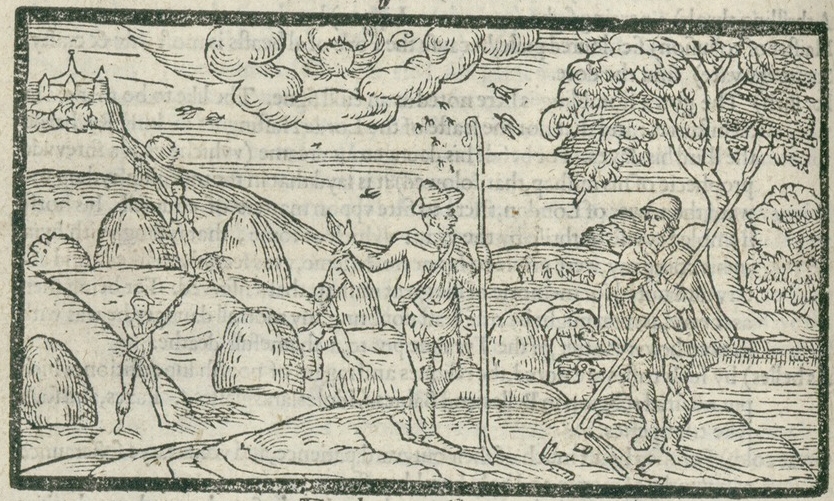
The woodcut draws attention to the centrality of the poet’s role in society, but does not make clear which figure is Colin and which Hobbinol. On the right, a figure appears shrouded in the pleasure of the locus amoenus, standing contentedly under a shade tree, beside a stream, with sheep resting peacefully and with birds flying overhead; at his feet lies a broken pipe. This last detail seems to identify the figure as Colin; however, the figure’s position in the pleasure garden corresponds to the role of Hobbinol in the eclogue proper. In the center, a second figure gestures beyond the harvesters of summer working amid their haycocks to a steep hill with a city topping it. The topos of dale and hill corresponds to a lower pastoral leisure (with a gesture to georgic labor) and a higher epic duty to the nation . In the eclogue, Hobbinol does this gesturing, but he directs Colin to turn from hill back to dale. The woodcut thus offers a counterpoint to the eclogue.
Finally, as if to accentuate the centrality of June, Spenser invents an eight-line stanza rhyming ababbaba. The second sequence of cross-rhymes reverses the order of the first, creating two quatrains that mirror each other, with a heavy emphasis at the midpoint on the ‘b’ rhyme—an intriguing anticipation of the nine-line stanza of FQ (ababbcbcc). The success of such a ‘difficult’ rhyme may be debatable (Var 7: 308, 310), but long ago Thomas Warton called June ‘one of the most poetical and elegant of the Pastorals’ (Var 7: 308). Indeed, its virtuoso effect competes with one of the high-water marks of the Calender, Colin’s August sestina (Brooks-Davies 1995: 102). Through heightened verse accomplishment, June accrues significance, not because it clarifies a new idea of an English literary career, but because it troubles it.

;)
;)
;)
;)
;)
;)
;)
;)
;)
;)
;)
;)
;)
;)
;)
;)
;)
;)
;)
;)
;)
;)
;)
![1579 [E.K. gl. 23];](javascript:link_to_image('calender','1579','SC.1579.PM','G1r','SC.1579.PM_G1r.jpg','ect','calender.june.23.collation');)
;)
;)
;)
;)
;)
;)
;)
;)
;)
;)
;)
;)
;)
;)
;)
;)
;)
;)
;)
;)
;)
;)
;)
;)
;)
;)
;)
;)
;)
;)
;)
;)
;)
;)
;)
;)
;)
;)
;)
;)
;)
;)
;)
;)
;)