Headnote

Februarie is notable for its verse achievement in poetic narrative. In 1586, William Webbe first admired the ‘Sheepeheardes homelyst talke’ (Var 7: 253), and the admiration continued in the eighteenth, nineteenth, and twentieth centuries, with William Hazlitt calling the inset fable of the Oak and the Briar ‘as splendid a piece of oratory as any found in the records of the eloquence of the British senate’ (Friedland 1954: 224). Yet Hazlitt’s political metaphor from the Roman Republic also speaks to the particular way that Spenser harnesses poetic eloquence here: on behalf of a ‘British’ nation committed to free debate.

Spenser’s oratory divides into three parts: 1) lines 1-101 feature a sometimes rancorous debate between the younger shepherd Cuddie and the older Thenot on the topic of youth and age; 2) lines 102-238 present Thenot telling Cuddie a fable of the Oak and the Briar about the arrogance of youth undercutting the authority of age, only to destroy itself; and 3) lines 239-46 show Cuddie’s biting rejection of the moral utility of Thenot’s fable.

To accomplish such a ‘homely’ narrative, Spenser relies on rugged tetrameter couplets with an often coarse and archaic diction. The lines vary from eight to ten syllables, and the baseline iambic meter frequently modulates through anapests (two unstressed syllables followed by a stressed one). By writing so many lines having four beats with stresses tending to fall on the heavy alliteration, the poet evokes the medieval tradition of Piers Plowman and the pseudo-Chaucerian Plowman’s Tale, important to the Protestant reform movement. This helps explain the first appearance in the Calender of ‘Tityrus’, the shepherd whom Thenot cites as the inventor of the fable, and whom Cuddie admires, bringing to their rancor an unusual moment of accord. Tityrus, we learn, is Chaucer, and the reference allows Februarie to record Spenser’s own budding genealogy as England’s national poet.

The shepherds’ debate evokes several controversies taking place in mid-Elizabethan culture: about the relative merits of youth and age (Cullen 1970: 34-41); about court patronage, in which warring factions at the Elizabethan court vie for power, the younger generation vying for authority with the older one (Hoffman 1977: 92-7; Montrose 1981; Bond 1981; Patterson 1991: 59-61, 88-9); about Protestant attacks on both older Catholic faith and younger Protestant radicalism (Hume 1984: 43-4; J.N. King 1990: 34); and about opposing Elizabethan poetics (Berger 1988: 425; Halpern 1991: 176-214; Pugh 2005: 30-4), including the two major poetics of the 1570s: Cuddie’s courtly ‘amateur’ art, which features delightful love stories without an ethical end; and Thenot’s older ‘humanist’ art, which insists on moral instruction (P. Cheney 2002). Not just good storytelling, Februarie packs in a wide cultural conversation.

The central precursor text for the eclogue’s showpiece, the fable of the Oak and the Briar, is Aesop’s The Bush and the Aubyer, in which a tree persuades a woodsman to cut down a rival tree, although Spenser superimposes onto this a poem from the reign of Edward VI, The Hospitable Oake, which uses Virgilian allusions to represent powerful patrons as vulnerable shade trees (Patterson 1991: 60-1). Yet in the background is likely Gascoigne’s Princely Pleasures of Kenilworth Castle (1576), in which Queen Complacida (she who pleases everyone) metamorphoses an oak of Constancy and a briar of Contention (Friedland 1954; Watson 1993), in an allegory featuring Queen Elizabeth’s favoring of the earl of Leicester, patron of Gascoigne (and later, Spenser). Perhaps also applicable is the first fable in The Seven Ages of Rome, a medieval romance popular in the sixteenth century (Roberts 1950). These subtexts gesture to the social, political, and religious issues resonating in Februarie.

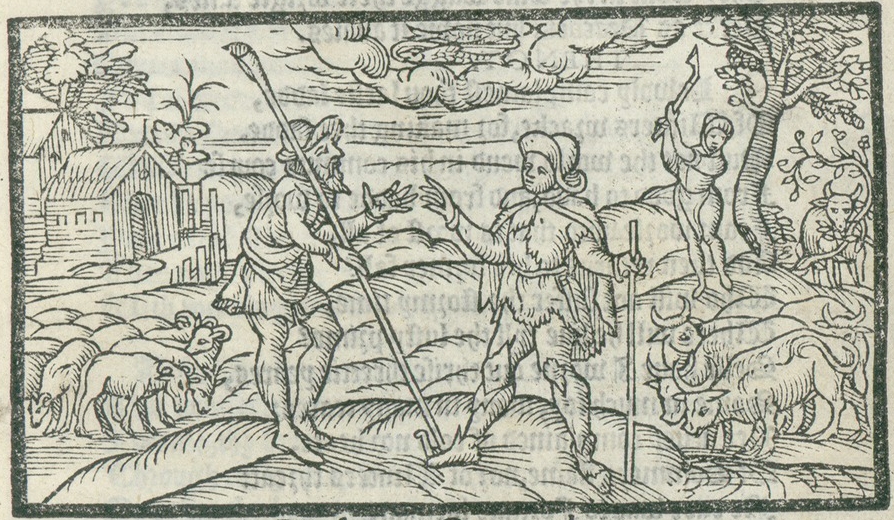
The woodcut is impressively done, and gestures to these issues as well, with the two debating shepherds standing in the center, their hands nearly touching in accord, balanced by their flocks standing behind them (Thenot, sheep; Cuddie, bullocks). To the right, behind Cuddie, are the emblems of the fable: a husbandman cutting down a tall tree, with a briar standing in its shadow—curiously being eaten by one of the bullocks. To the left, behind Thenot, are buildings that evoke the institutions of church and state.

Both the content of Februarie and its archaic prosody link it with the ecclesiastical eclogues, Maye, Julye, and September, and, together with October, they form what E.K. calls the ‘moral’ eclogues (see note below on Arg ‘morall’). Moreover, Februarie stands out from the eclogue it follows, Januarye, which has featured a smoother poetic surface and a solo artist, Colin Clout. Not merely splendid narrative, Februarie is among the most sophisticated of the eclogues, relying self-consciously on rugged poetic meter to air—rather than simply ‘moralize’ (FQ I.pr.1.9)—social, religious, political, and finally poetic debates. Indeed, Spenser’s ability to contain cultural debate within a verse narrative that manages to balance resonance with restraint demonstrates his emerging authority as a leading voice in ‘the British senate’.
0.1calender.february.0.1 0.2calender.february.0.2 0calender.february.argument.0 1calender.february.argument.1 2calender.february.argument.2 3calender.february.argument.3 4calender.february.argument.4 5calender.february.argument.5 6calender.february.argument.6 7calender.february.argument.7 8calender.february.argument.8 9calender.february.argument.9 10calender.february.argument.10 11calender.february.argument.11 12calender.february.argument.12 0calender.february.1.0 1calender.february.1 2calender.february.2 3calender.february.3 4calender.february.4 5calender.february.5 6calender.february.6 7calender.february.7 8calender.february.8 0calender.february.9.0 9calender.february.9 10calender.february.10 11calender.february.11 12calender.february.12 13calender.february.13 14calender.february.14 15calender.february.15 16calender.february.16 17calender.february.17 18calender.february.18 19calender.february.19 20calender.february.20 21calender.february.21 22calender.february.22 23calender.february.23 24calender.february.24 0calender.february.25.0 25calender.february.25 26calender.february.26 27calender.february.27 28calender.february.28 29calender.february.29 30calender.february.30 31calender.february.31 32calender.february.32 0calender.february.33.0 33calender.february.33 34calender.february.34 35calender.february.35 36calender.february.36 37calender.february.37 38calender.february.38 39calender.february.39 40calender.february.40 41calender.february.41 42calender.february.42 43calender.february.43 44calender.february.44 45calender.february.45 46calender.february.46 47calender.february.47 48calender.february.48 49calender.february.49 50calender.february.50 0calender.february.51.0 51calender.february.51 52calender.february.52 53calender.february.53 54calender.february.54 55calender.february.55 56calender.february.56 57calender.february.57 58calender.february.58 59calender.february.59 60calender.february.60 61calender.february.61 62calender.february.62 63calender.february.63 64calender.february.64 65calender.february.65 66calender.february.66 67calender.february.67 68calender.february.68 0calender.february.69.0 69calender.february.69 70calender.february.70 0calender.february.71.0 71calender.february.71 72calender.february.72 73calender.february.73 74calender.february.74 75calender.february.75 76calender.february.76 77calender.february.77 78calender.february.78 79calender.february.79 80calender.february.80 81calender.february.81 82calender.february.82 83calender.february.83 84calender.february.84 0calender.february.85.0 85calender.february.85 86calender.february.86 87calender.february.87 88calender.february.88 89calender.february.89 90calender.february.90 91calender.february.91 92calender.february.92 93calender.february.93 0calender.february.94.0 94calender.february.94 95calender.february.95 96calender.february.96 97calender.february.97 0calender.february.98.0 98calender.february.98 99calender.february.99 100calender.february.100 101calender.february.101 102calender.february.102 103calender.february.103 104calender.february.104 105calender.february.105 106calender.february.106 107calender.february.107 108calender.february.108 109calender.february.109 110calender.february.110 111calender.february.111 112calender.february.112 113calender.february.113 114calender.february.114 115calender.february.115 116calender.february.116 117calender.february.117 118calender.february.118 119calender.february.119 120calender.february.120 121calender.february.121 122calender.february.122 123calender.february.123 124calender.february.124 125calender.february.125 126calender.february.126 127calender.february.127 128calender.february.128 129calender.february.129 130calender.february.130 131calender.february.131 132calender.february.132 133calender.february.133 134calender.february.134 135calender.february.135 136calender.february.136 137calender.february.137 138calender.february.138 139calender.february.139 140calender.february.140 141calender.february.141 142calender.february.142 143calender.february.143 144calender.february.144 145calender.february.145 146calender.february.146 147calender.february.147 148calender.february.148 149calender.february.149 150calender.february.150 151calender.february.151 152calender.february.152 153calender.february.153 154calender.february.154 155calender.february.155 156calender.february.156 157calender.february.157 158calender.february.158 159calender.february.159 160calender.february.160 161calender.february.161 162calender.february.162 163calender.february.163 164calender.february.164 165calender.february.165 166calender.february.166 167calender.february.167 168calender.february.168 169calender.february.169 170calender.february.170 171calender.february.171 172calender.february.172 173calender.february.173 174calender.february.174 175calender.february.175 176calender.february.176 177calender.february.177 178calender.february.178 179calender.february.179 180calender.february.180 181calender.february.181 182calender.february.182 183calender.february.183 184calender.february.184 185calender.february.185 186calender.february.186 187calender.february.187 188calender.february.188 189calender.february.189 190calender.february.190 191calender.february.191 192calender.february.192 193calender.february.193 194calender.february.194 195calender.february.195 196calender.february.196 197calender.february.197 198calender.february.198 199calender.february.199 200calender.february.200 201calender.february.201 202calender.february.202 203calender.february.203 204calender.february.204 205calender.february.205 206calender.february.206 207calender.february.207 208calender.february.208 209calender.february.209 210calender.february.210 211calender.february.211 212calender.february.212 213calender.february.213 214calender.february.214 215calender.february.215 216calender.february.216 217calender.february.217 218calender.february.218 219calender.february.219 220calender.february.220 221calender.february.221 222calender.february.222 223calender.february.223 224calender.february.224 225calender.february.225 226calender.february.226 227calender.february.227 228calender.february.228 229calender.february.229 230calender.february.230 231calender.february.231 232calender.february.232 233calender.february.233 234calender.february.234 235calender.february.235 236calender.february.236 237calender.february.237 238calender.february.238 0calender.february.239.0 239calender.february.239 240calender.february.240 241calender.february.241 242calender.february.242 243calender.february.243 244calender.february.244 245calender.february.245 246calender.february.246 247calender.february.247 248calender.february.248 249calender.february.249 250calender.february.250 251calender.february.251 252calender.february.252 0calender.february.glosse.0 1calender.february.glosse.1 2calender.february.glosse.2 3calender.february.glosse.3 4calender.february.glosse.4 5calender.february.glosse.5 6calender.february.glosse.6 7calender.february.glosse.7 8calender.february.glosse.8 9calender.february.glosse.9 10calender.february.glosse.10 11calender.february.glosse.11 12calender.february.glosse.12 13calender.february.glosse.13 14calender.february.glosse.14 15calender.february.glosse.15 16calender.february.glosse.16 17calender.february.glosse.17 18calender.february.glosse.18 19calender.february.glosse.19 20calender.february.glosse.20 21calender.february.glosse.21 22calender.february.glosse.22 23calender.february.glosse.23 24calender.february.glosse.24 25calender.february.glosse.25 26calender.february.glosse.26 27calender.february.glosse.27 28calender.february.glosse.28 29calender.february.glosse.29 30calender.february.glosse.30 31calender.february.glosse.31 32calender.february.glosse.32 33calender.february.glosse.33 34calender.february.glosse.34 35calender.february.glosse.35 36calender.february.glosse.36 37calender.february.glosse.37 38calender.february.glosse.38 39calender.february.glosse.39 40calender.february.glosse.40 41calender.february.glosse.41 42calender.february.glosse.42 43calender.february.glosse.43 44calender.february.glosse.44 45calender.february.glosse.45 46calender.february.glosse.46 47calender.february.glosse.47 48calender.february.glosse.48 49calender.february.glosse.49 50calender.february.glosse.50 51calender.february.glosse.51 52calender.february.glosse.52 53calender.february.glosse.53 54calender.february.glosse.54 55calender.february.glosse.55 56calender.february.glosse.56 57calender.february.glosse.57 58calender.february.glosse.58 59calender.february.glosse.59 60calender.february.glosse.60 61calender.february.glosse.61 62calender.february.glosse.62 63calender.february.glosse.63 64calender.february.glosse.64 65calender.february.glosse.65 66calender.february.glosse.66 67calender.february.glosse.67 68calender.february.glosse.68 69calender.february.glosse.69 70calender.february.glosse.70 71calender.february.glosse.71 72calender.february.glosse.72 73calender.february.glosse.73 74calender.february.glosse.74 75calender.february.glosse.75 76calender.february.glosse.76 77calender.february.glosse.77 78calender.february.glosse.78 79calender.february.glosse.79 80calender.february.glosse.80 81calender.february.glosse.81 82calender.february.glosse.82 83calender.february.glosse.83 84calender.february.glosse.84 85calender.february.glosse.85 86calender.february.glosse.86 87calender.february.glosse.87 88calender.february.glosse.88 89calender.february.glosse.89 90calender.february.glosse.90 91calender.february.glosse.91 92calender.february.glosse.92 93calender.february.glosse.93 94calender.february.glosse.94 95calender.february.glosse.95 96calender.february.glosse.96 97calender.february.glosse.97 98calender.february.glosse.98 99calender.february.glosse.99 100calender.february.glosse.100 101calender.february.glosse.101 102calender.february.glosse.102 103calender.february.glosse.103 104calender.february.glosse.104 105calender.february.glosse.105 106calender.february.glosse.106 107calender.february.glosse.107 108calender.february.glosse.108 109calender.february.glosse.109 110calender.february.glosse.110 111calender.february.glosse.111 112calender.february.glosse.112 113calender.february.glosse.113 114calender.february.glosse.114 115calender.february.glosse.115 116calender.february.glosse.116 117calender.february.glosse.117 118calender.february.glosse.118 119calender.february.glosse.119 120calender.february.glosse.120
Februarie.
Ægloga Secunda.
ARGVMENTARGUMENT.
THisThis Æglogue is rather morall and generall, 1. then: thanthenthan bent to any secrete or particular purpose. It specially conteyneth a discourse of old age, in the persone of
Thenot
an olde Shepheard, who for his crookednesse and vnlustinesse,unlustinesse, is scorned of
Cuddie
an vnhappyunhappy Heardmans boye
. The matter very well accordeth with the season of the moneth, the yeare now drouping, &and as it were, drawing to his last age. For as in this time of yeare, so thẽthen in our bodies there is a dry &and withering cold, which congealeth the crudled blood, and frieseth the wetherbeatẽwetherbeaten flesh, with stormes of Fortune, &and hoare frosts of Care. To which purposepnrpoſepurpoſepurpoſe the olde man telleth a tale of the Oake and the Bryer, so liuelylively and so feelingly, as if the thing were set forth in some Picture before our eyes, more plainly could not appeare.
CVDDIECUDDIE. THENOT.
AHAh for pittie, wil rancke Winters rage,
These bitter blasts neuernever ginne tasswage?
The kene cold blowes through my beaten hyde,
All as I were through the body gryde.
My ragged rontes all shiver and shake,
As doen high Towers in an earthquake:
They wont in the wind wagge their wrigle tailes,
Perke as Peacock: but nowe it aualesavales..
THENOT
.
Lewdly complainest thou laesie ladde,
Of Winters wracke , for making thee sadde.
Must not the world wend in his commun course
From good to badd, and from badde to worse,
From worse vntounto that is worst of all,
And then returne to his former fall?
Who will not suffer the stormy time,
Where will he liuelive tyll the lusty prime?
Selfe hauehave I worne out thrise threttie yeares,
Some in much ioyjoy, many in many teares:
Yet neuernever complained of cold nor heate,
Of Sommers flame, nor of Winters threat:
Ne euerever was to Fortune foeman,
But gently tooke, that vngentlyungently came..
And euerever my flocke was my chiefe care,
Winter or Sommer they mought well fare.
CVDDIECUDDIE
.
No marueilemarveile
Thenot
,
if thou can beare
Cherefully the Winters wrathfull cheare:
For Age and Winter accord full nie,
This chill, that cold, this crooked, that wrye.
And as the lowring Wether lookes downe,
So semest thou like good fryday to frowne.
But my flowring youth is foe to frost,
My shippe vnwontunwont in stormes to be tost.
THENOT
.
The soueraignesoveraigne of seas he blames in vaine,
That once seabeate, will to sea againe..
So loytring liuelive you little heardgroomes,
Keeping your beastes in the budded broomes:
And when the shining sunne laughethlanghethlaugheth once,
You deemen, the Spring is come attonce..
Tho gynne you, fond flyes, the cold to scorne,
And crowing in pypes made of greene corne,
You thinken to be Lords of the yeare.
But eft, when ye count you freed from feare,
Comes the breme winter with chamfred browes,
Full of wrinckles and frostie furrowes:
Drerily shooting his stormy darte,
Which cruddles the blood, and pricks the harte.
Then is your carelesse corage accoied,
Your carefull heards with cold bene annoied..
Then paye you the price of your surquedrie,
With weeping, and wayling, and misery.
CVDDIECUDDIE
.
Ah foolish old man, I scorne thy skill,
That wouldest me, my springing youngth to spil.
I deeme, thy braine emperished bee
Through rusty elde, that hath rotted thee:
Or sicker thy head veray tottie is,
So on thy corbe shoulder it leanes amisse.
Now thy selfe hast lost both lopp and topp,
Als my budding braunch thou wouldest cropp:
But were thy yeares greene, as now bene myne,
To other delights they would encline..
Tho wouldest thou learne to caroll of LoueLove,
And hery with hymnes thy lasses gloueglove.
Tho wouldest thou pype of Phyllis prayse:
But Phyllis is myne for many dayes:
I wonne her with a gyrdle of gelt,
Embost with buegle about the belt.
Such an one shepeheards woulde make full faine:
Such an one would make thee younge againe.
THENOT
.
Thou art a fon, of thy louelove to boste,
All that is lent to louelove, wyll be lost.
CVDDIECUDDIE
.
Seest, howe brag yond Bullocke beares,
So smirke, so smoothe, his pricked eares?
His hornes bene as broade, as Rainebowe bent,
His dewelap as lythe, as lasse of Kent.
See howe he venteth into the wynd.
Weenest of louelove is not his mynd?
Seemeth thy flocke thy counsell can,
So lustlesse bene they, so weake so wan,
Clothed with cold, and hoary wyth frost.
Thy flocks father his corage hath lost:
Thy Ewes, that wont to hauehave blowen bags,
Like wailefull widdowes hangen their crags:
The rather Lambes bene staruedstarved with cold,
All for their Maister is lustlesse and old.
THENOT
.
Cuddie
,
I wote thou kenst little good,
So vainely taduauncetadvaunce thy headlesse hood.
For Youngth is a bubble blown vpup with breath,
Whose witt is weakenesse, whose wage is death,
Whose way is wildernesse, whose ynne Penaunce,
And stoopegallaunt Age the hoste of GreeuaunceGreevaunce.
But shall I tel thee a tale of truth,
Which I cond of Tityrus in my youth,
Keeping his sheepe on the hils of Kent?
CVDDIECUDDIE
.
To nought more
Thenot
,
my mind is bent,
95. Then: ThanThenThan to heare nouellsnovells of his deuisedevise:
They bene so well thewed, and so wise,
What euerever that good old man bespake..
THENOT
.
Many meete tales of youth did he make,
And some of louelove, and some of cheualriechevalrie:
But none fitter 100. then: thanthenthan this to applie..
Now listen a whileawhile, and hearken the end.
THereThere grewe an aged Tree on the greene,
A goodly Oake sometime had it bene,
With armes full strong and largely displayd,
But of their leauesleaves they were disarayde:
The bodie bigge, and mightely pight,
Throughly rooted, and of wonderous hight:
Whilome had bene the King of the field,
And mochell mast to the husband did yielde,
And with his nuts larded many swine.
But now the gray mosse marred his rine,
His bared boughes were beaten with stormes,
His toppe was bald, &and wasted with wormes,
His honor decayed, his braunches sere.
Hard by his side grewe a bragging brere,
Which proudly thrust into Thelement,
And seemed to threat the Firmament..
Yt was embellisht with blossomes fayre,
And thereto aye wonned to repayre
The shepheards daughters, to gather flowres,
To peinct their girlonds with his colowres.
And in his small bushes vsedused to shrowde
The sweete Nightingale singing so lowde:
Which made this foolish Brere wexe so bold,
That on a time he cast him to scold,
And snebbe the good Oake, for he was old.
Why standst there (quoth he) thou brutish blocke?
Nor for fruict, nor for shadowe seruesserves thy stocke:
Seest, how fresh my flowers bene spredde,
Dyed in Lilly white, and Cremsin redde,
With LeauesLeaves engrained in lusty greene,
Colours meete to clothe a mayden Queene.
Thy wast bignes but combers the grownd,
And dirks the beauty of my blossomes rownd.
The mouldie mosse, which thee accloieth,
My Sinamon smell too much annoieth.
Wherefore soone I rede thee, hence remoueremove,
Least thou the price of my displeasure proueprove.
So spake this bold brere with great disdaine:
Little him answered the Oake againe,
But yielded, with shame and greefe adawed,
That of a weede he was ouerawedoverawed.. ouercrawed.ouercrawed.
Yt chaunced after vponupon a day,
The HusbandmanHuſ-bandmanhuſbandmanhuſbandmanshusbandmans selfe to come that way,
Of custome for to serueweservewe his grownd,
And his trees of state in compasse rownd.
Him when the spitefull brere had espyed,
Caus lesseCauslesse complained, and lowdly cryed
Unto his Lord, stirring vpup sterne strife:
O my liege Lord, the God of my life,
Pleaseth you ponder your Suppliants plaint,
Caused of wrong, and cruell constraint,
Which I your poore UassallVassall dayly endure:
And but your goodnes the same recure,
Am like for desperate doole to dye,
Through felonous force of mine enemie.
Greatly aghast with this piteous plea,
Him rested the goodman on the lea,
And badde the Brere in his plaint proceede.
With painted words tho gan this proude weede,
(As most vsenusen Ambitious folke:)folke):
His colowred crime with craft to cloke.
Ah my soueraignesoveraigne, Lord of creatures all,
Thou placer of plants both humble and tall,
Was not I planted of thine owne hand,
To be the primrose of all thy land,
With flowring blossomes, to furnish the prime,
And scarlot berries in Sommer time?
How falls it then, that this faded Oake,
Whose bodie is sere, whose braunches broke,
Whose naked Armes stretch vntounto the fyre,
Unto such tyrannie doth aspire:
Hindering with his shade my louelylovely light,
And robbing me of the swete sonnes sight?
So beate his old boughes my tender side,
That oft the bloud springeth from wounds wyde:
Untimely my flowres forced to fall,
That bene the honor of your Coronall.
And oft he lets his cancker wormes light
Upon my braunches, to worke me more spight:
And oft his hoarie locks downe doth cast,
Where with my fresh flowretts bene defast.
For this, and many more such outrage,
CrauingCraving your goodlihead to aswage
The ranckorous rigour of his might,
Nought aske I, but onely to hold my right:
Submitting me to your good sufferance,
And praying to be garded from greeuancegreevance.
To this theTo this thisTo this, thisTo this, this Oake cast him to replie
Well as he couth: but his enemie
Had kindled such coles of displeasure,
That the good man noulde stay his leasure,
But home him hasted with furious heate,
Encreasing his wrath with many a threate.
His harmefull Hatchet he hent in hand,
(Alas, that it so ready should stand)
And to the field alone he speedeth.
(Ay little helpe to harme there needeth)
Anger nould let him speake to the tree,
Enaunter his rage mought cooled bee:
But to the roote bent his sturdy stroke,
And made many wounds in the wast Oake.
The Axes edge did oft turne againe,
As halfe vnwillingunwilling to cutte the graine:
Semed, the sencelesse yron dyd feare,
Or to wrong holy eld did forbeare.
For it had bene an auncient tree,
Sacred with many a mysteree,
And often crost with the priestes crewe,
And often halowed with holy water dewe.
But sike fancies weren foolerie,
And broughten this Oake to this miserye.
For nought mought they quitten him from decay:
For fiercely the good man at him did laye.
The blocke oft groned vnderunder the blow,
And sighed to see his neare ouerthrowoverthrow.
In fine the steele had pierced his pitth,
Tho downe to the earth he fell forthwith:
His wonderous weight made the grounde to quake,
Thearth shronke vnderunder him, and seemed to shake.
There lyeth the Oake, pitied of none..
Now stands the Brere like a Lord alone,
Puffed vpup with pryde and vaine pleasaunce:
But all this glee had no continuaunce.
For eftsones Winter gan to approche,
The blustring Boreas did encroche,
And beate vponupon the solitarie Brere:
For nowe no succoure was seene him nere.
Now gan he repent his pryde to late:
For naked left and disconsolate,
The byting frost nipt his stalke dead,
The watrie wette weighed downe his head,
And heaped snowe burdned him so sore,
That nowe vprightupright he can stand no more:
And being downe, is trodde in the durt
Of cattell, and brouzed, and sorely hurt.
Such was thend of this Ambitious brere,
For scorning Eld
CVDDIECUDDIE
.
Now I pray thee shepheard, tel it not forth:
Here is a long tale, and little worth.
So longe hauehave I listened to thy speche,
That graffed to the ground is my breche:
My hartblood is welnigh frorne I feele,
And my galage growne fast to my heele:
But little ease of thy lewd tale I tasted.
Hye thee home shepheard, the day is nigh wasted..
Thenots
Embleme.
JddioIddio perche è vecchio,
Fa suoi al suo essempio.
Cuddies
Embleme.
Niuno vecchio,
Spaventa Iddio.
GLOSSE.
Kene) sharpe.
Gride) perced: an olde vvordword much vsedused of Lidgate, but not found (that I know of) in Chaucer.
Ronts) young bullockes.
VVrackeWracke) ruine or Violence, vvhencewhence commeth shipvvrackeshipwracke: and not vvreakewreake, that is vengeaunce or vvrathwrath.
Foeman) a foe.
Thenot
) the name of a shepheard in Marot his Æglogues.
The soueraignesoveraigne of Seas) is Neptune the God of the seas. The saying is borovvedborowed of Mimus Publianus, vvhichwhich vsedused this prouerbproverb in a verse. Improbè Neptunum accusat, qui iterum naufragium facit.
Heardgromes.)Heardgromes) Chaucers verse almost vvholewhole.
Fond Flyes) He compareth carelesse sluggardes or ill husbandmen to flyes, that so soone as the sunne shineth, or yt wexeth any thing vvarmewarme, begin to flye abroade vvhenwhen sodeinly they be ouertakenovertaken vvithwith cold.cold:colde:colde.
But eft when) A verye excellent and liuelylively description of VVinterWinter, so as may bee indifferently taken, eyther for old Age, or for VVinterWinter season.
Breme) chill, bitter.
Chamfred) chapt, or vvrinckledwrinckled.
Accoied) plucked dovvnedowne and daunted.
Surquedrie) pryde.
Elde) olde age.
Sicker) sure.
Tottie) vvaueringwaueringwavering.
Corbe) crooked.
Herie) worshippe.
Phyllis) the name of some mayde vnknowenunknowen, whom
Cuddie
, whose person is secrete, loued.loved. The name is vsuallusuall in Theocritus, Virgile, and Mantuane.
Belte) a girdle or wast band.
A fon) a foole.
lythe) soft &and gentile.
Venteth) snuffeth in the vvindwind.
Thy flocks Father) the Ramme.
Crags) neckesneckes.
Rather Lambes) that be evvedewed early in the beginning of the yeare.
Youth is) A verye moral and pitthy Allegorie of youth, and the lustes thereof, compared to a vveariewearie vvayfaringwayfaring man.
Tityrus) I suppose he meane Chaucer, whose prayse for pleasaunt tales cannot dye, so long as the memorie of hys name shal liuelive, &and the name of Poetrie shal endure.
VVellWell thevvedthewed) that is, Bene moratæ, full of morall wisenesse.
There grew) This tale of the Oake and the Brere, he telleth as learned of Chaucer, but it is cleane in another kind, and rather like to Æsopes fables. It is very excellente for pleasaunt descriptions, being altogether a certaine Icon or Hypotyposis of disdainfull younkers.
Embellisht) beautified and adorned.
To wonne) to haunt or frequent.
Sneb) checke.
VVhyWhy standst) The speach is scorneful &and very presumptuous.
Engrained) dyed in grain.
Accloieth) encombreth.encombrerh.accombreth.accumbreth.
AdavvedAdawed) daunted &and confounded.
Trees of state) taller trees fitte for timber vvoodwood.
Sterne strife) said Chaucer .s. fell and sturdy.
O my liege) A maner of supplication, vvhereinwherein is kindly coloured the affection and speache of Ambitious men.
Coronall) Garlande.
Flourets) young blossomes.
The Primrose) The chiefe and vvorthiestworthiestvvorthiest.worthiest.
Naked armes) metaphorically ment of the bare boughes, spoyled of leauesleaves. This colourably he speaketh, as adiudgingadjudging hym to the fyre.
The blood) spoken of a blocke, as it vverewere of a liuingliving creature, figuratiuelyfiguratively, and (as they saye) κατ’ εἰκασμόνκα]τ’ ἐικα[σμ]όν.
Hoarie lockes) metaphorically for vvitheredwithered leauesleaves.
Hent) caught.
Nould) for vvouldwould not.
Ay) euermoreevermore.
VVoundsWounds) gashes.
Enaunter) least that.
The priestes crevvecrewe) holy vvaterwater pott, wherewith the popishe priest vsedused vfedvſed to sprinckle &and hallovvehallowe the trees from mischaunce. Such blindnesse vvaswas in those times, which the Poete supposeth, to hauehave bene the finall decay of this auncient Oake.
The blocke oft groned) A liuelyelivelye figure, vvhichewhiche geuethgeveth sence and feeling to vnsensibleunsensible creatures, as Virgile alsoalfoalſo sayeth: Saxa gemunt grauidogravido &c.etc.
Boreas) The Northerne vvyndwynd, that bringeth the moste stormie vveatherweather.
Glee) chere and iollitiejollitie.
For scorning Eld) And minding (as shoulde seme) to hauehave made ryme to the former verse, he is conningly cutte 84. of: offofoff by
Cuddye
, as disdayning to here any more.
Galage) a startuppe or clovvnishclownish shoe.
Embleme.
This embleme is spoken of
Thenot
, as a moral of his former tale: namelye, that God, vvhichwhich is himselfe most aged, being before al ages, and vvithoutwithout beginninge, maketh those, vvhomwhom he louethloveth like to himselfe, in heaping yeares vntounto theyre dayes, and blessing them vvythwyth longe lyfe. For the blessing of age is not giuengiven to all, but vntounto those, vvhomewhome God will so blesse: and albeit that many euilevil mẽ men reache vntounto such fulnesse of yeares, and some also vvexewexe olde in myserie and thraldome, yet therefore is not age euerever the lesse blessing. For eueneven to such euillevill men such number of yeares is added, that they may in their last dayes repent, and come to their first home. So the old man checketh the rashheaded boy, for despysing his gray and frostye heares.
VVhomWhom
Cuddye
doth counterbuff with a byting and bitter prouerbeproverbe, spoken indeede at the first in cõtemptcontempt of old age generally. forFor it vvaswas an old opinion, and yet is cõtinuedcontinued in some mens conceipt, that mẽmen of yeares hauehave no feare of god at al, or not so much as younger folke. For that being rypened with long experience, and hauinghaving passed many bitter brunts and blastes of vengeaunce, they dread no stormes of Fortune, nor wrathe of Gods, nor daunger of menne, as being eyther by longe and ripe vvisedomewisedome armed against all mischaunces and aduersitie,adversitie, or vvithwith much trouble hardened against all troublesome tydes: lyke vntounto the Ape, of which is sayd in Æsops fables, that oftentimes meeting the Lyon, he vvaswas at first sore aghast &and dismayed at the grimnes and austeritie of hys countenance, but at last being acquainted vvithwith his lookes, he vvaswas so furrefo furreſo furreſo farre from fearing him, that he would familiarly gybe and iestjest with him: Suche longe experience breedeth in some men securitie. Although it please ErasmusEra[ſi]musEraſmusEraſmus,Eraſmus, a great clerke and good old father, more fatherly and fauourablyefavourablye to construe it in his Adages for his own behoofe, Thatthat by the prouerbeproverbe Nemo Senex metuit IouemIovem, is not meant, that old men hauehave no feare of God at al, but that they be furre from superstition and Idolatrous regard of false Gods, as is IupiterJupiter. But his greate learning notwithstanding, it is to plaine, to be gainsayd, that olde men are muche more enclined to such fond fooleries, 119. then: thanthenthan younger heades.
1. generall: universal, with wide application
8. crudled: thickened, clotted, curdled
11. liuely: lifelike
3. kene: E.K.
4. gryde: E.K.
5. rontes: E.K.
6. doen: do [archaic]
7. wrigle: wriggling
8. Perke: pert, brisk, self-satisfied, assertive
8. auales: abases, humbles; lowers
10. wracke: E.K.
11. wend: 'change from one state to another'.
15. Who: he who
17. threttie: thirty
21. foeman: E.K.
22. gently: mildly, in genteel fashion
27. accord full nie: correspond exactly
28. wrye: awry, bent
32. vnwont: unaccustomed, unused
35. loytring: idling
35. heardgroomes: herdsmen, young shepherds
39. fond flyes: E.K.
43. breme: E.K.
43. chamfred: E.K.
47. accoied: E.K.
49. surquedrie: E.K.
51. skill: reasoning, knowledge
52. youngth: youth
52. spil: destroy, ruin
53. emperished: enfeebled
54. elde: E.K.
55. sicker: E.K.
55. tottie: E.K.
56. corbe: E.K.
57. lopp: small branches, prunings
61. caroll: sing joyously
62. hery: Medievalism. Cf.Nov10.
66. belt: E.K.
69. fon: E.K.
71. brag: proudly
72. smirke: neat
72. pricked: pricked up
74. lythe: E.K.
75. venteth: E.K.
77. can: studies, accepts
78. lustlesse: listless
80. Thy . . . lost: ‘Your ram has lost his sexual desire’.
80. corage: sexual appetite.
81. blowen bags: swollen udders
82. crags: Northern, Scots dialect.
83. starued: perished
85. wote thou kenst: 'know you understand'
88. witt: power of comprehending
90. stoopegallaunt: humbling
90. Greeuaunce: grief
96. well thewed: E.K.
105. disarayde: stripped of
109. mochell mast: many acorns
109. husband: farmer
110. larded: fattened
111. rine: rind, bark
114. sere: dry, withered
118. embellisht: E.K.
126. snebbe: E.K.
128. stocke: trunk; stupidity; a line of descent
131. engrained: E.K.
131. lusty: bright, vigorous
133. wast: superfluous
133. combers: troubles
134. dirks: darkens
135. accloieth: E.K.
141. adawed: E.K.
142. ouerawed: filled with awe; exulted over
145. seruewe: survey
146. in compasse rownd: all around
151. Pleaseth you ponder: 'may it please you to weigh'
154. recure: cure
155. doole: distress
156. felonous: mischievous; thievish
158. Him: himself (i.e., the husbandman)
160. painted: deceitful; feigned
166. primrose: E.K.
167. prime: spring
178. Coronall: E.K.
179. cancker wormes: caterpillars
182. flowretts: E.K.
182. defast: defaced, marred
188. greeuance: injury, oppression
195. hent: E.K.
198. Ay: E.K.
199. nould: E.K.
200. Enaunter: E.K.
207. auncient: aged; ancestor
209. crewe: E.K.
213. decay: destruction
215. blocke: tree trunk
217. In fine: in the end
236. brouzed: bruised
242. graffed: grafted
242. breche: breeches, or buttocks
243. frorne: frozen
244. galage: E.K.
248. Jddio . . . essempio: E.K.
48. Icon or Hypotyposis: picture or type; image or pattern
86. startuppe: short rustic boot
99. counterbuff: counter-strike, rebuff
10.purpose] pnrpoſe 1579; purpoſe 1581, 1586, 1591, 1597; purpoſe 1611
37.laugheth] langheth 1579; ~ 1581, 1586, 1591, 1597; laugheth 1611
142.ouerawed.] 1579, 1581; ouercrawed. 1586, 1591, 1597; ouercrawed. 1611
144.Husbandman] Huſ-bandman 1579, 1581; huſbandman 1586, 1591; huſbandmans 1597; husbandmans 1611
189.To this the] 1579; To this this 1581, 1586; To this, this 1591, 1597; To this, this 1611
16.cold.] cold: 1579, 1581; colde: 1586; colde. 1591; ~ 1597, 1611
55.encombreth.] encombrerh. 1579; accombreth. 1581, 1586, 1591; accumbreth. 1597, 1611
74.vsed] vfed 1579; vſed 1581, 1586, 1591, 1597, 1611
79.also] alfo 1579; alſo 1581, 1586, 1591, 1597, 1611
111.so furre] fo furre 1579; ſo furre 1581; ſo farre 1586, 1591, 1597, 1611
113.Erasmus] Era[ſi]mus 1579; Eraſmus 1581; Eraſmus, 1586, 1591; Eraſmus, 1597, 1611
1 morall: ‘Didactic, edifying’, but also said ‘Of a literary work, an artistic or dramatic representation’ (OED, citing, e.g., ‘Chaucer Melibeus 2130 It is a moral tale virtuous’). In the General Argument, E.K. classifies Februarie according to the ‘three formes or ranckes’ of eclogues: ‘Plaintive . . . recreative . . . Moral.’ The moral eclogues, identified as Februarye, Maye, Julye, September, and October, ‘for the most part be mixed with some Satyrical bitternesse’ (24-7). Yet E.K.’s three-form structure appears in the three worlds of Februarie itself: ‘recreative’, in Cuddie’s ‘world of joy and delight’; ‘Plaintive’, in Thenot’s counter-world of ‘loss’ and ‘lamentation’; and ‘Moral’, in the world of Thenot’s fable of the Oak and the Briar, ‘where actions are defined in ethical terms’ (Shore 1985: 25).
1–2 then bent to any secrete or particular purpose: E.K. implies a contrast with Januarye. Despite the disclaimer, critics for four centuries have speculated on the secret purpose of Februarie (see headnote).
2–4 discourse of old age . . . Heardmans boye: Introduces the nominal theme of the eclogue: a debate between youth and age.
3 Thenot: Named after a figure in Marot’s Eglogue de ma Dame Loyse de Savoye, the model for November, where Thenot also appears, as he does in Aprill. See Feb gl 3.
4 vnlustinesse: ‘Lack of strength or vigor’, with sexual connotation.
4 Cuddie: Abbreviation for Cuthbert: northern dialect. Cuddie reappears in August, where he judges the singing contest between Willye and Perigot, and in October, where E.K. says Cuddie ‘set[s] out the perfecte paterne of a Poete’ (Oct Arg), as well as in Colin Clouts Come Home Againe.
5–6 yeare . . . last age: The vernal equinox occurs in March, when the legal year was said to begin (cf. Gen Arg 37-8). It was a commonplace to equate the four seasons of the year with the four ages of man.
8 crudled: Both 'curdled' and 'crudled' were common in the early modern period; 'crudled', likely the older of the two forms, was Spenser's preferred form, and typical of northern and Scottish usage in his day.
10–11 so liuely and so feelingly: Readers have long agreed with E.K. in their response to the eclogue’s narrative verve (see headnote).
11 liuely: ‘[T]hat brings the subject to life; that represents the original faithfully’ (OED, citing FQ II.ix.2.9). Spenser recurrently uses the term to describe the working of art and poetry.
11 some Picture: On the commonplace association of poetry with painting (ut pictura poesis), see Horace, Ars Poetica 361-5; Plutarch, How the young man should study poetry 3; Scaliger, Poetices 1.1; P. Sidney, Defence of Poetry 1975: 80.
7 They wont . . . tailes: ‘They would often shake their tails in the wind’.
8 Peacock: A traditional figure of flashy pride or displayed arrogance. See Mar 80 and Oct 31.
8 nowe it auales: 'The wind' must be the referent of the singular 'it' and 'auales' seems to be transitive: it ‘auales’ (humbles) the sheep or ‘auales’ (makes them lower) their wriggling tails. (Avails can be intransitive, and can mean ‘subside’, but context argues against the wind’s subsiding.)
11–14 Must not the world . . . to his former fall: For a commonplace of cyclical history, see Maye 103-31. For a comparison of the aging of man to the decline of the world, see T. Smith, De Republica Anglorum, p. 4 (1.4).
11–12 world . . . worse: Spenser will return to the (false, punning) etymology that links 'world' to 'worse' at Sept 108 (‘They sayne the world is much war than it wont’, where E.K. glosses ‘war’ as ‘worse’), and he will recycle it with a difference at FQ IV.viii.31.6-7 (‘when the world woxe old, it woxe warre old, / [Whereof it hight])’.
14 former fall: The original fall of Adam and Eve in the Garden of Eden (ME forme means earliest).
16 lusty prime: Pleasant spring. Prime could also mean first age, the return of Edenic innocence. The word ‘lusty’ also has connotations of both self-confidence and sexual vigor (OED).
17 thrise threttie: Ninety is a number of renewal in Scripture, especially aged renewal through childbirth. In Gen 5:9 and 17:17, Enosh and Sarah each become parents at ninety.
21–24 Ne euer was to Fortune foeman . . . they mought well fare: Identifies Thenot as a ‘Christian stoic,’ able to endure the buffets of fortune and to act ethically in society, in contrast to Cuddie with his ‘thoughtless hedonism’ (J.N. King 1990: 32).
21–22 foeman . . . came: A rare instance in the Calender of assonance for rhyme.
21 Fortune: The goddess of cyclical experience, conventionally depicted with a wheel. Yet the randomness of Fortune (misfortune) is both the core concept in Thenot’s moral philosophy and one of the major themes of the Calender; his emphasis on the role of Fortune here contrasts with his emphasis on human agency (esp. envy) in the fable of the Oak and Briar (Bond 1981: 55-6).
26 Cherefully . . . cheare: The rhetorical figure of ploce, the repetition of a word in close proximity having different meanings. ‘Cherefully’ means ‘cheerfully’; ‘cheare’, either ‘face’ or ‘mood’.
27–29 For Age . . . lookes downe: Cf. Ovid, Met 15.212: Inde senilis hiems tremulo venit horrida passu (‘And then comes aged winter, with faltering step and shivering’).
29 lowring Wether: The spelling and capitalization of ‘Wether’ personifies the frowning weather as the Ram, Aries, the first astrological sign of spring (in February, still a month away). A ‘wether’ is a ram (or male sheep), especially a castrated one.
30 So semest thou . . . to frowne: See Luke 23:44-5 for the sky becoming overcast as the crucifixion approaches. The image becomes proverbial. February is typically the month when Lent begins.
35–50 So loytring . . . and misery: Embroiders Mantuan, Eclogues 6.19-24, perhaps through Turberville’s 1567 translation (pp. 53-4).
35–36 So loytring . . . broomes: A striking imitation (as E.K. notes) of Chaucer’s House of Fame 1225-6, which dilates briefly on pastoral: ‘As han thise lytel herde-gromes / That kepen bestis in the bromes’.
36 broomes: Broom is a sun-loving shrub that flowers in spring.
40 And crowing . . . corne: A clear imitation of Chaucer, House of Fame 1224: ‘And pipes made of grene corn.’ Thus, Spenser divides his imitation of House of Fame 1224-6 across lines 35-40. The crow is a traditional image of the false, cacophonous poet, from Pindar (Olympian Odes 2.85-87) to George Whetstone (‘Dedication’ to Promos and Cassandra [1578] in G.G. Smith 1: 60). As such, the crow is the antagonist of the sweet-singing nightingale, referred to at Feb 123 (see note). For the crow as the antagonist of Colin Clout, see Dec 136 and note. See also Sept 46.
41 You thinken . . . yeare: Lords of misrule: OED, citing Grindal, Injunction at York: ‘The Minister and churchwardens shall not suffer any Lords of misrule or Summer Lords . . . to come unreverently into any Church’ (see McLane 1961: 153).
43 chamfred: An architectural term meaning ‘Channelled, fluted, furrowed, grooved’ (OED, citing this passage).
47 corage: Cf. Feb 80.
51–63 Ah foolish . . . Phyllis prayse: Imitated in An Eglogue Concerning olde Age 59-62, in Francis Davison’s Poetical Rhapsody (1602): ‘Ah Thenot, be not all thy teeth on edge, / To see youngths folke to sport in pastimes gay? / To pitch the Barre, to throwe the weightie fledge / To dance with Phillis all the holli-day?’
55 tottie: See Chaucer, CT Reeve 4253: ‘Myn heed is toty of my swynck to-nyght’.
56 corbe: See Gower, Florent 5.273: ‘Her neck is short, her shoulders courb’.
57 lopp and topp: A woodman’s phrase. A ‘top’ is a small branch but can mean the topmost part of a tree. Cuddie suggests that Thenot is ready for felling, having lost his vitality. February is the traditional month for wood-cutting (Luborsky 1981: 21 and her figure 14).
60 delights: Horace and Renaissance heirs like Philip Sidney stress that pleasure in poetry serves the goal of instruction or learning; here, Cuddie makes pleasure an end in itself.
62 hymnes: A hymn could be a song either in praise of the Christian God or in honor of a classical deity. Cuddie’s use of the term to designate an erotic song differs from the other fifteen uses the word hymn in the Spenser canon, where it means a high-ranking devotional genre. For the distinction between divine hymn and love song, see Nov 7-10, where the terms ‘hymn’ and ‘hery’ recur (this last term is used only these two times in the Spenser canon).
62 gloue: Focusing on the beloved’s glove rather than on her person was a common fetish. See Wyatt, ‘What needs these threatening words,’ titled in Tottel’s Miscellany (1557) ‘To his love from whom he had her gloves’. Edward de Vere, earl of Oxford, was well known to have introduced embroidered gloves into England, and famously he gave Queen Elizabeth a scented pair (see McLane 1961: 70).
63 Phyllis: The name, rare in Elizabethan poetry before Spenser, is largely classical and pastoral, and shows up recurrently in Virgil’s Eclogues (e.g., 3.76-9, 106-7), as well as in Horace, Propertius, and Ovid; yet Surrey had included Phyllis in the Petrarchan complaint ‘If waker care’, which Tottle titles ‘The lover confesseth him in love with Phillis’. Edward Dyer, a close friend of Philip Sidney, mentioned by Spenser in Letters~~--~~and called by Harvey ‘oure onlye Inglish poet’ (Sargent 1935: 167), wrote an important poem on a figure named Phyllis, although it may postdate the Calender (May 1991: 7.1-3).
65 gyrdle of gelt: A gold waist-band, or cestus, an emblem of chastity, worn by Venus in Homer, Il 14.214-21, but also by Persephone when raped by Pluto in Ovid, Met 5.468-70. In Spenser, the cestus is worn by Florimell at FQ III.vii.31.8; see also FQ IV.v.3-6. Skelton uses ‘gelt’ for ‘gold’, as in The tunnyng of Elynour Rummyng 607-10. Cuddie’s use of the golden girdle to ‘win’ Phyllis identifies seduction as the goal of his song.
66 buegle: 'A tube-shaped bead made of glass used to make jewellery or to ornament clothing' (OED, citing Spenser).
74 dewelap: 'The fold of loose skin which hangs from the throat of cattle' (OED, citing this instance).
74 lythe, as lasse of Kent: Cf. Drayton, Idea: The Shepheards Garland, Eclogue 8.147-9: ‘Her feature all as fresh above / As is the grasse that growes by Dove / As lyth as lasse of Kent.’
77–84 Semeth thy . . . lustlesse and old: Cf. Jan 43-8.
86 headlesse hood: Heedless hood; (hence brainless, stupid). Spenser is playfully responding to the proverbial phrase, 'two heads in one hood' (sometimes rendered as 'two faces in one hood'): someone with two heads in one hood is two-faced. Thenot wittily dismisses Cuddie as brainless; his hood has no head in it whatsoever.
87–90 For Youngth . . . hoste of Greeuaunce: A mini-narrative that Spenser will expand often in The Faerie Queene, in which a hero’s wandering in the ‘wildernesse’ will lead to an ‘ynne’ of ‘Pennaunce’ or house of instruction (e.g., FQ I.x). Cf. 2 Cor 11:26: ‘In journaying I was often . . . in perils in wilderness.’
87 For Youngth . . . breath: A common emblem. Cuddie violates Eccles 12:1: ‘Remember now thy Creator in the daies of thy youth’.
88 Whose wage is death: Cf. Rom 6:23: ‘the wages of sinne is death’.
90 stoopegallaunt: 'Something that humbles "gallants"' (OED, citing this instance). The word was also a name for the sweating sickness, a highly contagious disease that affected many, so the line means both 'humbling age' and something like 'plague-ridden age'. Brian Melbanke recycles Spenser's phrase, 'stoupe gallant age', in a darker, more bitterly satiric passage from Philotimus (1583, K2r).
91–97 But shall . . . old man bespake: Cf. Mantuan, Eclogues 6.38-40.
91–92 tale of truth . . . cond of Tityrus: As E.K. points out in his gloss, Thenot’s tale does not derive from Chaucer but from Aesop (see headnote).
92 Tityrus: The shepherd’s name adopted by Virgil for his pastoral persona in Eclogues, but here adapted to mean Chaucer (see Introduction). Cf. June 81. At Oct 55, Virgil is distinguished as ‘the Roman Tityrus’.
93 Keeping his sheepe on the hils of Kent: Chaucer was an MP from Kent and contributed to the Kent peace commission.
95 nouells of his deuise: News invented by him. OED cites Spenser’s use of ‘novells’: ‘Something new; novelty. Obs.’ Yet two other definitions apply: ‘news, tidings’, which is closely related to the first; and ‘Any of a number of tales or stories making up a larger work; a short narrative of this type’, including ‘the Decameron of Boccaccio and the Heptameron of Marguerite of Valois’. Modern editors gloss ‘novells’ with only this third definition, but the second also applies, since Cuddie has ‘hear[d]’ the novels. Thus, Spenser’s word taps into all three definitions, suggesting a new form of vernacular literature that communicates important news to society (P. Cheney 2002: 247).
98–101 Many meete . . . hearken the end: Introduces a Chaucerian triad of literary forms: tales of ‘love’; tales of ‘chevalrie’; and ‘novels’ that are ‘well thewed’. This triad coheres with the tripartite scheme of literary topics in Dante’s De vulgaria eloquentia: 'prowess in arms, kindling of love, rectitude of will’ (Shapiro 1990: 71). In turn, the Dantean/Chaucerian model of love poetry, didactic poetry, and heroic poetry forms a medieval version of the Virgilian triad of pastoral, georgic, and epic, which Spenser specifies at Oct 55-9 (and E.K. clarifies in his gloss). Thenot’s fable of the Oak and the Briar qualifies as a didactic work corresponding to the Georgics in Virgil’s career model, as the role of the Husbandman suggests (P. Cheney 2002; see below). The balanced phrasing ‘And some of love, and some of chevalrie’ anticipates ‘Fierce warres and faithfull loves’ at FQ I.pr.1.9.
101 Now listen . . . the end: ‘Listen to the outcome’, but also ‘attend to the moral lesson’. Thenot’s moralizing tale evokes not only an older generation of humanist educators, such as Sir Thomas Elyot, but also an older generation of didactic poets, such as Thomas Churchyard.
102–238 There grewe an aged Tree . . . For scorning Eld: Matt 3:10 and Luke 3:9 became the basis for the Protestant Reformers to cut down the tree of Catholicism. Cf. Maye 174-305 for another fable evoking the religious situation in England. For imitations of Spenser’s fable, see Drayton, Idea: The Shepheards Garland 2.41-60; Shirley, The Royal Master (1638) 5.2.4-17. In Thenot’s fable, the Oak may represent the earl of Leicester, the Briar the earl of Oxford, and the Husbandman Elizabeth (McLane 1961), but such simplistic identifications seem less compelling than more general allusions to generational disputes between older and younger courtiers, although the Husbandman does evoke the queen (Bond 1981; Montrose 1981).
102–114 There grewe . . . braunches sere: Traditionally, the oak is the tree of kingship, strength, and endurance, but it is also the tree of epic (SpE s.v. ‘trees’). In his Roman epic the Pharsalia, Lucan famously presents Pompey the Great as an old oak tree vulnerable to the lightning bolt of his arch-enemy, Julius Caesar (1.136-43). Subsequently, Du Bellay borrows Lucan’s oak in his sonnet sequence Les Antiquitez de Rome (1558), which Spenser translates in his 1591 Complaints as The Ruines of Rome, where Rome is a ‘great Oke drie and dead, / Yet clad with reliques of some Trophees olde’, still able to support ‘manie yong plants’ (379-89). See also Nov 125, Dec 31, and notes.
114 His honor . . . sere: Cf. Virgil, Geor 2.403-4: Ac iam olim, seras posuit cum vinea frondes, / Frigidus et silvis Aquilo decussit honorem (‘And already, whenever the vineyard has shed her autumn leafage, and the North Wind has shaken their glory from the woods’).
115 brere: Briar, a wild rose bush. Feb 130 evokes the Tudor Rose of Queen Elizabeth (Brooks-Davies 1995: 46), suggesting that Spenser alludes to the proposed French marriage of the late 1570s, when Elizabeth was matched with the Duc d’Alençon, only to be vigorously opposed by the Leicester-Sidney circle, to which Spenser was party.
116 Thelement: The air, regarded as the element par excellence.
120–123 shepheards daughters . . . Nightingale singing so lowde: The image of the shepherds’ daughters coming to the rose briar to make floral garlands for themselves in tune with the nightingale evokes the art of making poetry.
121 girlonds: The unusual spelling, unprecedented in EEBO-TCP, seems to pun on 'girl'. (On the other hand, the word 'girl' appears nowhere in Spenser's printed works.)
123 Nightingale: Philomela, a traditional figure for poetry and pastoral poetry, associated in the Calender with Colin Clout (Aug 183-86; Nov 25 and 141; Dec 79). For the story of Philomela, Princess of Athens, raped and silenced by her brother-in-law, Tereus, and eventually metamorphosed into a nightingale, see Ovid, Met 6.440-674. Feb 123 is ‘the fable’s central line’ (Oram 1989: 38).
126 And snebbe . . . was old: Cf. Chaucer, CT Gen Pro 523.
129–132 Seest, how . . . mayden Queene: An allusion to Queen Elizabeth. Cf. Apr 68 and E.K.’s gloss.
132 Colours meete . . . Queene: Like her father, Henry VIII, Elizabeth united the red rose of the House of Lancaster and the white rose of the House of York.
133 combers the grownd: Cf. Luke 13:7 in William Tyndale’s translation: ‘Cut it down: why combreth it the grounde?’
134 dirks: Cf. Chaucer, Boethius, who uses forms of the word ten times and only in this translation.
135–136 The mouldie . . . annoieth: Cf. Chaucer, PF 517-8: ‘And whoso hit doth ful foule hymself acloyeth, / For office uncommytted ofte anoyeth.’ ‘Encloy’, a variant spelling of ‘accloy’, is also used by Lydgate (OED).
142 overawed: Most editors adopt the reading of the 1586 edition: ‘overcrawed’.
144–146 The Husbandman . . . compasse rownd: This passage contains technical terms from the Elizabethan project of land and property surveying (see below).
145 custome: A term from surveying. A ‘landscape of custom’ is ‘a landscape structured by custom---those activities performed by lord and tenantry, but especially the latter, that "have been used, time out of memorie of man"---and everyday practice’ (Sullivan 1998: 12).
145 seruewe: Evokes estate surveying. During the period, writers complained about ‘the decline of hospitality [and] survey-engendered abuses of the tenantry through rack-renting or "progressive estate management"’ (Sullivan 1998: 12). By surveying his land ‘Of custome’, Thenot’s Husbandman paradoxically evokes both customary relations to the land threatened by surveying and the activity of the surveyor himself.
146 trees . . . rownd: ‘Stately, well-grown trees’. The phrase ‘trees of state’ evokes the monarch and her monarchy.
146 state: Can also mean ‘estate’, the land of a wealthy landowner.
149 Unto his . . . strife: Cf. Tyndale’s translation of Prov 10:12: ‘Evyll wyll stereth up stryfe’ (and Prov 15:18, 28: 25). Also, see the opening of the pseudo-Chaucerian Plowman’s Tale: ‘A sterne strife stired newe.’
150–156 O my liege Lord . . . felonous force of mine enemie: The ‘briar engages in a "crafty" exploitation of a legal form---as Thenot notes, he cloaks "colowred crime with craft"---here [dressing] a personal grudge in an apparently [legally] actionable form’(Zurcher 2007: 75).
156 felonous: Chaucerian, obsolete by 1590s.
158 lea: Most likely ‘scythe’ (a northernism: OED) but perhaps also ‘ground’ (untilled land).
160 With painted . . . weede: Cf. Cicero, Orator 27.96.
163–165 Ah my . . . owne hand: Gesturing to the new gentry fostered by the Tudors and the new aristocrats they occasionally created.
167 blossomes, For a possible emendation to ‘bloosmes’ see Maye 187n.
178 Coronall: Cf. Edward Hall: 'euery duches had put on their bonettes a coronal of gold wrought with flowers' (The Vnion of the Two Noble and Illustre Famelies of Lancastre [and] Yorke, NNN6r); and Lydgate's apostrophe to the Virgin Mary: 'eternall ye shyne, | In glory with Laureat coronall, | . . . Floure of clennes and pure virginite!' (Regina celi letare, ll. 1-6).
187 sufferance: ‘Choice, decision, indulgence’; also punning on the legal meaning of the condition of holding a lawfully inherited estate or kingdom after the title has become invalid.
191 Had kindled . . . displeasure: Cf. Sept 86.
195 hent: Archaic. Cf. Nov 169.
201 But to . . . stroke: Cf. Gray, Elegy Written in a Country Churchyard 28: ‘How bow’d the woods beneath their sturdy stroke’.
206–210 Or to wrong . . . water dewe: Cf. Virgil, Aen 7.59-62: Laurus erat tecti medio in penetralibus altis, / Sacra comam multosque metu servata per annos, / Quam pater inventam, primas cum conderet arces, / Ipse ferebatur Phoebo sacrasse Latinus (‘In the midst of the palace, in the high inner courts, stood a laurel of sacred leafage, preserved in awe through many years, which Lord Latinus himself, ’twas said, found and dedicated to Phoebus’). The passage is the first in Februarie to evoke the Reformation battle between Protestant and Catholic: ‘a double-edged warning against the religious excesses of both radical Protestants and Catholic recusants. . . . Even though Protestantism claimed that it was the ancient "religion of the apostles and Catholicism a latter-day distortion," Reformation satirists used generational conflict as a conventional allegorical figure that could be directed against either "old" Catholic believers or headstrong Protestant youth’ (J.N. King 1990: 34).
207–208 For it . . . a mysteree: An allusion to the Druids, whom the Reformers identified as an ancient religion thought to herald Christianity, thus identifying the oak ‘as a symbol of ancient British liberties’ (Brooks-Davies 1995: 49). Yet Thenot’s speech is studded with ambiguity (Berger 1988: 427), and the druidic Oak has long been associated with the ‘foolerie’ (211) of Catholicism (Var 7: 264).
209 crewe: A French loan word, suggesting French Catholicism, and thus the proposed Alençon marriage.
210 dewe: Both ‘requisite’ and ‘droplets’.
211 sike: Northern, Scots dialect.
215–220 The blocke . . . to shake: Cf. Virgil, Aen 2.628-31: [ornus] vsque minatur / Et tremefacta comam concusso vertice nutat, / Vulneribus donec paulatim evicta supremum / Congemuit traxitque iugis avulsa ruinam (‘[the ash tree] ever threatens to fall, and nods, with trembling leafage and rocking crest, till, little by little, overcome with wounds, it gives one loud last groan and, uptorn from the ridges, comes crashing down’).
215 The blocke oft groned vnder the blow: Cf. Sonnets and Bellay 5.12.
219–237 His wonderous . . . Ambitious brere: Henry More, in The Apology of Dr. Henry More (1664: pp. 514-5), says of this passage: ‘Spencer . . . in his second Eclogue . . . has so lively set down the effects of the extirpation of Episcopacy upon the Presbyters themselves, when once that great shelter of Church-Government was removed’.
231 stalke: The final e is perhaps sounded, (see Maye 279). Given the balance of evidence in the eclogue, one might expect a disyllabic ‘stalke’, but other lines are also out of measure.
238 For scorning Eld: Unpunctuated in the original edition, a half line functioning in the fiction of the debate as an interruption---the first instance in the Spenser canon of a broken verse line to represent interrupted meaning (cf. Jan 71 and note; for later examples, see FQ II.x.68.2, III.iii.50.1). One of the ‘notable functions’ of Thenot’s fable ‘is to be interrupted’ (Montrose 1981: 71). Thenot’s failure to persuade Cuddie recalls Colin’s failure to persuade Rosalind (Jan 63-6).
244 galage: Variant of galosh, or a shoe with wooden sole and leather-thonged upper.
248–249 Jddio . . .essempio: '"Because he is old, God makes his own to his own pattern", or "Because God is old, take him for an example"' (McCabe 1999:525). Ital.
251–252 Niuno . . . Iddio: ‘No old man fears God’. Ital.
2–3 Gride) perced . . . in Chaucer: According to MED, ‘girds’ and ‘grides’ are interchangeable. Cf. Chaucer, who uses ‘girt’ and ‘girden’ (CT Knight 1010, Monk 7.2546 [3736]; TC 4.627), of which ‘gride’ is a metathesis. E.K. refers the form correctly to Lydgate, Troy Book 2.14.
10 Mimus Publianus: Erasmus edited the Sententiae or proverbs of Publius (Publilius) Syrus as Mimi Publiani (Opuscula Aliquot, Basel, 1514). Publilius Syrus was a Latin mime writer (one who wrote dramatic scenes representing real life) of the first century BC.
11 Improbe . . . facit: ‘It is an outrage in a man twice shipwrecked to blame the God of Sea’ (Sententiae 331).
20 Breme: OED notes Spenser's revival of the word from Lydgate as an adjective for ‘winter’ (Troy Book 2.16).
21 Chamfred: In Thesaurus linguae Romanae et Britannicae (1565), Thomas Cooper uses the word to translate striatus.
29 Phyllis: Cf. Virgil, Ecl 3.76; Mantuan, Eclogues 4.176. Theocritus never mentions Phyllis.
47 Æsopes: Cf. the reed and the olive tree, Fables 143.
111 Feb gl 111: furre] The spelling was sufficiently uncommon to incite 1586 to emendation, both here and four lines later. Either here or at 116, ‘furre’ may be a misreading of ‘ſure’ (sure, secure).
51 To wonne: E.K.s explanation of 'wonned' would lead to a tautology; Spenser’s 'wonned to' means 'used to'.
52 Sneb: 'Snub', a form of 'snib'.
63 The Primrose: An etymological pun: prim rose = L prima rosa, the first (or spring) rose.
67 κατ’ είκασμόν: Kat’ eikasmon (‘as a comparison’).
73 Enaunter: Or, ‘in case’. Archaic. Cf. Maye 78, Sept 161.
78–79 The blocke . . . grauido etc.: This phrase does not appear in Virgil. Cf. Mother Hubberd 1029-30; Silius Italicus, Punicorum 5.398: Dant gemitum scopuli (‘the cliffs bellow’); Flaccus, Argonautica 3.164: cuneisque gemit grave robur adactis (‘and the heavy oak groans as the wedges are driven home.’)
79 Saxa gemunt grauido: ‘[T]he rocks groaned at the heavy blow’.
113 [Em] Erasmus: Not in his Adagia (1500). Desiderius Erasmus was a widely influential Dutch humanist, author of The Praise of Folly (1509), and a friend of Sir Thomas More.
115 Nemo . . . Iouem: ‘No old man fears Jove’. Not in Erasmus.
Building display . . .
Re-selecting textual changes . . .

Introduction

The toggles above every page allow you to determine both the degree and the kind of editorial intervention present in the text as you read it. They control, as well, the display of secondary materials—collational notes, glosses, and links to commentary.

Textual Changes

The vagaries of early modern printing often required that lines or words be broken. Toggling Modern Lineation on will reunite divided words and set errant words in their lines.

Off: That a large share it hewd out of the rest, (blest.And glauncing downe his shield, from blame him fairely (FQ I.ii.18.8-9)On: That a large share it hewd out of the rest,And glauncing downe his shield, from blame him fairely blest.

Toggling Expansions on will undo certain early modern abbreviations.

Off: Sweet slõbring deaw, the which to sleep them biddes:(FQ I.i.36.4)On: Sweet slombring deaw, the which to sleep them biddes:

Toggling Modern Characters on will convert u, v, i, y, and vv to v, u, j, i, and w. (N.B. the editors have silently replaced ſ with s, expanded most ligatures, and adjusted spacing according contemporary norms.)

Off: And all the world in their subiection held,Till that infernall feend with foule vprore(FQ I.i.5.6-7)On: And all the world in their subjection held,Till that infernall feend with foule uprore

Toggling Lexical Modernizations on will conform certain words to contemporary orthographic standards.

Off: But wander too and fro in waies vnknowne(FQ I.i.10.5)On: But wander to and fro in waies vnknowne.

Toggling Emendations on will correct obvious errors in the edition on which we base our text and modernize its most unfamiliar features.

Most lothsom, filthie, foule, and full of vile disdaine(FQ I.i.14.9)14.9. Most lothsom] this edn.;Mostlothsom 1590

(The text of 1590 reads Mostlothsom, while the editors’ emendation reads Most lothsom.)

Apparatus

Toggling Collation Notes on will highlight words that differ among printings.

And shall thee well rewarde to shew the place,(FQ I.i.31.5)5. thee] 1590; you 15961609

(The text of 1590 reads thee, while the texts of 1596 and 1609 read you.)

Toggling Commentary Links on will show links to the editors’ commentary.

Toggling Line Numbers on will show the number of the line within each stanza.

Toggling Stanza Numbers on will show the number of the stanza within each canto.

Toggling Glosses on will show the definitions of unfamiliar words or phrases.

To my long approoved and singular good frende, Master G.H.(Letters I.1)1. long aprooved: tried and true,found trustworthy over along period
v2026-4-14_13:20