Headnote

March is unusual for its attempt to ‘English’ the classical (and continental) pastoral of Cupid: the eclogue brings an ancient tradition of eros home to the English countryside. In particular, the eclogue divides its fiction into two symmetrical parts: in lines 1-60, two young shepherds, Willye and Thomalin, discuss the nature of erotic desire; and in lines 61-117 Thomalin tells the story of his encounter with Cupid, god of love, who has wounded him in the Achilles’ heel, while Willye recalls the story of his father, who also encounters the deity.

The topic of the eclogue, adolescent boys awakening to sexual desire, conjoins with Januarye, the story of Colin Clout’s youthful unrequited love for Rosalind, and with Februarie, divided between a dialogue and a fable. March also anticipates Aprill, with its springtime topicality evoking the predicament of Queen Elizabeth contemplating a marriage with the French Duc d’Alençon.

Spenser’s attempt to naturalize the originary erotic classical myth on English soil shows him engaging a venerable topic, however successful artistically (cf. Bush, Var 7: 268 versus Palgrave, Var 7: 266-7). Specifically, Spenser rewrites Bion’s Idylls 4 and Ronsard’s 1556 ode, L’Amour oiseau (Spitzer 1950), the two key precursor texts (Spenser may have known Bion through Angelo Poliziano’s 1512 Latin translation). Bion tells how, one day, the boy Ixeutas goes out hunting for birds, only to encounter Eros. Shooting all his arrows but missing the god, the boy turns to an old ploughman, who had taught him the art of hunting in the first place: the tutor counsels patience, for one day the god will return to hunt him. Ronsard adapts the story to emphasize both the beauty of the winged god and the pessimism of the tutor, an old fortuneteller, in a narrative design that features the simple disparity between innocence and experience. Spenser, in contrast, shows two boys actually experiencing desire, and talking about it, free of the interference of adult wisdom.

March thus constitutes ‘an inimitable poetic description of puberty’ (Spitzer 1950: 499), a phrase that usefully sustains both erotic and poetic valence. On the one hand, the eclogue offers ‘a comic portrayal of man’s initiation and perennial re-initiation into the sexual rites of spring’ (Cullen 1970: 100), in which ‘Adolescent psychology and budding eroticism are Spenser’s interests’ (Hoffman 1977: 82). On the other, the eclogue’s spring landscape refers ‘primarily to the topoi and symbols of previous literature and only secondarily to objects and figures in “nature”’: ‘the intent is to imitate and signify poetry’—specifically, to undercut ‘the wisdom of the literary elders, their vision of love as folly’, and to ‘show . . . what is wrong with it’ (Berger 1988: 364, 370).

The seemingly light-hearted eclogue also has political significance, exposed briefly in the curious reference to the shepherdess ‘Lettice’ in line 20, alluding to the earl of Leicester’s secret marriage to Lettice Knollys, which angered the queen (see Hadfield 2012: 128-31); and in the spelling of ‘gall’ in Thomalin’s emblem, ‘Gaule’ (France), punning on the bitterness of her proposed French marriage. Perhaps the eclogue also evokes the politics of desire in lines 49-50 in the image of an ‘Unhappye Ewe’ wearing a ‘clout’ (or bandage) on her ‘legge’ and falling ‘headlong into a dell’ (see comment below on line 50). Using such ‘markes and tokens’ (as E.K. calls them in the Argument), the eclogue creates a tension between a simple narrative surface in which boys talk about sex and the depth of an intertext that analyzes an entire tradition of love—all situated within international court politics. Yet the handling of the allusions in this eclogue is especially deft: the reader is constantly being made aware of contexts that remain outside the awareness of the speakers, teased by a sense that their topic exceeds their still childish grasp. The deliberately naive and toylike quality of the verse and fable do much to exclude the contexts that the allusions evoke.

To accomplish this maneuver, Spenser uses a version of ‘tail-rhyme’: a six-line stanza, rhyming aabccb, which divides into two units, each consisting of three lines (a tetrameter couplet followed by a single trimeter line), with both units using the same ‘b’ rhyme. Although Spenser begins by assigning each shepherd a six-line speech, he goes on to efface this stanzaic design. Willye’s second speech, for instance, consists of a single twelve-line stanza, while Thomalin’s second speech consists of just three lines, with his tale being a single forty-two line stanza. Paradoxically, March uses an idyllic-sounding representation of youthful spring desire to present a ‘somewhat sour’ attitude toward ‘love’ (McCabe 1999: 527).

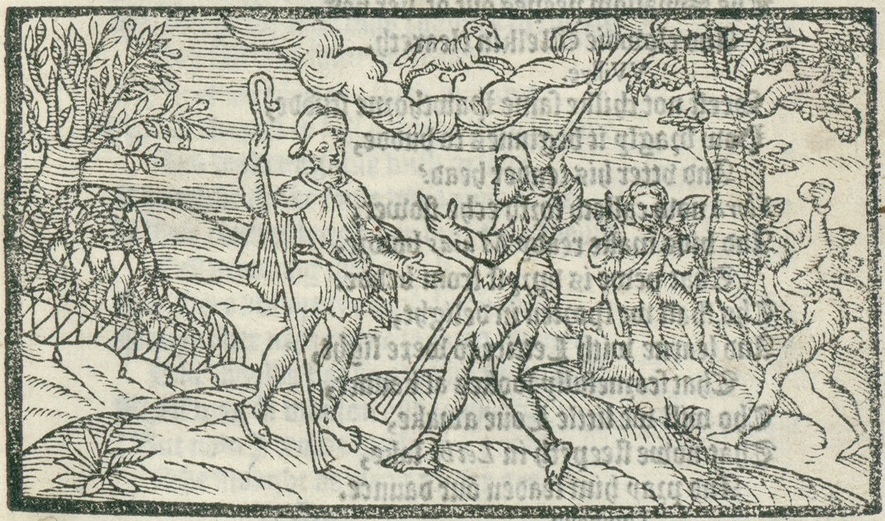
Hence, the woodcut ominously shows the boys standing in the center flanked by images of Cupid. Behind them on the left is an image of Cupid caught in a fowler’s net from Willye’s story of his father, which evokes the Homeric myth of Ares (the Roman Mars) and Aphrodite (Venus) displayed in the act of adultery before the gods on Mt. Olympus. (March is named after Mars; hence Aries or the Ram is its zodiacal sign, centered at the top of the woodcut.) On the right is the image from Thomalin’s story of his encounter with Cupid. ‘Maybe one of the points of the woodcut is that harmony is the opposite of what Protestants expected from the union of Elizabeth and Alençon’ (Brooks-Davies 1995: 55).

Of all the eclogues, March best displays Spenser’s skill at lading a simple and ancient classical myth with wide and fresh import for England.

The speciall meaning . . . the Poets God of Loue: E.K.'s phrasing suggests a story about the love-inflected art of the youthful poet (not simply love itself). E.K.'s preoccupation with the 'speciall meaning' of Spenser's poetry continues in his subsequent glossses, which recurrently translate the poet's metaphors for the reader, providing an early cue for modern interpretations (sometimes of E.K. himself). Whereas Cupid is certainly 'a supernatural ancient source' (Spitzer 1950: 500), the god is also 'an even more ancient psychological force subsequently externalized and apotheosized by classical tradition' (Berger 1988: 362).
0.1calender.march.0.1 0.2calender.march.0.2 0calender.march.argument.0 1calender.march.argument.1 2calender.march.argument.2 3calender.march.argument.3 4calender.march.argument.4 5calender.march.argument.5 6calender.march.argument.6 7calender.march.argument.7 8calender.march.argument.8 0calender.march.1.0 1calender.march.1 2calender.march.2 3calender.march.3 4calender.march.4 5calender.march.5 6calender.march.6 0calender.march.7.0 7calender.march.7 8calender.march.8 9calender.march.9 10calender.march.10 11calender.march.11 12calender.march.12 0calender.march.13.0 13calender.march.13 14calender.march.14 15calender.march.15 16calender.march.16 17calender.march.17 18calender.march.18 19calender.march.19 20calender.march.20 21calender.march.21 22calender.march.22 23calender.march.23 24calender.march.24 0calender.march.25.0 25calender.march.25 26calender.march.26 27calender.march.27 0calender.march.28.0 28calender.march.28 29calender.march.29 30calender.march.30 0calender.march.31.0 31calender.march.31 32calender.march.32 33calender.march.33 34calender.march.34 35calender.march.35 36calender.march.36 0calender.march.37.0 37calender.march.37 38calender.march.38 39calender.march.39 40calender.march.40 41calender.march.41 42calender.march.42 0calender.march.43.0 43calender.march.43 44calender.march.44 45calender.march.45 46calender.march.46 47calender.march.47 48calender.march.48 49calender.march.49 50calender.march.50 51calender.march.51 52calender.march.52 53calender.march.53 54calender.march.54 55calender.march.55 56calender.march.56 57calender.march.57 0calender.march.58.0 58calender.march.58 59calender.march.59 60calender.march.60 0calender.march.61.0 61calender.march.61 62calender.march.62 63calender.march.63 64calender.march.64 65calender.march.65 66calender.march.66 67calender.march.67 68calender.march.68 69calender.march.69 70calender.march.70 71calender.march.71 72calender.march.72 73calender.march.73 74calender.march.74 75calender.march.75 76calender.march.76 77calender.march.77 78calender.march.78 79calender.march.79 80calender.march.80 81calender.march.81 82calender.march.82 83calender.march.83 84calender.march.84 85calender.march.85 86calender.march.86 87calender.march.87 88calender.march.88 89calender.march.89 90calender.march.90 91calender.march.91 92calender.march.92 93calender.march.93 94calender.march.94 95calender.march.95 96calender.march.96 97calender.march.97 98calender.march.98 99calender.march.99 100calender.march.100 101calender.march.101 102calender.march.102 0calender.march.103.0 103calender.march.103 104calender.march.104 105calender.march.105 106calender.march.106 107calender.march.107 108calender.march.108 109calender.march.109 110calender.march.110 111calender.march.111 112calender.march.112 113calender.march.113 114calender.march.114 115calender.march.115 116calender.march.116 117calender.march.117 118calender.march.118 119calender.march.119 120calender.march.120 121calender.march.121 122calender.march.122 123calender.march.123 0calender.march.glosse.0 1calender.march.glosse.1 2calender.march.glosse.2 3calender.march.glosse.3 4calender.march.glosse.4 5calender.march.glosse.5 6calender.march.glosse.6 7calender.march.glosse.7 8calender.march.glosse.8 9calender.march.glosse.9 10calender.march.glosse.10 11calender.march.glosse.11 12calender.march.glosse.12 13calender.march.glosse.13 14calender.march.glosse.14 15calender.march.glosse.15 16calender.march.glosse.16 17calender.march.glosse.17 18calender.march.glosse.18 19calender.march.glosse.19 20calender.march.glosse.20 21calender.march.glosse.21 22calender.march.glosse.22 23calender.march.glosse.23 24calender.march.glosse.24 25calender.march.glosse.25 26calender.march.glosse.26 27calender.march.glosse.27 28calender.march.glosse.28 29calender.march.glosse.29 30calender.march.glosse.30 31calender.march.glosse.31 32calender.march.glosse.32 33calender.march.glosse.33 34calender.march.glosse.34 35calender.march.glosse.35 36calender.march.glosse.36 37calender.march.glosse.37 38calender.march.glosse.38 39calender.march.glosse.39 40calender.march.glosse.40 41calender.march.glosse.41 42calender.march.glosse.42 43calender.march.glosse.43 44calender.march.glosse.44 45calender.march.glosse.45 46calender.march.glosse.46 47calender.march.glosse.47 48calender.march.glosse.48 49calender.march.glosse.49 50calender.march.glosse.50 51calender.march.glosse.51 52calender.march.glosse.52 53calender.march.glosse.53 54calender.march.glosse.54 55calender.march.glosse.55 56calender.march.glosse.56 57calender.march.glosse.57 58calender.march.glosse.58 59calender.march.glosse.59 60calender.march.glosse.60 61calender.march.glosse.61 62calender.march.glosse.62 63calender.march.glosse.63 64calender.march.glosse.64 65calender.march.glosse.65 66calender.march.glosse.66 67calender.march.glosse.67 68calender.march.glosse.68 69calender.march.glosse.69 70calender.march.glosse.70 71calender.march.glosse.71 72calender.march.glosse.72 73calender.march.glosse.73 74calender.march.glosse.74 75calender.march.glosse.75 76calender.march.glosse.76 77calender.march.glosse.77 78calender.march.glosse.78 79calender.march.glosse.79 80calender.march.glosse.80 81calender.march.glosse.81 82calender.march.glosse.82 83calender.march.glosse.83 84calender.march.glosse.84 85calender.march.glosse.85 86calender.march.glosse.86 87calender.march.glosse.87 88calender.march.glosse.88 89calender.march.glosse.89 90calender.march.glosse.90 91calender.march.glosse.91 92calender.march.glosse.92
March.
Ægloga Tertia.
ARGVMENTARGUMENT.
INIn this Æglogue two shepheards boyes taking occasion of the season, beginne to make purpose of louelove and other plesaunce, which to springtime is most agreeable. The speciall meaning hereof is, to giuegive certaine markes and tokens, to know Cupide the Poets God of LoueLove. But more particularlye I thinke, in the person of
Thomalin
is meant some secrete freend, who scorned LoueLove and his knights so long, till at length him selfe was entangled, and vnwaresunwares wounded with the dart of some beautifull regard, which is Cupides arrowe.
VVillyeWillye Thomalin.
THomalinThomalin
, why sytten we soe,
As weren ouerwentoverwent with woe,
Upon so fayre a morow?
The ioyousjoyous time now nighethnighe[ſt]nigheth fast,
That shall alegge this bitter blast,
And slake the winters sorowe.
Thomalin
.
Sicker
Willye
, thou warnest well:
For Winters wrath beginnes to quell,
And pleasant spring appeareth.
The grasse nowe ginnes to be refresht,
The Swallow peepes out of her nest,
And clowdie Welkin cleareth.
VVillyeWillye
.
Seest not thilke same Hawthorne studde,
How bragly it beginnes to budde,
And vtterutter his tender head?
Flora now calleth forth eche flower,
And bids make ready Maias bowre,
That newe is vprystupryst from bedde.
Tho shall we sporten in delight,
And learne with Lettice to wexe light,
That scornefully lookes askaunce,
Tho will we little LoueLove awake,
That nowe sleepeth in Lethe lake,
And pray him leaden our daunce.
Thomalin
.
Willye
, I wene thou bee assott:
For lustie LoueLove still sleepeth not,
But is abroad at his game.
VVillyeWillye
.
How kenst thou, that he is awoke?
Or hast thy selfe his slomber broke?
Or made preuieprevie to the same?
Thomalin
.
No, but happely I hym spyde,
Where in a bush he did him hide,
With winges of purple and blewe.
And were not, that my sheepe would stray,
The preuieprevie marks I would bewray,
Whereby by chaunce I him knewe.
VVillyeWillye
.
Thomalin
, hauehave no care for thy,
My selfe will hauehave a double eye,
Ylike to my flocke and thine:
For als at home I hauehave a syre,
A stepdame eke as whott as fyre,
That dewly adayes counts mine.
Thomalin
.
Nay, but thy seeing will not serueserve,
My sheepe for that may chaunce to swerueswerve,
And fall into some mischiefe..
For sithens is but the third morowe,
That I chaunst to fall a sleepeasleepe with sorowe,
And waked againe with griefe:
The while thilke same vnhappyeunhappye Ewe,
Whose clouted legge her hurt doth shewe,
Fell headlong into a dell,
And there vnioyntedunjoynted both her bones:
Mought her necke bene ioyntedjoynted attones,
She shoulde hauehave neede no more spell.
ThelfThelfeTh'elfeTh'elfe was so wanton andaudand so wood,
(But now I trowe can better good)
She mought ne gang on the greenegreene,gr[ee]negr[ée]negreene.
VVillyeWillye
.
Let be, as may be, that is past:
That is to come, let be forecast.
Now tell vsus, what thou hast seene.
Thomalin
.
It was vponupon a holiday,
When shepheardes groomes han leaueleave to playe,
I cast to goe a shooting.
Long wandring vpup and downe the land,
With bowe and bolts in either hand,
For birds in bushes tooting:
At length within an YuieYvie todde
(There shrouded was the little God)
I heard a busie bustling.
I bent my bolt against the bush,
Listening if any thing did rushe,
But then heard no more rustling.
Tho peeping close into the thicke,
Might see the mouingmoving of some quicke,
Whose shape appeared not:
But were it faerie, feend, or snake,
My courage earnd it to awake,
And manfully thereat shotte.
With that sprong forth a naked swayne,
With spotted winges like Peacocks trayne,
And laughing lope to a tree.
His gylden quiuerquiver at his backe,
And siluersilver bowe, which was but slacke,
Which lightly he bent at me.
That seeing I, leueldelevelde againe,
And shott at him with might and maine,
As thicke, as it had hayled.
So long I shott, that al was spent:
Tho pumie stones I hastly hent,
And threwe: but nought availed::
He was so wimble, and so wight,
From bough to bough he lepped light,
And oft the pumies latched..
Therewith affrayd I ranne away:
But he, thattha[ſt]tha[ſt]that earst seemd but to playe,
A shaft in earnest snatched,
And hit me running in the heele:
For then I little smart did feele:
But soone it sore encreased.
And now it ranckleth more and more,
And inwardly it festreth sore,
Ne wote I, how to cease it.
VVillyeWillye
.
Thomalin
, I pittie thy plight.
Perdie with louelove thou diddest fight:
I know him by a token.
For once I heard my father say,
How he him caught vponupon a day,
(Whereof he wilbe wroken)
Entangled in a fowling net,
Which he for carrion Crowes had set,
That in our Peeretree haunted..
Tho sayd, he was a winged lad,
But bowe and shafts as then none had:
Els had he sore be daunted..
But see the Welkin thicks apace,
And stouping PhebusPhœbusPhoebusPhoebvs steepes his face:
Yts time to hast vsus homeward.
Willyes
Embleme.
To be wise and eke to louelove,
Is graunted scarce to God aboueabove.
Thomalins
Embleme.
Of Hony and of Gaule in louelove there is store:
The Honye is much, but the Gaule is more.
GLOSS.
THIS Æglogue seemeth somevvhatsomewhat to resemble that same of Theocritus, vvhereinwherein the boy likewise telling the old man, that he had shot at a vvingedwinged boy in a tree, vvaswas by hym warned, to beware of mischiefe to come.
Ouer vvent)Ouerwent)Overwent) ouergoneouergone.overgoneovergone.
Alegge) to lessen or asvvageaswage.
To quell) to abate.
VVelkinWelkin) the skie.
The swallow) vvhichwhich bird vsethuseth to be counted the messenger, and as it vverewere, the fore runner of springe.
Flora) the Goddesse of flovvresflowres, but indede (as saith Tacitus) a famous harlot, which vvithwith the abuse of her body hauinghaving gottẽgotten great riches, made the people of Rome her heyre: who in remembraunce of so great beneficence, appointed a yearely feste for the memoriall of her, calling her, not as she was, nor as some doe think, Andronica, but Flora: making her the Goddesse of all floures, and doing yerely to her solemne sacrificefacri[fi]ceſacri[fi]ce.
Maias bovvrebowre) that is the pleasaunt fielde, or rather the Maye bushes. Maia is a Goddes and the mother of Mercurie, in honour of whome the moneth of Maye is of her name so called, as sayth Macrobius.
Lettice) the name of some country lasse.
Ascaunce) askevveaskewe or asquint.
For thy) therefore.
Lethe) is a lake in hell, vvhichwhich the Poetes call the lake of forgetfulnes. For Lethe signifieth forgetfulnes. VVhereinWherein the soules being dipped, did forget the cares of their former lyfe. So that by louelove sleeping in Lethe lake, he meaneth he vvaswas almost forgotten and out of knovvledgeknowledge, by reason of winters hardnesse, when al pleasures as it were, sleepe and weare oute of mynde.
Assotte) to dote.
His slomber) To breake LouesLoves slomber, is to exercise the delightes of LoueLove and wanton pleasures.
VVingesWinges of purple) so is he feyned of the Poetes.
For als) he imitateth Virgils verse.
Est mihi namque domi pater, est iniusta nouercanoverca &c.etc.
A dell) a hole in the ground.
Spell) is a kinde of verse or charme, that in elder tymes they vsedused often to say ouerover eueryevery thing, that they would hauehave preseruedpreserved, as the Nightspel for theeuestheeves, and the vvoodspellwoodspell. And herehence I thinke is named the gospell, as it were Gods spell or vvordeworde. And so sayth Chaucer, Listeneth Lordings to my spell.
Gange) goe.
An YuieYvie todde) a thicke bushe.
Swaine) a boye: For so is he described of the Poetes, to be a boye .s. alwayes freshe and lustie: blindfolded, because he maketh no difference of Personages: wyth diuersdivers coloured winges, .s. ful of flying fancies: vvithwith bovvebowe and arrow, that is vvithwith glaunce of beautye, vvhichwhich prycketh as a forked arrowe. He is sayd also to hauehave shafts, some leaden, some golden: that is, both pleasure for the gracious and louedloved, and sorovvsorow for the louerlover that is disdayned or forsaken. But vvhowho liste more at large to behold Cupids colours and furniture, let him reade ether Propertius, or Moschus his Idyllion of wandring louelove, being now most excellently translated into Latine by the singuler learned man Angelus Politianus: whych vvorkeworke I hauehave seene amongst other of thys Poets doings, very wel translated also into Englishe Rymes.
VVimbleWimble and vvightewighte) Quicke and deliuerdeliver.
In the heele) is very Poetically spoken, and not vvithoutwithout speciall iudgementjudgement. For I remember, that in Homer it is sayd of Thetis, that shee tooke her young babe Achilles being nevvelynewely borne, and holding him by the heele, dipped him in the RiuerRiver of Styx. The vertue vvhereofwhereof is, to defend and keepe the bodyes vvashedwashed therein from any mortall vvoundwound. So Achilles being washed al ouerover, sauesave onely his hele, by which his mother held, was in the rest invulnerable:invnluerable:invnluerable :inuulnerable:inuuluerable: therfore by Paris vvaswas feyned to bee shotte vvithwith a poysonedpoyfonedpoyſoned arrowe in the heele, vvhileswhiles he vvaswas busie about the marying of Polyxena in the temple of Apollo. whichWhich mysticall fable Eustathius vnfoldingunfolding, sayth: that by vvoundingwounding in the hele, is meant lustfull louelove. For from the heele (as say the best Phisitions) to the preuieprevie partes there passe certaine veines and slender synnevvessynnewes, as also the like come from the head, and are carryed lyke little pypes behynd the eares: so that (as sayth Hipocrates) yf those veynes there be cut a sonder, the partie straighte becõmethbecommeth cold and vnfruitefulunfruiteful. vvhichVVhichwhichWhich reason our Poete vvelwel weighing, maketh this shepheards boye of purpose to be vvoundedwounded by LoueLove in the heele.
Latched) caught.
VVrokenWroken) reuengedrevenged.
For once) In this tale is sette out the simplicitye of shepheards opinion of LoueLove.
Stouping Phœbus)Phæbus)Phœbus,Phoebus, Is a Periphrasis of the sunne setting.
Embleme.
Hereby is meant, that all the delights of LoueLove, wherein vvantonwanton youth vvallovvethwalloweth, be but follye mixt vvithwith bitternesse, and sorovvsorow savvcedsawced with repentaunce. For besides that the very affection of LoueLove it selfe tormenteth the mynde, and vexeth the body many vvayeswayes, vvithwith vnrestfulnesseunrestfulnesse all night, and vvearineswearines all day, seeking for that we can not hauehave, &and fynding that we would not hauehave: euẽevẽeueneven the selfe things vvhichwhich best before vsus lyked, in coursecourfecourſe of time and chaung of ryper yeares, vvhichewhiche also therevvithalltherewithall chaungeth our vvontedwonted lyking and former fantasies, vvillwill then seeme lothsome and breede vsus annoyaunce, vvhenwhen yougthes flovvreflowre is vvitheredwithered, and vvewe fynde our bodyes and vvitswits aunswere not to suchevaynesuche vayne iollitiejollitie and lustfull pleasaunce.
2. purpose: topic or subject of conversation
6. knights: military attendants, followers
8. regard: sight, glance
2. ouerwent: E.K.
4. nigheth: approaches
5. alegge: E.K.
8. to quell: E.K.
11. The Swallow: E.K.
12. Welkin: E.K.
13. studde: tree trunk, stem
20. Lettice: E.K.
20. wexe light: become frivolous or wanton
21. askaunce: E.K.
22. Loue: Cupid.
25. assott: E.K.
26. lustie: lively
28. How kenst thou: ‘how do you know’
29. his slomber: E.K.
31. happely: by chance; felicitously
33. With winges . . . blewe: E.K.
37. for thy: E.K.
39. Ylike: alike
40. For als: E.K.
43. seeing: overseeing
44. swerue: deviate, go astray
46. sithens . . . morowe: ‘it was only three days ago’
49. vnhappye: unfortunate
50. clouted: bandaged, wrapped in cloths
51. a dell: E.K.
52. vnioynted: disjointed, disconnected
53. ioynted: disjointed, broken
54. spell: E.K.
55. Thelf: the elf (ewe), mischievous creature
56. I trowe . . . good: ‘I hope she knows better’
57. gang: E.K.
59. forecast: anticipated
62. groomes: helpers
62. han: have
65. bolts: arrows
66. tooting: searching; spying
67. Yuie todde: E.K.
73. thicke: thicket
74. some quicke: something alive; a living creature
77. earnd: yearned
81. lope: lept
85. leuelde: aimed
89. pumie: pumice
89. hastly hent: quickly picked up
90. availed: succeeded
91. wimble . . . wight: nimble . . . strong
93. latched: E.K.
98. For then: as a result
98. smart: sharp pain
105. token: sign, example, mark
108. wroken: E.K.
111. haunted: frequented
115. thicks: darkens
116. stouping Phebus: E.K.
56. deliuer: agile
79. Periphrasis: circumlocution
4.nigheth] nighe[ſt] 1579, 1581, 1586, 1591, 1597; nigheth 1611
55.Thelf] 1579, 1581; Thelfe 1586; 1591, Th'elfe 1597; Th'elfe 1611
55.and] aud 1579; ~ 1581; 1586; 1591, 1597; and 1611
57.greene.] greene, 1579, 1581; ~ 1586; gr[ée]ne. 1591, 1597; greene. 1611
95.that] tha[ſt] 1579, 1581; ~ 1586, 1591, 1597; that 1611
116.Phebus] 1579; Phœbus 1581, 1597; Phoebus 1586, 1591; Phoebvs 1611
16.sacrifice.] facri[fi]ce. 1579; ſacri[fi]ce. 1581, 1586, 1591, 1597, 1611
63.invulnerable:] invnluerable: 1579 state 1; invnluer- [|] able: 1581; ~ 1579 state 2, 1611; inuulnerable: 1586, 1597; inuuluerable: 1591
64.poysoned] poyfoned 1579; poyſoned 1581, 1586, 1591, 1597, 1611
79.Phœbus)] Phæbus) 1579; Phœbus 1581, 1597, 1611; Phoebus 1586, 1591
87.course] courfe 1579; courſe 1581, 1586, 1591, 1597, 1611
3–4 The speciall meaning . . . the Poets God of Loue: E.K.’s phrasing suggests a story about the love-inflected art of the youthful poet (not simply love itself). E.K.’s preoccupation with the ‘speciall meaning’ of Spenser’s poetry continues in his subsequent glosses, which recurrently translate the poet’s metaphors for the reader, providing an early cue for modern interpretations (sometimes of E.K. himself). Whereas Cupid is certainly ‘a supernatural ancient source’ (Spitzer 1950: 500), the god is also ‘an even more ancient psychological force subsequently externalized and apotheosized by classical tradition’ (Berger 1988: 362).
5–6 secrete freend: Not identified. Cf. Julye, where Thomalin reappears, more mature, and identifiable with Thomas Cooper, Bishop of London.
6 knights: Hints at the courtly, political matrix of the eclogue.
11 The swallow: Cf. Ovid, Fasti 2.853: veris pranuntia venit hirundo (‘has the swallow come, the harbinger of spring’).
13–24 Seest not . . . our daunce: The unusual congestion of ‘figurative phrases’ here dilates on the gap between Willye’s casual, innocent references (to the hawthorn bush putting forth its head, the classical goddess Flora making Maia’s bower ready, the shepherdess Lettice ‘wex[ing] . . . light’, the god Cupid awakening, and the lake/river Lethe sleeping), on the one hand, and, on the other, the verse’s sophisticated learning, which gives Spenser’s ‘fable a distinctly literary flavor and sets it in a network of myths and motifs that have already been invested with allegorical values by established interpretive traditions’ (Berger 1988: 365-6). Willye’s cheerful representation of a vital springtime world arousing love from dormancy is ominously laden with danger: with arrogance, sexual aggression, illicit misconduct, mastery, and oblivion.
13–15 Seest not . . . head?: The youthful hawthorn here recalls the bragging Briar at Feb 115-26.
13 Hawthorne: Cf. Maye 13.
20 Lettice: Probably from L laetitia, joy, thus a name appropriate for the spring (cf. Apr 144, ‘flower Delice’, which E.K. glossed as flos delitiarum). The name may allude to Lettice Knollys, the widowed countess of Essex, whose secret marriage to Robert Dudley, Earl of Leicester, early in 1579 infuriated the queen.
21 askaunce: The detail is so striking in context as to raise an eyebrow at E.K.’s gloss on Lettice: ‘the name of some country lasse’.
23 That nowe . . . Lethe lake: Lethe was not a lake but a river in the classical underworld, and souls drank of it to lose their memory of a painful life on earth, which Virgil famously describes at Aen 6.703-51. Cf. Aen 6.134 for lacus (‘lake’) applied to the River Styx, which E.K might be remembering. Yet ‘Spenser’s “errors” are . . . poetically motivated’, for ‘Lethe becomes a stagnant lake, not a flowing river’; moreover, ‘in medieval English, lake meant . . . a "slowly flowing river"’ (Spitzer 1950: 501n2).
34–35 my sheepe . . . bewray: Cf. Januarye, where Colin Clout’s love of Rosalind threatens to impede his duty to his flock.
37–57 Thomalin . . . on the greene: In the context of the Calender (e.g., To His Booke 10, Jan 43-9), Willye and Thomalin’s sustained dialogue on watching their sheep suggests the enduring topic of pastoral responsibility---ecclesiastical, political, poetic---as details following indicate.
37–42 Thomalin, haue . . . mine: A topos common to pastoral (see E.K.’s gloss): Theocritus, Idyll 1.12-4; Virgil, Ecl 5.12; Boccaccio, Eclogues 5.620; Marot, Complainct de Madame Loyse 2.261. Cf. Maye 172-3.
38 a double eye: In an eclogue about adolescents who ‘spy’ Cupid, a resonant phrase. Willye uses it to advance his friendly skill at seeing two things at once, his own flock and Thomalin’s--a skill he has honed because his father and stepmother routinely count his sheep. But at Maye 254 ‘double-eyed’ means ‘two-faced’ or ‘deceitful’.
39 Ylike: Archaic.
41 whott: ‘Hot and choleric’, but also ‘sexually aroused and threatening’. Willye is unique in the Calender in having a full set of parents---for having parents at all. Indeed, March is the one eclogue featuring shepherds who have a family, although Spenser keeps it in the background of the fiction. Cf. Maye for Piers’ fable of the Dame and her Kid. The concept of ‘home’ in the Calender, which concludes most eclogues, including Mar (117), tends to be more about friendship than family.
50 clouted: Cf. Maye 243, where the Foxe who traps the Kid has ‘His hinder heele . . . wrapt in a clout’. The word also evokes Colin Clout, Spenser’s persona, suggesting that the ‘unhappye Ewe’ who wears the clout on her leg and falls in a dell might be Queen Elizabeth, who would be harmed through the French marriage. Thus, the idea of the clout as a bandage evokes the traditional idea of the poet as a physician or healer (P. Cheney 1993: 135-56, 277n25). The Ewe with her bandaged leg ‘mirror[s]’ Thomalin’s wounded heel (Berger 1988: 363).
53–54 Mought her . . . spell: ‘If she had also broken her neck, she would not need healing charms’.
57 mought . . . greene: ‘Would not stay on the public pasture land (village green)’.
58–60 Let be . . . seene: ‘These three lines, delicately poised between past and future, serve as the structural centre of the eclogue, dividing 57 lines of dialogue from 57 lines of mythological anecdote’ (McCabe 1999: 527). One wonders whether Shakespeare remembers these lines in Hamlet: ‘There is special providence in the fall of a sparrow. If it be [now], ’tis not to come; if it be not to come, it will be now; if it be not now, yet it [will] come---the readiness is all. Since no man, of aught he leaves, knows what is’t to leave betimes, let be’ (5.2.219-24).
61–102 Thomalin’s detailed story of discovering Cupid in a bush while out hunting one holiday---based on Bion’s Idylls 4, perhaps mediated through Ronsard’s translation, L’Amour oiseau, or Poliziano’s Latin translation (see headnote)---is the set piece of March, the correlate to Colin’s song to Pan in Januarye and Thenot’s fable of the Oak and the Briar in Februarie, as well as an anticipation of Colin’s lay of Elisa in Aprill.
62 When shepheardes groomes han leaue to playe: Inaugurates the Calender’s dialogue on the merits of pastoral play. Cf. Sept 232, where Diggon contradicts Thomalin’s youthful holiday principle with one appropriate to the mature gloom of autumn: ‘with shepheard sittes not playe.’ Maye especially features the topos; see Maye 179n. At Mar 95, Cupid continues to ‘playe’ even after Thomalin runs away.
64 wandring: Usually in Spenser a sign of moral straying, yet here presented as the sporting act of youth.
66 tooting: Cf. Skelton, Philip Sparrow 421-2; Piers Plowmans Creed 219. In the Calender, the singing of birds almost always functions as a symbol of the poet’s art, thereby inviting a vocational reading of Thomalin’s story. In his translation of Tasso’s GL 14.66, Fairfax imitates line 66.
67 Yuie todde: Spenser replaces Bion’s box-tree with an ivy-bush. Typically in Spenser, ivy is a symbol of lust (e.g., Aug 30).
71 Listening:The producers of 1586, working from 1581 as their copy text and having apparently recognized that the orthography of the poems in their copy usually serves to guide syllable-count, adjust their reading to ‘Listning’.
76 snake: Cf. Jan 65 and note on Rosalind’s response to Colin’s art: ‘Shepheards devise she hateth as the snake’.
79–83 With that sprong . . . slacke: Cf. Henry More, Cupid’s Conflict, which imitates the lines: ‘At’s snowy back the boy a quiver wore / Right fairly wrought and gilded all with gold: / A silver bow in his left hand he bore’ (49-51).
80 Peacocks: Here a symbol of alertness and colorful splendor (cf. Ovid, Met 1.720-23), but evocative also of pride (cf. Feb 8, Oct 31). The passage seems to be indebted to lines 9-10 of Ronsard, ‘Ode’ (the original version of ‘L’amour oyseau’), Nouvelle continuation des amours (1556) e2.
82 gylden quiuer: Cf. Moschus, Eros the Runaway 20.
89 pumie: Pumice is not native to England, but rather to the literary tradition. See Ovid’s description of the grotto named Gargaphie (Met 3.156-60; Friedman 1966; Cullen 1970: 104), transplanted to Belphoebe’s glade at FQ III.v.39.8. Yet the pumice stone is also an implement of the poet (Propertius, Elegies 3.1.8; Greek Anthology 6.62-8, 295). The stone reappears at 93.
91wight: Cf. Chaucer, CT Monk 2265-7: 'she koude eke / Wrastlen . . . / With any yong man, were he never so wight'.
94 affrayd I ranne away: Thomalin earlier described himself as ‘manfully’ shooting at Cupid (78).
95 playe: See 62n.
97 And hit me running in the heele: See Mar gl #n. The detail shows Thomalin to be ‘our tiny Achilles’ (Berger 1988: 363).
98–102 For then I little smart . . . cease it: The process recurs throughout Spenser, and especially recalls Colin in Januarye. Yet, whereas lovers like Colin become lovesick at seeing the physical beauty of a person, Thomalin becomes lovesick at the sight of originary desire itself, participating in a ‘homoerotic narcissism, since what the hunter pursues is not a woman but (presumably his own) desire as a god’ (Berger 1988: 361).
102 wote: Archaism.
105 token: E.K. introduces the word in the Argument.
106–114 For once . . . daunted: Willye’s story of his father’s entrapment of Cupid in a net alludes to Vulcan’s entrapment of the adulterous Venus and Mars (headnote). See Homer, Od 8.266-369.
106 For once I heard my father say: Willye’s father (the eclogue’s replacement for Bion’s old ploughman) is the ‘graybeard’ who represents the literary tradition (Berger 1988: 369).
110 carrion Crowes: The idea that ‘love’ (104) becomes entangled in a net originally set for crows who eat carrion functions as a symbol of the tradition of love as a grim form of malady, recorded graphically in the emblems of both Willye and Thomalin (see below).
111 Peeretree: This striking scene with Cupid caught in a pear tree---‘the lecherous perch’ (Allen 1960: 18)---replays Chaucer, CT Merchant 2207-11, the story of beautiful young May’s adultery with her lover Damyan while she stands on the shoulders of her old husband January (Nelson 1963: 42-3).
118–123 In Let 3.188-93, Harvey quotes both emblems.
119–120 To be wise . . . aboue: From Publilius Syrus, Sententiae 22: Amare et sapere vix Deo conceditur. Willye’s Emblem fits in with the eclogue’s evocations of two significant marriages, both involving Queen Elizabeth: Leicester’s marriage to Lettice Knollys (see 20n), and Elizabeth’s proposed marriage to Alençon (see 50n and Mar gl #n) by warning powerful adults to be wise about desire.
122–123 Of Hony . . . is more: Refers to the Platonic-Orphic tradition of the bitterness underlying love’s sweetness (cf. Theocritus, Idylls 1.19; Plautus, Cistellaria 1.69-70), which becomes a Renaissance commonplace.
122 Gaule: The spelling suggests an allusion to Elizabeth’s proposed French marriage (Gaul = France).
1 Theocritus: Not Theocritus, but Bion (Idylls 4).
4 Ouerwent We follow 1597 in closing up the two words in our copy, bringing E.K.’s lemma into accord with the text of the eclogue.
6 To quell: A form of the intransitive verb, quail: cf. Nov 91.
14 Andronica: Unidentified. ‘[P]resumably [this] alludes to her power over men as lover or prostitute: Greek andros ([ἀνδρός,] ‘man’) + nikē ([νίκη,] victory)’ (Brooks-Davies 1995: 61).
10 Tacitus: Not Tacitus but Boccaccio, Gen Deor 4.61.3-4. Nonetheless, E.K.’s reference to Tacitus, republican author of Rome and outspoken critic of the corrupt Roman empire, coheres with the reference to Sir Thomas Smith in Januarye, thereby evoking the group of aristocrats in the Sidney-Leicester circle who criticized the queen for pursuing the French marriage.
10 Flora: Cf. Maye 31. The language of E.K.’s gloss here and at Apr 86-7, 122, and especially Apr 110 and Maye 142, derives from Cooper, Thesaurus.
19 Macrobius: See Saturnalia 1.12.19; at paragraph 20, he reports that ‘Maia . . is the Earth’; but E.K. probably relies on Boccaccio, Gen Deor 4.35.4.
18 Mercurie: Messenger god, god of eloquence, and god of shepherds, who could be depicted bearing a ram (zodiacal sign of March).
21 Ascaunce: Can imply disdain.
32 Poetes: Cf. Ovid, Remedia Amoris 701 for purpureas pueri . . . alas (‘the Boy’s purple wings’; trans. adapted). Also, cf. Henry More, Cupid’s Conflict for an imitation of these lines and of 67-9: ‘Lo! on the other side in thickest bushes / A mighty noise! with that a naked swain / With blew and purple wings streight rudely rushes’ (44-6); Milton, PL 4.763-4: ‘Here Love his golden shafts employs, here lights / His constant lamp, and waves his purple wings’.
34 Est . . . nouerca: ‘I have at home a harsh father and stepmother’ (Virgil, Ecl 3.33).
40 Chaucer: In CT Thopas 893, but misquoted: E.K. is condensing three separate calls for attention in the Tale of Thopas. The third instances Chaucer's only use of 'spell' to describe a poetic narrative. This notion of poetry as a form of magic influences Colin's account of his developing skills in Dec.
51 Propertius: See Elegies 2.12.
51–53 Moschus . . . Politianus: See Moschus, Idylls 1.15, and Poliziano’s Latin translation in his 1512 Epigrammata.
54 thys Poets: Spenser’s translation does not survive, but cf. FQ III.vi.11-26 for the story of Venus searching for the runaway Cupid. march.glosse.56 Quicke and deliuer: E.K. slightly misrepresents 'wimble and wight' as a pleonasm, whereas the two terms suggest two different, but complementary aspects of Cupid's power. On wight see Mar 91n.
56 Quicke and deliuer: E.K. slightly misrepresents 'wimble and wight' as a pleonasm, whereas the two terms suggest two different, but complementary aspects of Cupid's power. On wight see Mar 91n.
58 Homer: Not in Homer but Fulgentius, Mythologiae 3.7 via Boccaccio, Gen Deor 12.52.
66 Eustathius: A twelfth-century Homeric scholar from Constantinople who produced allegorizing commentary on the Iliad and Odyssey; but E.K.’s source is Boccaccio, Gen Deor 12.52.
71 Hipocrates: Gr physician of the fifth century BC. Cf. Hippocrates, Of Airs, Waters, Places 22.
Building display . . .
Re-selecting textual changes . . .

Introduction

The toggles above every page allow you to determine both the degree and the kind of editorial intervention present in the text as you read it. They control, as well, the display of secondary materials—collational notes, glosses, and links to commentary.

Textual Changes

The vagaries of early modern printing often required that lines or words be broken. Toggling Modern Lineation on will reunite divided words and set errant words in their lines.

Off: That a large share it hewd out of the rest, (blest.And glauncing downe his shield, from blame him fairely (FQ I.ii.18.8-9)On: That a large share it hewd out of the rest,And glauncing downe his shield, from blame him fairely blest.

Toggling Expansions on will undo certain early modern abbreviations.

Off: Sweet slõbring deaw, the which to sleep them biddes:(FQ I.i.36.4)On: Sweet slombring deaw, the which to sleep them biddes:

Toggling Modern Characters on will convert u, v, i, y, and vv to v, u, j, i, and w. (N.B. the editors have silently replaced ſ with s, expanded most ligatures, and adjusted spacing according contemporary norms.)

Off: And all the world in their subiection held,Till that infernall feend with foule vprore(FQ I.i.5.6-7)On: And all the world in their subjection held,Till that infernall feend with foule uprore

Toggling Lexical Modernizations on will conform certain words to contemporary orthographic standards.

Off: But wander too and fro in waies vnknowne(FQ I.i.10.5)On: But wander to and fro in waies vnknowne.

Toggling Emendations on will correct obvious errors in the edition on which we base our text and modernize its most unfamiliar features.

Most lothsom, filthie, foule, and full of vile disdaine(FQ I.i.14.9)14.9. Most lothsom] this edn.;Mostlothsom 1590

(The text of 1590 reads Mostlothsom, while the editors’ emendation reads Most lothsom.)

Apparatus

Toggling Collation Notes on will highlight words that differ among printings.

And shall thee well rewarde to shew the place,(FQ I.i.31.5)5. thee] 1590; you 15961609

(The text of 1590 reads thee, while the texts of 1596 and 1609 read you.)

Toggling Commentary Links on will show links to the editors’ commentary.

Toggling Line Numbers on will show the number of the line within each stanza.

Toggling Stanza Numbers on will show the number of the stanza within each canto.

Toggling Glosses on will show the definitions of unfamiliar words or phrases.

To my long approoved and singular good frende, Master G.H.(Letters I.1)1. long aprooved: tried and true,found trustworthy over along period
v2026-4-14_13:20