Headnote

As the only eclogue in The Shepheardes Calender formally on ‘the state of Poete’ (97), October is striking as one of the most complex (cf. Lane 1993: 158). The pastoral dialogue here is indeed challenging, as two shepherds from previous eclogues, the younger Cuddie (Februarie, August), and the older Piers (Maye), debate the highest stakes for poetry in 1570s England: the ‘place’ of ‘pierlesse Poesye’ both in ‘Princes pallace’ (79-80) and in ‘Heaven’ (54, 60, and 84).

As with June, the difficulty results from failed, or obscure, narrative transitions among the topics that the shepherds discuss. These topics may be divided into four main parts. 1) In lines 1-36, Cuddie complains that he has written poetry to delight the youth but failed to secure the material gain required to continue writing, while Piers reminds him that the poet should strive for ‘glory’ rather than ‘gayne’ (20): that Cuddie should use poetic delight for ethical education, on the model of Orpheus’s rescue of his wife Eurydice from Hades—a proposal that Cuddie rejects: ‘But who rewards him ere the more for thy’ (33). 2) In lines 37-78, Piers suggests that if Cuddie really wants to secure ‘reward’ he should write the kinds of poetry that meet the needs of powerful patrons: he should turn from pastoral to epic but also (as June has intimated) he should include love lyric as a mediating form. This advice reminds Cuddie of the ‘Romish Tityrus’ (55), Virgil, who secured patronage from Maecenas to pursue a career of pastoral, georgic, and epic in service of Augustan Rome—a model, Cuddie adds, that no longer applies in England, where patronage, heroism, and poetic achievement are absent. 3) In lines 79-97, Piers thus raises the central question about the place of poetry at court, and suggests that Cuddie may need to write poetry that ‘flye[s] backe to heaven apace’ (84). This final advice prompts Cuddie to recall Colin Clout’s potential to complete such a ‘famous flight’ (88), if Colin’s love for Rosalind did not ground him. Cuddie’s recollection, nonetheless, leads Piers to identify Colin as a model for such a glorious ascent. 4) In lines 98-120, Cuddie then rejects the serene possibility of high flight on the wings of love—‘All otherwise the state of Poet stands’ (97)—and outlines a more violent model for poetic loftiness, a Horatian reliance on wine to write ‘stage’ tragedy (112), even though Cuddie concludes by admitting his own inability to do so. At the end, Piers offers Cuddie consolation by promising to award him a ‘Kidde’ (120).

In these complex modulations, Spenser represents three basic career models available to the patron-seeking poet in mid-Elizabethan England: amateur; professional; laureate (Helgerson 1983). Cuddie’s youthful poetic model of the poet delighting his audience with pleasant ditties corresponds to an amateur model, because he sees poetry as merely a pastime. Cuddie’s dramatic model, in which tragedy allows the poet to ‘compasse weightye prise’ (103), corresponds to the professional, who writes primarily to make a living. And Cuddie’s reference to Virgil’s career corresponds to the laureate model, in which the poet serves the nation in the context of eternity: ‘So as the Heavens did quake his verse to here’ (60). Yet Piers’ insertion of love poetry into the laureate model (presumably as a substitute for georgic, which did not yet exist in England [A. Fowler 1982: 240]) is innovative, showing Spenser finding a ‘place’ for the Petrarchan lyric in the career of the aspiring poet: ‘Of love and lustihead tho mayst thou sing, . . . / So mought our Cuddies name to Heaven sownde’ (50, 54). Moreover, Piers’ suggestion that the poet should return to heaven when he fails to find a place in ‘Princes pallace’ may indicate that Spenser himself envisions an Augustinian-based hymn as an endpoint for the poet’s career. Thus the dialogue dilates on the most influential classical model of a literary career available to English poets and shows Spenser adapting Virgil in light of both an Augustinian Christianity and Petrarchism. Yet the shepherds’ dialogic pattern of proposal and rejection leaves the state of poet open-ended.

Accordingly, October ‘explores the stark contrast’ between ‘the material needs of the poet’ and ‘the sublime aspirations of poetry’ (McCabe 1999: 559). For all the shepherds’ worldly discussion of practicality, career, and money, they recurrently turn to a heighted discourse of poetic sublimity—a discourse that also characterizes the glossarial language of E.K. Spenser here taps into the late sixteenth-century experimentation with four principal forms of ‘aesthetic extremes’: ‘wonder’, ‘Christian ecstasy’, Neoplatonic ‘furor’, and the ‘sublime’ (Sedley 2005: 9, 157n17). Longinus, whose On Sublimity saw seven continental editions published before 1579 (Weinberg 1950), including two copies of the Portus edition in a 1578 Cambridge bookshop (Leedham-Green, personal communication), links sublimity with all three aesthetic extremes, but shows the sublime to be distinctive for its commitment to confusion, ignorance, and breakdown: ‘Sublimity tears everything up like a whirlwind’ (1.4, in Russell and Winterbottom 1972: 144). Thus this heightened poetics proceeds through metaphors of the whirlwind but also of earth-quaking lightning; it locates poetic excellence in a lofty style of poetry; it valorizes the emotions of rapture and rage, beyond reason, intoxicated; and it makes both poet and audience gods, not simply citizens (see Introduction). October’s discourse recurrently expresses the sublime, which Longinus finds in Plato but which cannot be equated with Platonism (or Neoplatonism) because of its willingness to enter into the dangerous space of irrationality: e.g., in the dialogue, such language as ‘soule of sence bereave . . . quake his verse to here . . . climbe so hie . . . the ryme should rage . . . troublous tydes’; and, in E.K.’s gloss, ‘make men immortall . . . astonied and as it were ravished . . . ravished with Poeticall furie’. E.K.’s gloss on Cuddie’s emblem summarizes the sublime succinctly, from Longinus to Kant to Lyotard: ‘Poetry is a divine instinct and unnatural rage passing the reache of comen reason’.

Spenser’s formal source-texts for October are the two cited by E.K., Theocritus’ Idylls 16, a pastoral complaint about the niggardliness of the tyrant Ptolemy; and Mantuan’s Eclogues 5, a dialogue about the difficulty of writing poetry in an age devoid of patrons, heroes, and successful poets. Specifically, Spenser may depend on Barclay’s adaptation of Mantuan’s eclogue, published in 1570 in Barclay’s posthumous Certain Eclogues (although written earlier in the sixteenth century), and Turbervile’s translation of Mantuan in 1567 (cf. Hoffman 1977: 11-29). Yet the passages on Virgil’s career, Neoplatonic love, Horatian wine, and Senecan tragedy (‘lavish cups and thriftie bittes of meate’ [105]) shows Spenser suturing pastoral to a wide ‘webbe’ (102) of literary and philosophical intertexts.

Within such a web, where is the ‘place’ of Edmund Spenser? Is October a ‘personal manifesto, a declaration of his own aims’ (Renwick, Var 7: 374), a ‘climactic hymn to poetry’ (King 1986: 397), and the ‘articulation of . . . a theory . . . [that] combines neoplatonism and traditional Horatianism along with a Christian emphasis on divine inspiration’ (Waller 1993: 44)—in all of which the author can be seen to identify with Piers and with E.K? Or does the author side more with Cuddie and his fraught social embeddedness, disparaging Piers’ Neoplatonic transcendence as escapist (Lane 1993: 158-67), since the Spenserian gold standard surely lies in a ‘poetry of virtuous action-in-the-world’ (Montrose 1979: 49)? Alternatively, does Spenser critique both Piers and Cuddie, who share a naïve ‘golden-age sensibility’: ‘Cuddie withdraws in defeat while Piers converts to a gesture of escape’ (Berger 1988: 314)? Finally, then, does Spenser present the poet as transcendent or contingent, writing for this world or the next, promoting citizenship or godhood? October’s potency may lie in its complex use of pastoral dialogue to represent this very question.

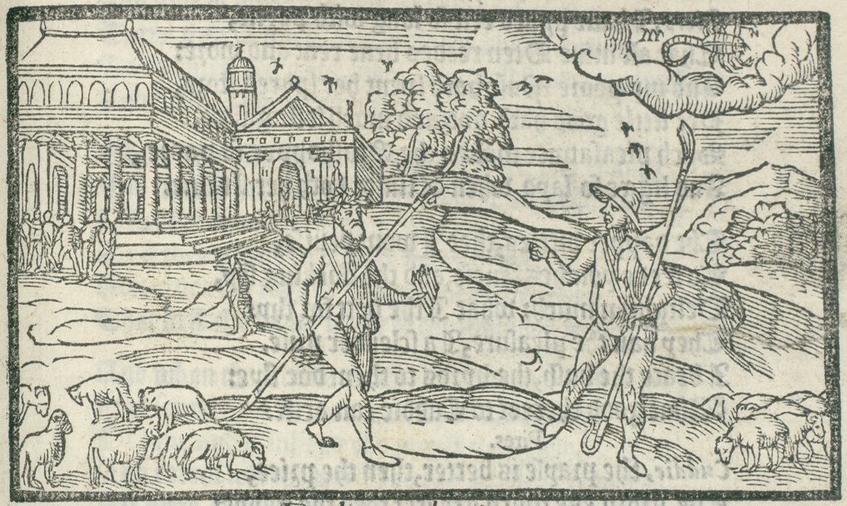
A version of the question arises in the woodcut, indicating once again how the complexity of the poet either baffled the eye of the artisan or liberated it. Standing in the foreground closest to the center is a figure marked as a wise and successful older poet: he is bearded, wears a garland, and holds out a panpipe, his sheep at his feet. To his right is a younger shepherd with one arm reaching out and the other holding a crook, his sheep also near him. Behind the younger shepherd, an indistinct hill looms on the horizon, a small tree at its base, while behind the older shepherd are two scenes: in the first, a figure walks up the steps of an imposing edifice that is part temple and part palace, and is overlooked by a leafy tree; and in the second, to the left, another figure walks toward a group of people standing beside the building. Most directly, ‘The woodcut depicts the Virgilian paradigm by showing an aged Piers as Virgil crowned with laurel and offering Cuddie the pastoral oaten reeds. On a hill behind Piers-Virgil is an empty classical temple and an Italianate palace (cf. “Princes palace,” 80 and 81). Several figures admire the temple, but one moves resolutely toward it and another climbs its steps. . . . Cuddie rejects Piers’s offer by pointing out the figure approaching the temple. . . . Obviously, the figure ascending to the temple of fame is Colin’ (Cain in Oram 1989: 167-8; see Luborsky 1981: 36-9; Brooks-Davies 1995: 158). Yet the shepherd wearing the laurel garland may also be Cuddie, since E.K. identifies him as ‘the perfecte paterne of a Poete’ (Gen Arg), one who has ‘turned his back on the halls of power. . . , [and who] retains the crown of laurels, the sign of public status and influence’ (Lane 1993: 163, 166, 228n37). Irrespective of which figure is which, it remains difficult to determine whether the laurel poet supports or rejects a public poetry of epic in favor of a private poetry of pastoral: is the laurel poet pointing the way to the Virgilian model or turning away from it (cf. McCabe 1999: 559)?

As if to highlight the complexities of both the woodcut and the dialogue, October’s verse form remains paradoxically clear and simple. Cuddie and Piers, for all their differences, share a six-line stanza adapted from Januarye, now rhyming abbaba.

The achievement of October has long rivaled that other pinnacle of Spenserian pastoral authorship, November, which E.K. finds ‘farre passing . . . all other the Eglogues of this booke’ (Nov Arg). Yet in his October gloss, E.K. says that the ‘style’ in this tenth eclogue is ‘more loftye then the rest’ (for agreements, see Craik, Var 7: 366; Herford, Var 7: 368; Cory, Var 7: 369). Rather than solve the problem of the poet’s ‘place’ in the world, October presents a verse prism that refracts it. In the end, Spenser represents, rather than reveals, the sublime ‘state’ of poetic truth in 1570s England.
0.1calender.october.0.1 0.2calender.october.0.2 0calender.october.argument.0 1calender.october.argument.1 2calender.october.argument.2 3calender.october.argument.3 4calender.october.argument.4 5calender.october.argument.5 6calender.october.argument.6 7calender.october.argument.7 8calender.october.argument.8 9calender.october.argument.9 10calender.october.argument.10 11calender.october.argument.11 0calender.october.1.0 1calender.october.1 2calender.october.2 3calender.october.3 4calender.october.4 5calender.october.5 6calender.october.6 0calender.october.7.0 7calender.october.7 8calender.october.8 9calender.october.9 10calender.october.10 11calender.october.11 12calender.october.12 13calender.october.13 14calender.october.14 15calender.october.15 16calender.october.16 17calender.october.17 18calender.october.18 0calender.october.19.0 19calender.october.19 20calender.october.20 21calender.october.21 22calender.october.22 23calender.october.23 24calender.october.24 25calender.october.25 26calender.october.26 27calender.october.27 28calender.october.28 29calender.october.29 30calender.october.30 0calender.october.31.0 31calender.october.31 32calender.october.32 33calender.october.33 34calender.october.34 35calender.october.35 36calender.october.36 0calender.october.37.0 37calender.october.37 38calender.october.38 39calender.october.39 40calender.october.40 41calender.october.41 42calender.october.42 43calender.october.43 44calender.october.44 45calender.october.45 46calender.october.46 47calender.october.47 48calender.october.48 49calender.october.49 50calender.october.50 51calender.october.51 52calender.october.52 53calender.october.53 54calender.october.54 0calender.october.55.0 55calender.october.55 56calender.october.56 57calender.october.57 58calender.october.58 59calender.october.59 60calender.october.60 61calender.october.61 62calender.october.62 63calender.october.63 64calender.october.64 65calender.october.65 66calender.october.66 67calender.october.67 68calender.october.68 69calender.october.69 70calender.october.70 71calender.october.71 72calender.october.72 73calender.october.73 74calender.october.74 75calender.october.75 76calender.october.76 77calender.october.77 78calender.october.78 0calender.october.79.0 79calender.october.79 80calender.october.80 81calender.october.81 82calender.october.82 83calender.october.83 84calender.october.84 0calender.october.85.0 85calender.october.85 86calender.october.86 87calender.october.87 88calender.october.88 89calender.october.89 90calender.october.90 0calender.october.91.0 91calender.october.91 92calender.october.92 93calender.october.93 94calender.october.94 95calender.october.95 96calender.october.96 0calender.october.97.0 97calender.october.97 98calender.october.98 99calender.october.99 100calender.october.100 101calender.october.101 102calender.october.102 103calender.october.103 104calender.october.104 105calender.october.105 106calender.october.106 107calender.october.107 108calender.october.108 109calender.october.109 110calender.october.110 111calender.october.111 112calender.october.112 113calender.october.113 114calender.october.114 115calender.october.115 116calender.october.116 117calender.october.117 118calender.october.118 0calender.october.119.0 119calender.october.119 120calender.october.120 121calender.october.121 122calender.october.122 0calender.october.glosse.0 1calender.october.glosse.1 2calender.october.glosse.2 3calender.october.glosse.3 4calender.october.glosse.4 5calender.october.glosse.5 6calender.october.glosse.6 7calender.october.glosse.7 8calender.october.glosse.8 9calender.october.glosse.9 10calender.october.glosse.10 11calender.october.glosse.11 12calender.october.glosse.12 13calender.october.glosse.13 14calender.october.glosse.14 15calender.october.glosse.15 16calender.october.glosse.16 17calender.october.glosse.17 18calender.october.glosse.18 19calender.october.glosse.19 20calender.october.glosse.20 21calender.october.glosse.21 22calender.october.glosse.22 23calender.october.glosse.23 24calender.october.glosse.24 25calender.october.glosse.25 26calender.october.glosse.26 27calender.october.glosse.27 28calender.october.glosse.28 29calender.october.glosse.29 30calender.october.glosse.30 31calender.october.glosse.31 32calender.october.glosse.32 33calender.october.glosse.33 34calender.october.glosse.34 35calender.october.glosse.35 36calender.october.glosse.36 37calender.october.glosse.37 38calender.october.glosse.38 39calender.october.glosse.39 40calender.october.glosse.40 41calender.october.glosse.41 42calender.october.glosse.42 43calender.october.glosse.43 44calender.october.glosse.44 45calender.october.glosse.45 46calender.october.glosse.46 47calender.october.glosse.47 48calender.october.glosse.48 49calender.october.glosse.49 50calender.october.glosse.50 51calender.october.glosse.51 52calender.october.glosse.52 53calender.october.glosse.53 54calender.october.glosse.54 55calender.october.glosse.55 56calender.october.glosse.56 57calender.october.glosse.57 58calender.october.glosse.58 59calender.october.glosse.59 60calender.october.glosse.60 61calender.october.glosse.61 62calender.october.glosse.62 63calender.october.glosse.63 64calender.october.glosse.64 65calender.october.glosse.65 66calender.october.glosse.66 67calender.october.glosse.67 68calender.october.glosse.68 69calender.october.glosse.69 70calender.october.glosse.70 71calender.october.glosse.71 72calender.october.glosse.72 73calender.october.glosse.73 74calender.october.glosse.74 75calender.october.glosse.75 76calender.october.glosse.76 77calender.october.glosse.77 78calender.october.glosse.78 79calender.october.glosse.79 80calender.october.glosse.80 81calender.october.glosse.81 82calender.october.glosse.82 83calender.october.glosse.83 84calender.october.glosse.84 85calender.october.glosse.85 86calender.october.glosse.86 87calender.october.glosse.87 88calender.october.glosse.88 89calender.october.glosse.89 90calender.october.glosse.90 91calender.october.glosse.91 92calender.october.glosse.92 93calender.october.glosse.93 94calender.october.glosse.94 95calender.october.glosse.95 96calender.october.glosse.96 97calender.october.glosse.97 98calender.october.glosse.98 99calender.october.glosse.99 100calender.october.glosse.100 101calender.october.glosse.101 102calender.october.glosse.102 103calender.october.glosse.103 104calender.october.glosse.104 105calender.october.glosse.105 106calender.october.glosse.106 107calender.october.glosse.107 108calender.october.glosse.108 109calender.october.glosse.109 110calender.october.glosse.110 111calender.october.glosse.111 112calender.october.glosse.112 113calender.october.glosse.113 114calender.october.glosse.114 115calender.october.glosse.115 116calender.october.glosse.116 117calender.october.glosse.117 118calender.october.glosse.118 119calender.october.glosse.119 120calender.october.glosse.120 121calender.october.glosse.121 122calender.october.glosse.122 123calender.october.glosse.123 124calender.october.glosse.124 125calender.october.glosse.125 126calender.october.glosse.126 127calender.october.glosse.127 128calender.october.glosse.128 129calender.october.glosse.129 130calender.october.glosse.130 131calender.october.glosse.131 132calender.october.glosse.132 133calender.october.glosse.133 135calender.october.glosse.135 136calender.october.glosse.136 137calender.october.glosse.137 138calender.october.glosse.138 139calender.october.glosse.139 140calender.october.glosse.140 141calender.october.glosse.141 142calender.october.glosse.142 143calender.october.glosse.143 144calender.october.glosse.144 145calender.october.glosse.145 146calender.october.glosse.146 147calender.october.glosse.147 148calender.october.glosse.148 149calender.october.glosse.149 150calender.october.glosse.150 151calender.october.glosse.151 152calender.october.glosse.152 153calender.october.glosse.153 154calender.october.glosse.154 155calender.october.glosse.155 156calender.october.glosse.156 157calender.october.glosse.157 158calender.october.glosse.158 159calender.october.glosse.159 160calender.october.glosse.160 161calender.october.glosse.161 162calender.october.glosse.162 163calender.october.glosse.163 164calender.october.glosse.164 165calender.october.glosse.165 166calender.october.glosse.166 167calender.october.glosse.167 168calender.october.glosse.168 169calender.october.glosse.169 170calender.october.glosse.170 171calender.october.glosse.171 172calender.october.glosse.172 173calender.october.glosse.173 174calender.october.glosse.174 175calender.october.glosse.175 176calender.october.glosse.176
October.
Ægloga decima.
ARGVMENTARGUMENT.
INIn
Cuddie
is set out the perfecte paterne of a Poete, whichewhishewhichwhich finding no maintenaunce of his state and studies, complayneth of the contempte of Poetrie, and the causes thereof: Specially hauinghaving bene in all ages, and eueneven eneneuen amõgstamongst the most barbarous alwayes of singular accoumptaccounptaccount &and honor, &and being indede so worthy and commendable an arte: or rather no arte, but a diuinedivine gift and heauenlyheavenly instinct not to bee gotten by laboure and learning, but adorned with both: and poured into the witte by a certaine ἐνθουσιασμὸς.ἐνθουσιασμὸς.( Kithou[ſi]aſmos )Kithou[ſi]aſmosEnthou[ſi]aſmos, and celestiall inspiration, as the Author hereof els where at large discourseth, in his booke called the English Poete, which booke being lately come to my hands, I mynde also by Gods grace vponupon further aduisementadvisement to publish.
Pierce.
Cuddie
.
CVddieCvddieCuddie
,
for shame hold vpup thy heauyeheavye head,
And let vsus cast with what delight to chace,chace:chace :chace,
And weary thys long lingring PhoebusPbœbusPhœbusPhœbusP H O E B V S race.
Whilome thou wont the shepheards laddes to leade,
In rymes, in ridles, and in bydding base::
Now they in thee, and thou in sleepe art dead.dead?deade?deade.dead.
Cuddye
.
Piers
,
I hauehave pyped erst so long with payne,
That all mine Oten reedes bene rent and wore:
And my poore Muse hath spent her spared store,
Yet little good hath got, and much lesse gayne.
Such pleasaunce makes the Grashopper so poore,
And ligge so layd, when Winter doth her straine:
The dapper ditties, that I wont deuisedevise,
To feede youthes fancie, and the flocking fry,
Delighten much: what I the bett for thy?
They han the pleasure, I a sclender prise.
I beate the bush, the byrds to them doe flye:
What good thereof to
Cuddie
can arise?
Piers.Pires.PIERS.
Cuddie
,
the prayse is better, 19. then: thanthenthan the price,
The glory eke much greater 20. then: thanthenthan the gayne:
O what an honor is it, to restraine
The lust of lawlesse youth with good aduiceadvice:
Or pricke them forth with pleasaunce of thy vaine,
Whereto thou list their trayned willes entice.
Soone as thou gynst to sette thy notes in frame,
O how the rurall routes to thee doe cleauecleave:
Seemeth thou dost their soule of sence bereauebereave,
All as the shepheard, that did fetch his dame
From Plutoes balefull bowre withouten leaueleave:
His musicks might the hellish hound did tame.
Cuddie
.
So praysen babes the Peacoks spotted traine,
And wondren at bright Argus blazing eye:
But who rewards him ere the more for thy?
Or feedes him once the fuller by a graine?
Sike prayse is smoke, that sheddeth in the skye,
Sike words bene wynd, and wasten soone in vayne.
Piers
.
Abandon then the base and viler clowne:clowne,clowne,clowne,
Lyft vpup thy selfe out of the lowly dust,du[ſt]:du[ſt]:du[ſt]:
And sing of bloody Mars, of wars, of giusts.giu[ſt]s,giu[ſt]s,gu[ſt]s,
Turne thee to those, that weld the awful crowne,crowne.crowne.crowne,
To doubted Knights, whose woundlesse armour rusts,
And helmes vnbruzedunbruzed wexen dayly browne.
There may thy Muse display her fluttryng wing,
And stretch her selfe at large from East to West:
Whither thou list in fayre Elisa rest,
Or if thee please in bigger notes to sing,
AduaunceAdvaunce the worthy whome shee louethloveth best,
That first the white beare to the stake did bring.
And when the stubborne stroke of stronger stounds,
Has somewhat slackt the tenor of thy string:
Of louelove and lustihead tho mayst thou sing,
And carrol lowde, and leade the Myllers rownde,
All were Elisa one of thilke same ring..
So mought our
Cuddies
name to HeauenHeaven sownde
..
Cuddye
.
Indeede the Romish Tityrus, I heare,
Through his Mecœnas left his Oaten reede,
Whereon he earst had taught his flocks to feede,
And laboured lands to yield the timely eare,
And eft did sing of warres and deadly drede,
So as the HeauensHeavens did quake his verse to here..
But ah Mecœnas is yclad in claye,
And great Augustus long ygoe is dead:
And all the worthies liggen wrapt in leade,
That matter made for Poets on to play:
For euerever, who in derring doe were dreade,
The loftie verse of hem was louedloved aye..
But after vertue gan for age to stoupe,
And mighty manhode brought a bedde of ease:
The vaunting Poets found nought worth a pease,
To put in preace emong the learned troupe.
Tho gan the streames of flowing wittes to cease,
And sonnebright honour pend in shamefull coupe.
And if that any buddes of Poesie,
Yet of the old stocke gan to shoote agayne:
Or it mens follies mote be forst to fayne,
And rolle with rest in rymes of rybaudrye:rybaudrye.rybaudrie.rybaudrie:ribaudry:
Or as it sprong, it wither must agayne:
Tom Piper makes vsus better melodie..
Piers
.
O pierlesse Poesye, where is then thythethy place?
If nor in Princes pallace thou doe sitt:
(And yet is Princes pallace the most fitt)
Ne brest of baser birth doth thee embrace..
Then make thee winges of thine aspyring wit,
And, whence thou camst, flye backe to heauenheaven apace..
Cuddie
.
Ah
Percy
it is all 85. to: toototoo weake and wanne,
So high to sore, and make so large a flight:
Her peeced pyneons bene not so in plight,
For
Colin
fittes such famous flight to scanne:
He, were he not with louelove so ill bedight,
Would mount as high, and sing as soote as Swanne..
Piers.PiresPiers.PIERS.
Ah fon, for louelove does teach him climbe so hie,
And lyftes him vpup out of the loathsome myre:
Such immortall mirrhor, as he doth admire,
Would rayse ones mynd aboueabove the starry skie..
And cause a caytiuecaytive corage to aspire,
For lofty louelove doth loath a lowly eye..
Cuddie.CVDDY.
All otherwise the state of Poet stands,
For lordly louelove is such a Tyranne fell:
That where he rules, all power he doth expell..
The vaunted verse a vacant head demaundes,demaundes.demaundes,demands,demands,
Ne wont with crabbed care the Muses dwell.dwell,dwell:
Unwisely weauesweaves, that takes two webbes in hand.
Who euerever casts to compasse weightye prise,
And thinks to throwe out thondring words of threate:
Let powre in lauishlavish cups and thriftie bitts of meate,
For Bacchus fruite is frend to Phœbus wise.
And when with Wine the braine begins to sweate,
The nombers flowe as fast as spring doth ryse.
Thou kenst not
Percie
howe the ryme should rage..
O if my temples were distaind with wine,
And girt in girlonds of wild YuieYvie twine,
How I could reare the Muse on stately stage,
And teache her tread aloft in buskinbuſ-kinbuskin fine,
With queint Bellona in her equipage.
But ah my corage cooles ere it be warme,
For thy, content vsus in thys humble shade:
Where no such troublous tydes han vsus assayde,
Here we our slender pipes may safely charme..
Piers.Pires.PIERS.
And when my Gates shall han their bellies layd:
Cuddie
shall hauehave a Kidde to store his farme.
Cuddies
Embleme.
Agitante calescimus illo &c.etc.
GLOSSE.
This Æglogue is made in imitation of Theocritus his xvi. Idilion, vvhereinwherein hee reprouedreproved the Tyranne Hiero of Syracuse for his nigardise towarde Poetes, in whome is the power to make men immortal for theyr good dedes, or shameful for their naughty lyfe. And the lyke also is in Mantuane.Mantuane, The style hereof as also that in Theocritus, is more loftye 5. then: thanthenthan the rest, and applyed to the heighte of Poeticall vvittewitte.
Cuddie]Cuddie) I doubte vvhetherwhether by
Cuddie
be specified the authour selfe, or some other. For in the eyght Æglogue the same person was brought in, singing a Cantion of
Colins
making, as he sayth. So that some doubt, that the persons be different.
VVhilomeWhilome) sometime.
Oaten reedes) AuenaAvena.
Ligge so layde) lye so faynt and vnlustyeunlustye.
Dapper) pretye.
Frye) is a bold Metaphore, forced from the spawning fishes,fi][sh]es.[fi][sh]es, for the multitude of young fish be called the frye.
To restraine.)restraine) This place seemeth to conspyre vvithwith Plato, who in his first booke de Legibus sayth, that the first inuentioninvention of Poetry vvaswas of very vertuous intent. For at what time an infinite number of youth vsuallyusually came to theyr great solemne feastes called Panegyrica, vvhichwhich they vsedused eueryevery fiuefive yeere to hold, some learned man being more hable 22. thẽ: than22. then: thanthẽthenthãthan the rest, for speciall gyftes of wytte and Musicke, vvouldwould take vponupon him to sing fine verses to the people, in prayse eythereytheteither of vertue or of victory or of immortality or such like. At whose wonderful gyft al men being astonied and as it vverewere rauishedravished, vvithwith delíght,delight, thinking (as it was indeed) that he vvaswas inspired from aboueabove, called him vatem: vvhichwhich kinde of men aftervvardeafterwarde framing their verses to lighter musick (as of musick be many kinds, some sadder, some lighter, some martiall, some heroical: and so diuerselydiversely eke affect the mynds of mẽmen) found out lighter matter of Poesie also, some playing vvythwyth louelove, some scorning at mens fashions, some povvredpowred out in pleasures, and so vverewere called Poetes or makers.
Sence bereauebereave) vvhatwhat the secrete vvorkingworking of Musick is in the myndes of men, asvvellaswell appeareth, hereby, that some of the auncient Philosophers, and those the moste vvisewise, as Plato and Pythagoras held for opinion, that the mynd vvaswas made of a certaine harmonie and musicall nombers, for the great compassion &and likenes of affection in thone and in the other as also by that memorable history of Alexander: to vvhomwhom vvhenwhen as Timotheus the great Musitian playd the Phrygian melodie, it is said, that he vvaswas distraught vvithwith such vnvvontedunvvontedvnwontedunwonted fury, that streight vvayway rysing from the table in great rage, he caused himselfe to be armed, as ready to goe to vvarrewarre (for that musick is very vvarwar like:)like): And immediatly whenas the Musitian chaunged his stroke into the Lydian and Ionique harmony, he vvaswas so furr from warring, that he sat as styl, as if he had bene in mattersmattesmattersmatters of counsell. Such might is in musick. vvhereforeWherefore Plato and Aristotle forbid the ArabianAradian Melodie from children and youth. forFor that being altogither onone the fyft and vij.vii.vij,ſeuenthſeauenth tone, it is of great force to molifie and quench the kindly courage, vvhichwhich vsethuseth to burne in yong brests. So that it is not incredible which the Poete here sayth, that Musick can bereauebereave the soule of sence.
The shepheard that) Orpheus: of whom is sayd, that by his excellent skil in Musick and Poetry, he recoueredrecovered his wife Eurydice from hell.
Argus eyes) of Argus is before said, that IunoJuno to him committed hir husband IupíterJupiter his Paragon Iô, bicause he had an hundred eyes: but afterwarde Mercury vvythwyth hys Musick lulling Argus aslepe, slevvslew him and brought Iô away, vvhosewhose eyes it is sayd that IunoJuno InnoIuno for his eternall memory placed in her byrd the Peacocks tayle. forFor those coloured spots indeede resemble eyes.
VVoundlesseWoundlesse armour) vnvvoundedunvvoundedvnwoundedunwounded in warre, doe rust through long peace.
Display) A poeticall metaphore: vvhereofwhereof the meaning is, that if the Poet list shovveshowe his skill in matter of more dignitie, 63. then: thanthenthan is the homely Æglogue, good occasion is him offered of higher veyne and more Heroicall argument, in the person of our most gratious soueraignsoveraign, vvhõvvhomwhõwhom (as before) he calleth Elisa. Or if mater of knighthoode and cheualriechevalrie please him better, that there be many Noble &and valiaunt men, that are both vvorthyworthy of his payne in theyr deserueddeserved prayses, and also fauourersfavourers of hys skil and faculty.
The vvorthyworthy) he meanethmeanerh (as I guesse) the most honorable and renowmed the Erle of Leycester, vvhõvvhomwhõwhom by his cognisance (although the same be also proper to other) rather 72. then: thanthenthan by his name he bevvrayethbewrayeth, being not likely, that the names of noble princes be knovvnknown to country clovvneclowne.
Slack) that is vvhenwhen thou chaungest thy verse from stately discourse, to matter of moremoro pleasaunce and delight.
The Millers) a kind of daunce.
Ring) company of dauncers.
The Romish Tityrus) vvelwel knowẽknowen to be Virgile, vvhowho by Mecænas means vvaswas brought into the fauourfavourfauonrfauourfauor of the Emperor Augustus, and by him mouedmoved to vvritewrite in loftier kinde, 81. then: thanthenthan he erst had doen.
VVhereonWhereon) in these three verses are the three seuerallseverall vvorkesworkes of Virgile intended. For in teaching his flocks to feede, is meant his Æglogues. In labouring of lands, is hys Bucoliques.Bucoliques.Georgiques. In singing of vvarswars and deadly dreade, is his diuinedivine Æneis figured.
In derring doe) In manhoode and cheualriechevalrie.
For euerever) He shevvethsheweth the cause, vvhywhy Poetes vverewere wont be had in such honor of noble men; that is, that by them their vvorthinesworthines &and valor shold through theyr famous Posies be cõmendedcommended to al posterities. vvherforewherforeVVherforeWherfore it is sayd, that Achilles had neuernever bene so famous, as he is, but for Homeres immortal verses. vvhichwhichVVhichWhich is the only aduantageadvantage, vvhichwhich he had of Hector. And also that Alexander the great cõmingcomming to his tombe in Sigeus, vvithwith naturall teares blessed him, that euerever vvaswas his hap to be honoured vvithwith so excellent a Poets work: as so renowmed and ennobled onely by hys meanes. vvhichwhichVVhichWhich being declared in a most eloquent Oration of Tullies, is of Petrarch no lesse worthely sette forth in a sonet:ſonetſonet:ſonet.Sonnet.
Giunto Alexandro a la famosa tomba
Del fero Achille sospírando disse
O fortunato che si chiara tromba. TrouastiTrovasti &c.etc.
And that such account hath bene alvvayesalwayes made of Poetes, asvvellaswell shevvethsheweth this that the vvorthyworthy Scipio in all his vvarreswarres against Carthage and Numantia had euermoreevermore in his company, and that in a most familiar sort the good olde Poet Ennius: as also that Alexander destroying Thebes,vvhenwhen he vvaswas enformed that the famous Lyrick Poet Pindarus vvaswas borne in that citie, not onely commaunded streightly, that no man should vponupon payne of death do any violence to that house by fire or othervviseotherwise: but also specially spared most, and some highly rewarded, that vverewere of hys kinne. So fauouredfavoured he the only name of a Poete,Poete.Poet,poet,Poet. vvhychwhych prayse otherwise vvaswas in the same man no lesse famous, that vvhenwhen he came to ransacking of king Darius coffers, vvhomwhom he lately had ouerthrowenoverthrowen, he founde in a little coffer of siluersilver the two bookes of Homers vvorksworks, as layd vpup there for speciall ievvellsjevvellsiewellsjewells and richesse, vvhichwhich he taking thence, put one of them dayly in his bosome, and thother eueryevery night layde vnderunder his pillovvepillowe. Such honor hauehave Poetes alvvayesalwayes found in the sight of princes and noble men. vvhichwhichVVhichWhich this author here very well sheweth, as els vvherewhere more notably.
But after) he sheweth the cause of contempt of Poetry to be idlenesse and basenesse of mynd.
Pent) shut vpup in slouth, as in a coope or cage.
Tom piper) An Ironicall Sarcasmus,Sacraſmus,Sarcaſmus, spoken in derision of these rude vvitswits, vvhychwhych make more account of a ryming rybaud, 122. then: thanthenthan of skill grounded vponupon learning and iudgmentjudgment.
Ne brest) the meaner sort of men.
Her peeced pineons) vnperfectunperfect skil. Spoken wythwithvvyrhvvith humble modestie.
As soote as SvvanneSwanne) The comparison seemeth to be strange: for the svvanneswanne hath euerever vvonnewonne small commendation for her svveteswete singing: but it is sayd of the learned that the svvanswan a little before hir death, singeth most pleasantly, as prophecying by a secrete instinct her neere destinie.de[ſt]iniede[ſt]inie.deſtinie.de[ſt]inie, As vvelwel sayth the Poete elsvvhereelswhere in one of his sonetts:ſonetts.ſonets.Sonnets.Sonets:
The siluersilver svvanneswanne doth sing before her dying day
As shee that feeles the deepe delight that is in death &c.etc.
Immortall myrrhour) Beauty, vvhichwhich is an excellent obiectobject of Poeticall spirites, as appeareth by the vvorthyworthy Petrachs sayingPetrachs ſaying.Petrarchs ſaying.Petrarch, ſaying.Petrarch, ſaying:
Fiorir faceuafaceva il mio debile ingegno
A la sua ombra, et crescer ne gli affanni.
A caytiuecaytive corage) a base and abiectabject minde.
For lofty louelove) I think this playing with the letter to be rather a fault 139. then: thanthenthan a figure, aswel in our English tongue, as it hath bene alvvayesalwayes in the Latine, called Cacozelon.
A vacant) imitateth Mantuanes saying:ſaying.ſaying,
vacuum curis diuínadivína cerebrum Poscit.
LauishLavish cups) Resembleth that comen verse Fæcundi calices quem non fecere disertum.
O if my) He seemeth here to be rauishedravished with a Poetical furie. For (if one rightly mark) the numbers rise so ful, &and the verse groweth so big, that it seemeth he hath forgot the meanenesse of shepheards state and stile.
VVildWild yuieyvie) for it is dedicated to Bacchus &and therefore it is sayd that the Mænades (that is Bacchus franticke priestes) vsedused in theyr sacrifice to carry Thyrsos, which were pointed stauesstaves or IauelinsJavelins, vvrappedwrapped about with yuieyvie.
In buskin) it vvaswas the maner of Poetes &and plaiers in tragedies to were buskins, as also in Comedies to vseuse stockes[ſt]ockesſockesſcockesſocks &and light shoes. So that the buskin in Poetry is vsedused for tragical matter, as isas it said in Virgile,Virgile.Virgill, Sola sophocleo tua carmina digna cothurno. And the like in Horace, Magnum loqui, nitique cothurno.
Queint) strange Bellona; the goddesse of battaile, that is Pallas, which may therefore wel be called queint for that (as Lucian saith) vvhenwhen IupiterJupiter hir father was in traueiletraveile of her, he caused his sonne Vulcane with his axe to hevvhew his head. Out of which leaped forth lustely a valiant damsell armed at all poyntes, vvhomwhom seeing Vulcane so faire &and comely, lightly leaping to her, proferred her some cortesie, which the Lady disdeigning, shaked her speare at him, and threatned his saucinesse. Therefore such straungenesse[st]rauugene[ſſ]e[st]raungene[ſſ]e[st]rangene[ſſ]e is vvellwell applyed to her.
Æquipage.)Æquipage) order.
Tydes) seasons.
Charme) temper and order. forFor Charmes vverewere vvontwont to be made by verses as OuidOvid sayth:ſayth.ſaithſaith: Aut si carminibus.
Embleme.
Hereby is meant, as also in the vvholewhole course of this Æglogue, that Poetry is a diuinedivine instinct and vnnaturalunnatural rage passing the reache of comen reason. VVhomWhom
Piers
answereth
Epiphonematicós as admiring the excellencye of the skyll vvhereofwhereof in
Cuddie
hee hadde alreadye hadde a taste.
2. state and studies: ‘standing and learning’; ‘condition and education’.
6. heauenly instinct: An aptitude inspired by heaven.
8. ἐνθουσιασμὸς: Grenthusiasmos, enthusiasm, inspiration, poetic furor.
1. heauye: downcast
2. chace: pursue, run, hasten
4. Whilome: E.K.
8. Oten reedes: E.K.
9. spared: reserved
12. straine: constrain, distress
14. fry: E.K.
15. what . . . thy?: ‘How does that better me?’
16. sclender prise: meager reward
19. price: reward
22. lust: desire, sexual desire.
24. trayned: drawn along, controlled; lagging
26. routes: crowds
27. Seemeth: it seems that
27. sence bereaue: E.K.
28. All: just
33. ere: ever, at all
35. sheddeth: dissipates, pours forth
37. base and viler clowne: ‘low-class, wretched rustic’.
39. giusts: jousts
40. weld: wield
41. doubted: dreaded, redoubted
41. woundlesse armour: E.K.
42. vnbruzed: undented, not battered
43. display: E.K.
45. rest: settle upon as a subject
46. bigger . . . sing: Sing in a loftier style.
47. Aduaunce: promote, praise
49. stounds: blows; strummings
50. Has . . . string: E.K.
50. tenor: tone
51. lustihead: delight, vigor, lustfulness
52. And carrol . . . rownde: E.K.
57. Whereon: E.K.
58. laboured: plowed, tilled
58. timely eare: seasonable grain harvest
59. drede: dread
63. liggen: lie
65. dreade: dreaded
66. of hem: about them; loved by them;aye: always
67. But after: E.K.
67. vertue: daring, heroism, valor
68. a bedde of: to bed by
69. pease: pea
70. To . . . preace: to promote, to advance for approval
71. wittes: individuals of great learning and talent
74. stocke: source; trunk
75. Or . . . fayne: ‘Either it must conceal (or ignore) men's follies’.
76. rybaudrye: ribaldry, irreverence
82. Ne brest: E.K.
87. peeced pyneons: E.K.
87. peeced pyneons: patched wings
88. fittes: it is proper or fitting
88. scanne: mount; analyze verse (metrically)
89. bedight: affected, governed, maltreated
90. soote: sweet
91. Ah . . . loue: ‘O fool, it is love . . .’
95. a caytiue corage: E.K.
96. For lofty loue: E.K.
100. The vaunted . . . demaundes: E.K
100. vaunted: celebrated, ambitious
101. crabbed care: perverse or irritating worries
103. compasse: achieve, gain, grasp
108. nombers: verses, meters, rhythms
110. distaind: stained
111. Yuie: E.K.
113. in buskin: E.K.
114. queint: E.K.
114. equipage: E.K.
117. tydes: E.K.
118. charme: temper, tune, play
119. Gates . . . layd: ‘Goats have given birth’.
120. store: stock
7. doubte: am uncertain
13. vnlustye: weak, dull, listless
17. conspyre: agree
37. compassion . . . affection: fellow feeling and similarity of affection
48. vii.: seventh
69. faculty: aptitude, ability
71. cognisance: badge, emblem. crest;other: i.e., other families’
153. buskin: boot
154. stockes: stockings
170. Aut si carminibus: ‘Or if in songs’.
1.whiche] whishe 1579; which 1581, 1586, 1591, 1597; which 1611
4.euen] enen 1579; ~ 1581, 1586, 1591, 1597; euen 1611
4.accoumpt] accounpt 1579; ~ 1581, 1586; account 1591, 1597; account 1611
2.chace,] chace: 1579, 1581, 1591; chace : 1586; ~ 1597; chace, 1611
3.Phoebus] Pbœbus 1579, 1591; Phœbus 1581, 1597; Phœbus 1586; P H O E B V S 1611
6.dead.] dead? 1579; deade? 1581, 1586, 1591; deade. 1597; dead. 1611
0.Piers.] Pires. 1579; ~ 1581, 1586, 1591, 1597; P I E R S. 1611
39.clowne: ... dust, ... giusts. ... crowne,] clowne, … du[ſt]: … giu[ſt]s, … crowne. 1579, 1581, 1586, 1591; clowne, … du[ſt]: … gu[ſt]s, … crowne, 1597; clowne, … du[ſt]: … gu[ſt]s, … crowne, 1611
76.rybaudrye:] rybaudrye. 1579, 1581; rybaudrie. 1586; rybaudrie: 1591, 1597; ribaudry : 1611
79.thy] the 1579, 1581; ~ 1586, 1591, 1597; thy 1611
0.Piers.] Pires 1579; ~ 1581, 1591, 1597; Piers. 1586; P I E R S. 1611
0.Cuddie.] [no heading] 1579, 1581; ~ 1586, 1591, 1597; C V D D Y 1611
100.demaundes, ... dwell.] demaundes. ... dwell, 1579, 1581; demaundes, ... dwell, 1586; ~ 1591; demands, ... dwell, 1597; demands, ... dwell: 1611
113.buskin] buſ-kin 1579, 1581, 1586, 1591, 1597; buskin 1611
0.Piers.] Pires. 1579, 1581; ~ 1586, 1591, 1597; P I E R S. 1611
4.Mantuane.] Mantuane, 1579, 1581, 1586; ~ 1591, 1597, 1611
15.fishes,] [fi][ſh]es. 1579; [fi][ſh]es , 1581; [fi][ſh]es, 1586, 1591, 1597, 1611
24.eyther] eythet 1579; ei- [|] ther 1581; ~ 1586, 1591, 1611; either 1597
45.matters] mattes 1579; ~ 1581, 1586, 1591, 1597, 1611
46.Arabian] Aradian 1579, 1581; ~ 1586, 1591, 1597, 1611
47.on] 1579, 1581, 1586, 1611; one 1591, 1597
48.vii.] vij, 1579; ſeuenth 1581, 1586, 1591, 1597; ſeauenth 1611
58.Iuno] Inno 1579; ~ 1581, 1586, 1591, 1597, 1611
70.meaneth] meanerh 1579; ~ 1581, 1586, 1591, 1597, 1611
76.more] moro 1579; ~ 1581, 1586, 1591, 1597, 1611
80.fauour] fauonr 1579; ~ 1581, 1586, 1591, 1611; fauor 1597
84.Bucoliques.] 1579, 1581; Georgiques. 1586, 1591, 1597, 1611
97.sonet:] ſonet 1579; ſonet: 1581; ſonet. 1586, 1591; Sonnet. 1597, 1611
109.Poete,] Poete. 1579; Poet, 1581, 1586, 1591; poet, 1597; Poet. 1611
121.Sarcasmus,] Sacraſmus, 1579, 1581; Sarcaſmus, 1586, 1591, 1597, 1611
125.wyth] vvyrh 1579; vvith 1581, 1611; ~ 1586, 1591, 1597
130.destinie.] de[ſt]inie 1579; de[ſt]inie. 1581, 1586, 1591, de[ſt]inie, 1597 1611
130.sonetts:] ſonetts. 1579; ſonets. 1581, 1586, 1591, Sonnets. 1597 Sonets: 1611
137.Petrachs saying:] Petrachs ſaying. 1579, 1581; Petrarchs ſaying. 1586; Petrarch, ſaying. 1591, 1597; Petrarch, ſaying: 1611
141.saying:] ſaying. 1579; ſaying, 1581, 1586, 1591, 1597, 1611
154.stockes] [ſt]ockes 1579, 1581; ſockes 1586; ſcocks 1591; ſocks 1597, 1611
155.as is] as it 1579; ~ 1581, 1586, 1591, 1597, 1611
156.Virgile,] Virgile. 1579; Virgill, 1581, 1586, 1591, 1597, 1611
165.straungenesse] [ſt]rauugene[ſſ]e 1579; [ſt]raungene[ſſ]e 1581, 1586, 1591, 1597, [ſt]rangene[ſſ]e 1611
170.sayth:] ſayth. 1579, 1581, 1597; ſaith 1586, 1591; ſaith : 1611
1 the perfecte paterne of a Poete: A key phrase, resonantly alliterative, on the central topic both of October in particular and the Calender in general (cf. Montrose 1979). Once a variant of ‘patron’, the word ‘paterne’ suggests both a ‘shape’ and a ‘model’ (OED)—a shape with a specific design and a model to be imitated because it is worthy (OED)—while ‘perfect’ records the truth-value of the exemplar. E.K. sees the perfect pattern in a person, a ‘Poete’, suggesting that Cuddie is both an excellent poet and worthy of emulation by others. E.K.’s identification of Cuddie as a perfect pattern of a poet contradicts the eclogue itself, for Cuddie’s presence here (and throughout the Calender) evokes a popular youthful poet of misguided ambitions--a model for no one. E.K. was the first to speculate on who Cuddie represents: ‘I doubte whether by Cuddie be specified the authour selfe . . . some doubt that the persons be different’ ([1]). As such, Cuddie functions as a surrogate for both Spenser and Colin (Var 7: 374-6): ‘Through this complex presentational device, Cuddie is made to stand in relation to Colin as Colin stands to [Spenser]’ (McCabe 1999: 559).
2–3 complayneth of the contempte of Poetrie: Cuddie’s complaint becomes a staple of English Renaissance literary criticism, as illustrated by Philip Sidney’s Defence.
5 so worthy and commendable an arte: This particular ‘defense of poetry’ is another staple of contemporary criticism. October both defends poetry and carries out a dialogue on its defense.
5–6 rather no arte, but a diuine gift: Another major topic of literary criticism, whether poets are born or made. E.K.’s self-correction rehearses the debate. His subsequent phrasing records the model that most resembles Spenser’s: ‘not to bee gotten by laboure and learning, but adorned with both’. E.K. distinguishes between the poet as vates or ‘prophet’ and the poet as craftsman or ‘maker’; see Oct gl 27 and cf. Sidney, Defence 1975: 77.
10 the English Poete: A lost work, referred to only here, and arguably the originary treatise on English poetics. E.K.'s Argument suggests the terms of the treatise and its direction: a defense of the English poet--and English poetry--that responds to contemporary indictments by relying on classical precedents and by featuring the English poet as both divinely inspired and hard-working, at once a vates and a maker.
11 publish: At this time, the word meant ‘make public’ or ‘promulgate’, but it was acquiring the modern sense of ‘appear in print’ (OED), a sense reinforced here through the word ‘booke’.
1.0 Pierce: See Maye Arg, where Piers represents a progressive Protestant; here he is a defender of the poet (headnote). The name is variously spelled Pierce, Piers, even Pires: ‘Uniquely in the Calender, his name is metamorphic. . . : as Piers he is the Protestant rock (with hints of Pieria, home of the Muses); as Pierce and Pires he is piercingly perceptive (pire = peer closely, scrutinize . . . )’ (Brooks-Davies 1995: 159).
1.0 Cuddie: For notes on this name, see Februarie and August. Of all shepherds in the Calender, Cuddie comes closest to representing the traditional poet writing in 1570s England—an ‘amateur’ with the ambitions of a ‘professional’—from which Spenser will invent the modern conception of the ‘laureate’ (see headnote).
1–78 Cvddie . . . better melodie: In the first half of the dialogue, Spenser ‘imitates’ Mantuan, Ecl 5, a debate between a younger shepherd, Candidus, and an older patron, Silvanus. In particular, Spenser borrows three topics from Mantuan, as well as from Barclay’s adaptation: ‘the poverty of poets because of niggardly patrons; the absence of heroic figures about whom poets can write inspired poetry; and the difficulty of finding a mode appropriate to the historical moment. . . . Spenser, Mantuan, and Barclay . . . derive a model relationship between poet, patron, and historical moment from Virgil’s poetic progression under Maecenas’ (Hoffman 1977: 16). In keeping with Renaissance theories of imitation, Spenser both follows Mantuan and Barclay and radically changes them, as registered in notes below. In general, where Mantuan and Barclay fixate on the poet’s sour complaint against poverty, Spenser devotes much of his attention to the high art of poetry.
1–5 Cvddie . . . bydding base: Cf. Mantuan, Ecl 5.1-5, from which Spenser draws ‘the motif of soporific heaviness’ (Hoffman 1977: 15). Where Silvanus accuses a sleepy Candidus of abandoning his once vital art and his community, Piers emphasizes the effect of the poet’s sleepiness on his community.
2 chace: Often used of driving cattle or sheep.
3 Phoebus race: ‘Course of the sun’, i.e., a day. Phoebus Apollo is the god of poetry, and ‘race’ is the eclogue’s first metaphor of competition (see 5n).
5 bydding base: In the game of prisoner’s base, ‘bid the base’ refers to one player challenging another to run from home base. Here the game functions as a metaphor for a youthful singing contest, as its listing with ‘rymes’ and ‘ridles’ indicates and as its performance by ‘laddes’ suggests.
7–12 Piers, I haue pyped . . . her straine: Cf. Mantuan, Ecl 5.21-37. (See 11n.)
11 Grashopper: Cf. Aesop, Fables no. 336, for the ant who stores up food in summer for the winter and the grasshopper who sings during the summer only to starve during the winter.
13–18 The dapper ditties . . . can arise: Cf. Mantuan, Ecl 5.55-7, which lacks Cuddie’s adept representation of an amateur art of poetry as a toy of youth.
13 dapper ditties: The phrase aptly describes Cuddie’s art, hinting at why he has failed to secure patronage; his subsequent language adds detail: he has aimed to ‘feede youthes fancie’ (cater to the adolescent imagination) by ‘Delight[ing them] . . . much’ with ‘pleasure’. Cf. Drayton, Shepherds Garland, Eclogue 3.10: ‘tune thy reede to dapper virelayes’.
15 bett: Cf. Chaucer, CT Man of Law 114: ‘Bet is to dyen than have indigence’.
17 I . . . flye: ‘I flush out the birds while others catch them’.
19–30 Cuddie, the prayse . . . hound did tame: Cf. Mantuan, Ecl 5.39-80, in which Silvanus claims that the gods have given him wealth and Candidus the gift of poetry, with Candidus retorting that he just wants to eat. In contrast, Piers outlines a full ethical theory of poetry and cites Orpheus as a model (see 28-30n below).
19–20 price . . . gayne: Cf. 1 Cor 9:24-5: ‘Knowe ye not, that they which runne in a race, runne all, yet one receiveth the price? so runne, that ye may obteine. And everie man that proveth masteries, absteineth from all things: and they do it to obteine a corruptible crown: but we for an uncorruptible’; 1 Pet 5:4: ‘And when the chief shepherd shal appeare, ye shall receive an incorruptible crowne of glorie’.
21–24 to restraine . . . trayned willes entice : An evocation of poetry’s moral function, explaining why poetry is honorable: it uses counsel to restrain loose desire; and it unlooses desire only to rein it in. For Piers, the goal of poetry is not, as Cuddie thinks, to 'feede youthes fancie' but to ‘trayne’ the ‘will’ of ‘lawlesse youth’.
23 pleasaunce . . . vaine: ‘The delight your talent or style can give’. For the Horatian dictum of utile dulci (profit and pleasure), see Ars Poetica 343.
24 their trayned willes entice: Piers's reference to enticing 'trayned willes' evokes the bait- and-switch (using Horatian dulce to make utile seem sweet) that Sidney famously describes in The Defense of Poesy: 'For even those had-hearted evil men who think virtue a school name, and know no other good but indulgere genio, and therefore despise the austere admonitions of the philosopher, and feel not the inward reason they stand upon, yet will be content to be delighted - which is all the good-fellow poet seemeth to promise - and so steal to see the form of goodness (which seen they cannot but love) ere themselves be aware, as if they took a medicine of cherries' (1975: 93). This is oddly close to the sense OED lists as primary for the verb train: 'To entice or induce into a mistake; to lead astray deceive, take in'.
27 sence bereaue: Piers contradicts his speech at 21-4, where he claims that poetry is honorable because it is a rational and ethical force in society. For the first time in October, the unsettling language of the sublime arrests the civilizing view of the poet. In his gloss, E.K. repeats Piers’ phrase, highlighting a kinship between the two figures.
28–30 All as . . . did tame: The story of Orpheus and Eurydice is a ‘myth of the power of poetry over the law of death’ (Lotspeich, Var 7: 381). Key versions of the myth appear in only when the musician breaks the divine decree not to look back at his wife (‘withouten leave’) does he lose her for good. Spenser may ‘pointedly and deliberately reject . . . Virgil’s innovation [of featuring Orpheus’ failure] and look beyond him to the earlier state of the myth’, according to which Orpheus succeeds in recovering Eurydice (Pugh 2016: 36). Even so, Spenser’s representation is fraught with ill omen via ‘balefull’ and ‘hellish’. He will go on to refer to the Orpheus myth throughout his poetry (e.g., Time 332-3; Epith 16; FQ IV.ii.1; HL 234-5). On the myth generally, see Segal 1989. On the myth in Spenser, see Cain 1971; Loewenstein 1986; P. Cheney 1993.
29 balefull bowre: A dangerous abode--the underworld--evoking Pluto’s abduction of Proserpina while she gathered flowers, and then his marriage to her in Hades (Ovid, Fasti 4.417-54, Met 5.385-408).
30 hellish hound: Cerberus, the triple-headed dog who guards the entrance to Hades, tamed by Orpheus’ song as the musician rescues Eurydice from the underworld.
31–32 So praysen babes . . . blazing eye: ‘Spenser had his Mantuan by him as he wrote’, although the conceit derives from Juvenal, Satires 7.30-2 (Renwick, Var 7: 382). Like the tale of Orpheus, this is a myth about the origin of poetry: Mercury beguiles Argus by playing ‘an oaten reed’ and then narrating the reed’s origins in the story of Pan pursuing Syrinx (Ovid, Met 1.568-747). For Argus, see Julye 154 and Sept 203. (For Pan and Syrinx, see Apr 50-1 and 91-4.)
37–40 clowne: . . . dust, . . . giusts. . . . crowne,: Although Walter Scott imitates it (presumably from instances in The Faerie Queene), 1581 is plainly baffled by what seems to be an unprecedented spelling of jousts. As for the misleading punctuation of 1579, which 1597 slightly ameliorates, it can be simply relieved by swapping the punctuation at the ends of lines 37 and 38 and of lines 39 and 40, as we have done.
37–42 Abandon . . . browne: For the turn from pastoral to epic, cf. Mantuan, Ecl 5.126-8. Marlowe notably imitates Spenser’s passage in the prologue to 1 Tamburlaine (Bakeless 1964: 1:208; P. Cheney 1997: 118-21).
39 Mars: The epic subject of Homer’s Iliad, but especially Virgil’s Aen 1.1: Arma virumque cano (‘Arms and the man I sing’).
42 helmes vnbruzed: Spenser reprises the image in the bruised arms of the Redcrosse Knight at FQ I.i.3. Cf. Shakespeare, Henry V 5.Prologue.18: 'bruised helmet'; Rape of Lucrece 110: ‘With bruised arms and wreaths of victory’ (110); Richard III 1.1.6: ‘Our bruised arms hung up for monuments’.
43 fluttryng: ‘Of birds. . . : To move or flap the wings rapidly without flying . . . or hang upon wing in the air’ (OED), citing as its first sixteenth-century example ‘1535 Bible (Coverdale) Isa. xxi. A, ‘Like as byrdes flotre aboute their nestes.’ The biblical allusion suggests that the bird fluttering its wings and stretching itself over its nest is the Muse hatching her poem. See 44n.
44 from East to West: The Roman ‘translation of learning and empire’ (translatio studii et imperii), extended to Elizabethan imperialism, which Piers sees as the subject of epic (Upton, Var 7: 382). The concept of ‘from East to West’ will recur in Spenser’s poetry (e.g., FQ I.i.5.5). Cf. Marlowe, 1 Tamburlaine: ‘So from the East unto the furthest West / Shall Tamburlaine extend his puissant arm’ (3.3.246-7).
45–48 Whither thou list . . . did bring: Piers identifies two possible subjects for the epic poem that he advises Cuddie to write: ‘Elisa’, Spenser’s figure for Queen Elizabeth; and Robert Dudley, earl of Leicester (named by E.K. at [47]), Spenser’s own patron.
45 Elisa: Cf. Apr 33.
46 bigger . . . sing: A song celebrating Leicester would be ‘bigger’ than one celebrating Elizabeth perhaps because she is not a military figure; it may also reflect Leicester’s penchant for militarism.
47 the worthy: For Spenser, the word would have had both aristocratic and heroic associations (cf. OED), an apt epithet for Leicester; it also evokes the Nine Worthies.
48 white beare: The Dudley crest displayed a bear chained to an uprooted tree stump (‘stake’).
49–54 And when the stubborne stroke . . . Heauen sownde: Piers inserts into the Virgilian turn from pastoral to epic the genre of love poetry, substituting it for the mediating genre of georgic (see headnote). As 53 reveals, Spenser imagines ‘Elisa’ to be a fit subject of love poetry. That Piers considers such verse an integral part of a career linking pastoral to epic is clear from line 54, which serves as conclusion to the larger passage (37-54): ‘So mought our Cuddies name to Heaven sownde’ (see note below). Spenser’s insertion of love lyric into the poet’s career has no basis in either Mantuan or Barclay (cf. Renwick, Var 7: 384). Spenser might have taken a hint from Sannazaro’s Arcadia (Nash 1966: chapter 7, pp. 74-5), where ‘Sannazaro is to move on [after writing pastoral] to an intermediate kind of poetry, and thence to heroic verse’---‘Perhaps his Ovidian imitation, Salices, was part of a projected series of Latin elegiacs celebrating Fauns and Nymphs’ (Nash 1966: 74n).
49 stubborne stroke of stronger stounds: Spenser does not specify what might cause the poet to turn to love poetry as a respite from epic—except the potency of desire itself.
50 Has . . . string: Spenser will re-use the image of the relaxed strings of a lyre at FQ I.xi.7.7-8.
51 loue and lustihead: A metonym for Petrarchan verse, evoking the subject of erotic poetry, sexual desire, and its goal, pleasure.
52 And carrol . . . rownde: Cf. P. Fletcher, Piscatorie Eclogue 2.5: ‘And carol lowd of love, and love’s delight’.
54 So mought our Cuddies name to Heauen sownde: Represents the link between poetic fame and Christian glory, the reputation of the poet reaching the kingdom of God. See Virgil, Ecl 9.27-9, for a classical analogue: Vare, tuum nomen . . . cantantes sublime fervent ad sidera cynci [‘Varus, thy name . . . singing swans shall bear aloft to the stars’]; see also Aen 1.379.
55–60 Indeede the Romish . . . here: Virgil’s generic progression from pastoral (Eclogues) through georgic (Georgics) to epic (Aeneid) first appears in a four-line verse prefacing the Aeneid since Roman times: ‘I am he who formerly tuned my song on a slender reed, then, leaving the woodland, compelled the neighboring fields to obey the husbandman, however grasping, a work pleasing to farmers: but now I turn to Mars [war]’. These lines established a paradigm for the poetic career. Cf. Mantuan, Eclogues 5.86-8, perhaps the first European pastoral recording the Virgilian career: Tityrus (ut fama est) sub Maecenate vetusto / rura, boves et agros et Martia bella canebat / altius et magno pulsabat sidera cantu (‘Under Maecenas’ care of old, Tityrus [so men say] sang more loftily of the countryside, of the oxen and fields, and of the wars of Mars; and with his mighty song he battered the heavens’; trans. Piepho). Barclay scrambles the sacred order by putting georgic before pastoral (Hoffman 1977: 19): ‘And Titerus (I trowe) was this shepherdes name, / I will remember alive yet is his fame. / He songe of fieldes and tilling of the grounde, / Of shepe, of oxen, and battayle did he sounde. / So shrill he sounded in termes eloquent, / I trowe his tunes went to the firmament’ (Ecl 4.411-6). It is appropriate to make Virgil the central exemplar of the poet in October because he was born in this month. Spenser opens The Faerie Queene by announcing his own progression from pastoral to epic (I.pr.1).
55 Indeede . . . heare: Cf. Boccaccio, Ecl 1.82-5, 5.56, 10.66-7. For Sannazaro’s representation of the three-part Virgilian career, see Arcadia, chapter 10, pp. 104-5 (Nash 1966).
56 Mecœnas: Caius Cilnius Maecenas, a loyal supporter of the Emperor Augustus and a patron of Virgil and Horace. He came to be seen as a type of generous patron of poets. For Spenser, as for Mantuan and Barclay, the relation between Maecenas and Virgil thus represents a lost ideal relating the poet and patron to the nation.
57 taught his flocks to feede: Tityrus/Virgil embodies the motif of shepherding as instruction, introduced at To His Booke 10 and exemplified throughout the Calender. For the English ‘Tityrus’, Chaucer, as an educator, see June 81-8; for Thenot’s application of this education to Cuddie, see Feb 91-101.
58 laboured: With reference to Virgil’s Georgics, which emphasizes the importance of farm work. The phrase ‘timely eare’ connects harvest with the poet’s reception.
59 sing of warres and deadly drede: Imitating the opening line of the Aeneid (see 39n), and revised for the opening of The Faerie Queene: ‘Fierce warres and faithfull loves shall moralize my song’ (I.pr.1.9).
60 So as the Heauens did quake his verse to here: An imitation of Mantuan and Barclay (see 55-60n). Spenser’s verb, ‘quake’, changes Mantuan’s pulsabet (‘resound’, ‘beat at’), and Barclay’s ‘went’, while Spenser’s subject, ‘Heavens’, changes Mantuan’s sidera (‘stars’) and Barclay’s ‘firmament’. Spenser also changes the syntax, introducing a slightly comical tone, for the heavens are afraid of the poet—perhaps appropriate for a representation of pagan culture (cf. Cuddie at 54).
61–63 But ah . . . in leade: Cf. June 89. Barnfield echoes these lines in ‘As it fell upon a Day’, originally published under Shakespeare’s name in the concluding poem to The Passionate Pilgrim (1599): ‘King Pandion, he is dead: / All thy friends are lapp’d in lead’ (20.23-4).
63 wrapt in leade: Used also at June 89 and Nov 59. Refers to the practice of wrapping the body in a lead sheet for burial.
65–66 For euer . . . loued aye: Cf. Mantuan, Eclogues 5.153-6: at qui dura manu gesserunt bella potenti / fortiter utentes ferro, non molliter auro, / dilexere graves Musas; heroica facta / qui faciunt reges heroica carmina laudent (‘But kings who with their mighty hands vigorously waged war and bravely revelled in arms, not spinelessly in gold—these men loved the grave muses. Kings who do heroic deeds praise heroic verses’; trans. Piepho).
65 derring doe: Cf. ‘derring to’ at Dec 43, glossed by E.K. using the lemma ‘derring doe’ (see Dec gl 86n for explanation).
67–72 But after . . . shamefull coupe: Cf. Mantuan, Ecl 5.157-9.
72 pend: If the reading in 1579 is to be trusted, 'pend' would pun on 'penned', written with a quill, as the avian metaphor of ‘coupe’ invites. Yet the reading of the lemma for E.K.s gloss is 'Pent', which may be closer to the reading in Spenser's autograph.
73–76 And if . . . rybaudrye: Cf. Mantuan, Ecl 5.148-50; Chaucer, CT Pardoner 324-5: ‘Nay, lat hym telle us no ribaudye! / Telle us som moral thyng’.
75 forst to fayne: ‘Either it must ignore (or dissemble) man’s follies’.
78 Tom Piper: Nickname for a local village piper, often associated with those who accompany Morris dancers---here a trope for an ignorant amateur poet. Cf. Drayton, Pastorals, Eclogue 3.29-32: ‘I care not the while, / My selfe above Tom Piper to advance, / Which so bestirs him at the Morrice Dance, / For penny wage’.
79–120 O pierlesse Poesye . . . store his farme: This second half of the eclogue has no precedent in Mantuan or Barclay (cf. Renwick, Var 7: 387).
79–84 O pierlesse Poesye . . . flye backe to heauen apace: Piers’ outburst on the proper ‘place’ of poetry dilates between two prospects: ‘Princes pallace’ and ‘heaven’. He identifies the royal court as the ‘fitt’ place for poetry (81), but adds that if poetry fails to find reception at court, the poet should turn to a contemplative, divine poetry, which the Renaissance associated with the hymn (cf. Rollinson 1968). Already in 1579, Spenser registers that the Protestant poet’s career may necessitate a turn from courtly to contemplative poetry. Piers’ lines 85-96 go on to link the hymn with Neoplatonism, as their common metaphor, that of winged flight, suggests (see note below).
79 pierlesse: Peerless, but also punning on Piers’ name.
84 flye backe to heauen apace: Identifies the hymn as the final literary form of the poet’s public career (P. Cheney 1993: 19). Cf. Theocritus, Idylls 17.1-4; Virgil, Ecl 3.60, 8.11 (Pugh 2016: 177).
85–96 Ah Percy . . . lowly eye: Cuddie and Piers engage in a dialogue on the topic of Neoplatonic poetry, and situate it with respect to Colin Clout. Whereas Cuddie thinks Colin (alone of their peers) would be able to write such high-flying poetry if his love of Rosalind did not impede him, Piers argues that ‘love’ is what allows Colin to ‘climbe so hie’ (91). This passage anticipates Spenser’s later hymnic verse, both FH and Colin’s great paean to love in CCCHA (835-94), both of which works inscribe Renaissance Neoplatonism (Var 7: 387-9; cf. Ellrodt 1960; McCabe 1999: 562; SpSt 2009). Thus, as early as October, Spenser demonstrates technical knowledge of Platonism and Neoplatonism (Borris, Quitslund, and Kaske 2009: 6; Kaske 2009: 30; Rees 2009: 98; Borris 2009: 461-7; Quitslund 2009: 503, 511—refuting Ellrodt 1960 and Jayne 1995): ‘When Spenser entered Pembroke Hall in 1569, texts of Plato were available and Ficino’s translations and commentaries were in use’ (Rees 2009: 125n1; see 98-124 for her ‘Appendix: Availability of the Works of Ficino and Plato and Their Place in the Cambridge Curriculum’).
87 peeced pyneons: Cf. Plato, Phaedrus 249. The metaphor of Platonic flight will become common in Spenser, as at HHB 26-8. That the pinions are patched suggests an artistic process of poetic making, also evoked in Colin’s last name, Clout, a piece or patch of clothing; that the patched wings are not ‘so in plight’ (in such condition) as to manage the projected flight emphasizes the ragged state of Cuddie’s ‘aspyring wit’, or what E.K. terms his ‘vnperfect skil’.
88 famous flight: Inspired verse that will secure the poet’s fame (P. Cheney 1993). The phrase recalls Troilus’ flight at the end of Troilus and Criseyde (5.1807-27), which ‘would have offered Spenser something rather different from the flight from Petrarchan pastoral to epic’: ‘Chaucer’s poem explicitly refuses to be "heroic"’ (Kinney 2003: 32, 34).
90 as soote as Swanne: The swan is the emblem of the poet’s transcendent verse, here a kind of Neoplatonic hymnody, (cf. Clements 1944). Cf. Virgil, Ecl 9.27-9 (Pugh 2016: 178).
91–96 Ah fon . . . eye: The discourse of Neoplatonic love. Piers argues that it does not matter that Colin’s love is unrequited; his love of Rosalind, a noble form of desire, ‘rayse[s]’ his ‘mynd above the starry skie’. In this, Piers assumes the familiar Platonic Ladder of Love from the Symposium (210a-211b), in which love of physical beauty leads to love of spiritual beauty and finally to the Idea of Beauty itself, an abstraction in the realm of the gods detached from materiality. See 93n. Spenser returns to the imagery in FH: HB 1-7; HL 64-3, 176-77, and 190-96.
93 immortall mirrhor: The phrase is ambiguous, enigmatic. Most directly, it means ‘reflection of the immortal world’ (Brooks-Davies 1995: 164); but, as an object that Colin ‘admire[s]’, it means beauty, the face of the beloved as it reflects the divine, referring to Rosalind (Shore 1985: 57). ‘Spenser probably means Elizabeth as Venus Coelestis, whom, according to Ficino, “dwells in the highest, supercelestial zone of the universe, i.e., in the zone of the Cosmic Mind, and the beauty symbolized by her is the primary and universal beauty of divinity”’ (Cain in Oram 1989: 168, quoting Panofsky 1962: 142). Ficino had featured the image of the mirror: ‘the single face of God shines successively in three mirrors . . . the Angelic Mind, the World Soul, and the [material] Body of the World’ (Commentary 5.4; quoted McCabe 1999: 562).
93 admire: Admiratio, a technical term in Neoplatonism and aesthetics, evoking the way Colin looks into the immortal mirror, gazing in a state of sublime wonder.
94 rayse ones mynd aboue the starry skie: Evokes a transcendent poetic art. The word ‘mynd’ identifies the intellectual faculty producing the art, tapping into Spenser’s innovative interest throughout the Calender in the ‘inwardness’ so important to later writers (Maus 1995). In the Ptolemaic system, the ‘starrie skie’ is the firmament or sphere of the fixed stars, which is above the sphere of the planets and near to primum mobile, the prime mover.
95 aspire: A loaded term. Aspiration is a premier activity of Elizabethan intellectual culture (Esler 1966), evoking both heroic achievement and dangerous overreaching, epitomized in the myths of Icarus and Phaethon. Yet the concept of winged aspiration is also the mark of the classical sublime in Lucretius, Virgil, and Horace (Hardie 2009: 201), Roman authors who attach to aspiration the very metaphors of ascent that Piers voices: ‘climbe so hie . . . lyftes him up . . . rayse ones mynd . . . above the starrie ekie . . . lofty.’ Only later in the first century AD will Longinus call such aspiration the sublime, centering it in Homer, Plato, and the Greek tragedians, Aeschylus, Sophocles, Euripides, as well as Sappho.
97.0 Cuddie. 1586 ingeniously supplies the speech heading missing from 1579 and 1581.
97–120 All otherwise . . . store his farme: The final part of the dialogue, emphasizing Cuddie’s response to Piers’ high-flying Neoplatonic discourse, presents a corresponding flight into the lofty genre of tragedy, comically abandoned before it is begun; Berger 1988 calls this the 'Vacant Head' model of poetic inspiration (314). The eclogue concludes with Piers taking up the role of patron, promising to award Cuddie a ‘Kidde’ for his lofty attempt (a promise that recalls the Greek festivals where tragedians competed publicly for awards). That Cuddie wins a prize in a competition of one sustains the complex blend of sympathy and humor with which Spensers treats this youthful shepherd.
98–99 Tyranne . . . rules . . . power: The metaphors are ‘political’ (Lane 1993: 165). See 117n.
100 The vaunted verse a vacant head demaundes: See E.K. and note. Cf. Ovid, Tristia 1.1.39-41: carmina proveniunt animo deducta sereno; / nubila sunt subitis pectora nostra malis. / carmina secessum scribentis et otia quaerunt (‘Poetry comes fine spun from a soul at peace; my mind is clouded with unexpected woes. Poetry requires the writer to be in privacy and ease’; see Stapleton 2009: 54). The line pinpoints what Berger describes as the ‘Vacant Head model’ of the poet, epitomized in Cuddie’s ‘plaintive’ poetry: love is an imaginary matter devised for the sake of song, as the youthful poet clears his mind of actuality to enter an idyllic paradise devoid of persons and personal frustration—a poetry on display in March, Aprill, and the August roundelay (Berger 1988: 357-9, 371).
103–114 Who euer casts . . . in her equipage: ‘Reading these words to-day they may well seem to us the charter of the new age of England’s song, and the effect is rendered all the more striking by the rhythm of the last line with its prophecy of Marlowe and mighty music to come’ (Greg, Var 7: 390; see P. Cheney 1993: 61-5). The passage illustrates Spenser’s early interest in drama, especially in tragedy, as revealed elsewhere in his canon (see Dolven 1999). Although Harvey says that Spenser wrote Nine Comedies in imitation of Ariosto (Let 4.267-70), the works are not extant.
103 casts to compasse: ‘Seeks to gain or achieve’. Cf. Sept 83.
104 thondring words of threate: Cf. Gascoigne, ‘The Author to the Reader’, The Steel Glass: ‘In rymeless verse, which thundreth mighty threates’. Cf. also Marlowe, 1 Tamburlaine Prologue.5: ‘Threat’ning the world with high astounding terms’.
105 lauish cups: October is the month of the wine harvest. On Bacchus and wine as inspirations of poetry, see Boccaccio, Gen Deor 5.25.20: ‘Poets are wont to be crowned with the vine, because by their skill they are sacred to Bacchus’; Conti, Myth 5.13. Cf. Jonson’s Conversations with Drummond of Hawthorndon, where Drummond says of Jonson: ‘He hath by heart some verses of Spenser’s Calender, about wine, between Colin [Cuddie] and Percy’. The link between wine and poetic inspiration is traditional (Clements 1955).
105 thriftie bitts: A difficult phrase: 'either frugal cuts or prime cuts' (McCabe 1999:562). Either the meat is lavish like the wine or it is stinted in comparison to the wine (so that the wine overwhelms the meat). If the latter, the friendship of reckless Bacchus and Phoebus involves a complementary antithesis.
106 For Bacchus . . . Phœbus wise: Bacchus is traditionally the god of tragedy, while Phoebus Apollo is the god of music, especially as composed on the lyre and epitomized in heroic poetry. The friendship between Bacchus and Phoebus thus represents a link between tragedy and epic as twin high genres, as featured in Aristotle’s Poetics.
108 spring: Spenser’s recurrent aquatic metaphor of poetic origin. See Apr 35-6n.
109 rage: The concept is ‘the all-consuming subject of Senecan tragedy’ (Braden 1985: 2). Beginning in 1569, Seneca’s tragedies were being translated into English (Senecas Tenne Tragedies is published in 1581). Rage is also ‘Platonic’, evoking ‘furor poeticus’: ‘Both Cuddie’s statement and [E.K.’s] . . . apparatus to it represent technical doctrinaire Florentine Neoplatonism’ (Kaske 2009: 30). In fact, ‘The most clearly Platonic and Ficinian notion in Spenser’s canon is that a beneficial kind of frenzy or madness magnifies creative achievement in love, in literature, and in the highest human endeavors’ (Borris, Quitslund, and Kaske 2009: 6). Spenser modulates the high seriousness of this doctrine--- buttressed with a number of classical allusions (see gl 141n)---by embodying it in the conspicuously inadequate Cuddie, so that its lofty claims to divine access are hedged with humor.
111 Yuie: Ivy crowns poets in Virgil, Ecl 7.25, 8.12-3. For the link between ivy and learning, cf. Horace, Odes 1.1.29; Philostratus, Imagines 1.18.23.
112 Muse: Melpomene, Muse of tragedy. Cuddie’s reference—and his speech on tragedy—builds a narrative bridge to the next eclogue, November, where Colin delivers a funeral elegy on Queen Dido, which begins, ‘Up then Melpomene thou mournefulst Muse of nyne’ (53). For Melpomene’s role in Teares, see 115-74.
112 stately stage: The word ‘stately’ can mean ‘grand, elevated, dignified’, but also, more precisely, ‘of state’, suggesting that Cuddie’s tragic theater treats its subject as the grandeur of the political state, a commonplace of criticism on the genre.
113 in buskin: For Dame Tragedy wearing the buskin, see, e.g, Ovid, Amores 3.1.11-14.
114 queint: E.K.’s gloss is probably correct but the term had a variety of connotations, from ‘skilled’ to ‘cunning’ to ‘haughty’. Cf. Chaucer, Rom 65-6: ‘And makith so queynt his robe and faire / That it hath hewes an hundred payre’.
114 Bellona: The goddess of war (cf. Lucan, Civil War 1.565-6). Bellona was distinct from Pallas Athena but became associated with her in the Renaissance (Brooks-Davies 1995: 170-1).
114 equipage: Properly understood as martial accouterment rather than, as E.K. maintains, ‘order’, but ‘retinue’ is also possible.
117 tydes: Cuddie’s phrase ‘troublous tydes’ is nebulous yet ominous, in keeping with the discourse of the sublime; his contentment to stay in the ‘humble shade’, where he can ‘safely’ write pastoral, evokes the political danger of writing tragedy, a genre, Sidney says in The Defence, that ‘maketh kings fear to be tyrants’ (96). Effectively, Cuddie’s speech ends where it began, with references to tyranny, rule, and power (98-9 and note).
118 Here . . . charme: Virgil, Ecl 10.50-1: Ibo et Chalcidico quae sunt mihi condita versu / Carmina, pastoris Siculi modulabor avena (‘I will be gone, and the strains I composed in Chalcidean verse I will play on a Sicilian shepherd’s pipe’).
119–120 And when . . . farme: For the pastoral promise of a gift, see Mantuan, Ecl 5.182-4: iuro / me tibi, si venti veniant ad vela secundi, / laturum auxilium (‘I swear . . . that if favorable winds fill my sails, I will bring help to you’; trans. Piepho).
121 Piers’ emblem is notably missing, but E.K. refers to it in his gloss [Embleme]; only Cuddie’s emblem is printed.
122 Agitante . . . etc: Part of a line in Ovid, Fasti 6.5: ‘[There is a god within us.] It is when he stirs us that our bosom warms’.
7–8 Cuddie . . . authour selfe: See headnote.
9 Cantion: From the It canzona ‘song’.
9 as he sayth: At Aug 139-95, Cuddie arrives to judge the singing contest between Willye and Perigot, and afterwards he records Colin’s sestina.
12 Auena: L for ‘reed pipe’. Cf. Virgil, Ecl 1.2.
17–18 Plato . . . de Legibus: E.K.’s information here is not in Plato’s Laws.
27 vatem: Seer, visionary. Writers on Renaissance poetics often distinguish between vates (prophet) and poeta (maker); see comment at Oct Arg 15. William Webbe uses this section of the gloss in his Discourse of English Poetrie (1586), B3r.
35–49 Plato . . . brests: Plato cites Pythagoras at Phaedo 86b-d, discussing the effects of different kinds of melodies, and seeing an analogy between music and politics (see Laws 2.655a-660a, 3.700a-701b). In the Republic, Socrates prohibits certain kinds of poetry from the ideal state because of their danger to youths and citizens (10.605c-607d). E.K.’s reference to Aristotle may be Politics 8.7.
38–39 Alexander . . . Timotheus: Suda, the important Byzantine encyclopedia, tells the story under the title ‘Timotheus’.
71 Erle of Leycester: Robert Dudley. Between early 1579 and mid-1580, Spenser served as secretary to Leicester. By the time the Calender was published, however, Leicester had been banished from court by the Queen, who was outraged at both his clandestine marriage to Lettice Knollys and his opposition to her own proposed marriage to d’Alençon.
71 cognisance: E.K. is correct in asserting that the bear and ragged staff was the cognizance of other families, but it clearly refers to the Dudley family. Cf. Shakespeare, 2 Henry VI 5.1.203: ‘The rampant bear chain’d to the ragged staff’.
96 Oration: See Cicero, Pro Archia Poeta 10.24.
96–100 Petrarch . . . tromba: RS 187.1-4.
102 Scipio: See Cicero, Pro Archia Poeta 9.22.
104–105 Alexander . . . Pindarus: See Plutarch, Alexander 11.4-6 and 26.1-4; Pliny, Natural History 7.29.109.
111 Darius: See Plutarch, Alexander 8.2-3; 26; Pliny, Natural History 7.29.108.
120 Pent: As observed above, Apr 72 reads ‘pend.’ We see no grounds for preferring one reading to the other.
84 Bucoliques: We preserve this reading, corrected in 1586, since there is no reason to believe that it misrepresents the copy from which 1579 was printed. Although ‘Bucoliques’ properly designates Virgil’s pastoral eclogues, E.K. is plainly referring to the Georgics.
131 The siluer swanne: This poem is lost, but for the myth of the swan singing before it dies, see Time 589-95. At Tristia 5.1.14, Ovid compares his poem to the song of a dying swan.
135–136 Fiorir . . . affanni: RS 60.3-4: ‘[The noble tree, i.e. the laurel, Laura] made my weak wit flower in its shade and grow in my troubles’.
138–139 I think this . . . a fault: Where the eclogue becomes loftiest, E.K. disparages the poet’s style.
140 Cacozelon: The Latin form of the Greek term is cacozelia, ‘bad imitation’. In rhetoric, the term is used for stylistic affectation (also called ambitio), with E.K. here referring to the line’s four-beat alliteration. The term was ‘the defect most frequently attributed to Virgil’s verse by his early commentators’ (W.J. Kennedy 1990: 99).
141–142 Mantuanes . . . Poscit: ‘Divine [poetry] demands a mind empty of cares’. The saying is not Mantuan’s, though a version of the idea appears at Ecl 5.18-9: laudabile carmen / omnem operam totumque caput, Silvane, requirit (‘A praiseworthy song, Silvanus, requires all my toil and thought’; trans. Piepho). Also, cf. Cicero, Epistuulae Ad Quintum Fratrem 3.4.4; Juvenal, Satires 7.63-6; Ovid, Heroides 15.14.
143–144 Fæcundi . . . disertum: ‘The flowing bowl--whom has it not made eloquent?' (Horace, Epistles 1.5.19).
145 Poetical furie: The furors were different kinds of inspiration: poetic, heroic, erotic, divine (Allen 1993). Sidney cites Plato’s Ion (534a-e) as a source for the notion in his Defence of Poetry 1975: 108.
156–157 Solo . . . cothurno: ‘your songs . . . alone are worthy of the buskin of Sophocles [i.e. tragedy]’ (Ecl 8.10).
157 Magnum . . . cothurno: ‘[Aeschylus] taught [actors] a lofty speech and stately gait on the buskin’ (Ars Poetica 280).
159 Lucian: Cf. Dialogues of the Gods, ‘Hephaestus and Zeus’ 225-6.
162–163 whom . . . comely: ‘Whom, when Vulcan saw her to be so fair and comely’.
170 Ouid: E.K. remembers Amores 3.7.27-30 on charms but mistakenly misquotes Aen 4.487: haec se carminibus (‘with her spells’).
137 Petrachs While 1586 adopts the more familiar English form, we preserve the spelling of 1579; it is instanced in print a few times prior to 1579, notably in Ascham’s Scholemaster. It appears again in Let 2.587.
174 Epiphonematicós: By way of epiphonema (acclamatio), a pithy way to summarize or end a discourse.
174 Piers answereth: Indicates that Piers’ emblem existed, but it is missing in all editions.
Building display . . .
Re-selecting textual changes . . .

Introduction

The toggles above every page allow you to determine both the degree and the kind of editorial intervention present in the text as you read it. They control, as well, the display of secondary materials—collational notes, glosses, and links to commentary.

Textual Changes

The vagaries of early modern printing often required that lines or words be broken. Toggling Modern Lineation on will reunite divided words and set errant words in their lines.

Off: That a large share it hewd out of the rest, (blest.And glauncing downe his shield, from blame him fairely (FQ I.ii.18.8-9)On: That a large share it hewd out of the rest,And glauncing downe his shield, from blame him fairely blest.

Toggling Expansions on will undo certain early modern abbreviations.

Off: Sweet slõbring deaw, the which to sleep them biddes:(FQ I.i.36.4)On: Sweet slombring deaw, the which to sleep them biddes:

Toggling Modern Characters on will convert u, v, i, y, and vv to v, u, j, i, and w. (N.B. the editors have silently replaced ſ with s, expanded most ligatures, and adjusted spacing according contemporary norms.)

Off: And all the world in their subiection held,Till that infernall feend with foule vprore(FQ I.i.5.6-7)On: And all the world in their subjection held,Till that infernall feend with foule uprore

Toggling Lexical Modernizations on will conform certain words to contemporary orthographic standards.

Off: But wander too and fro in waies vnknowne(FQ I.i.10.5)On: But wander to and fro in waies vnknowne.

Toggling Emendations on will correct obvious errors in the edition on which we base our text and modernize its most unfamiliar features.

Most lothsom, filthie, foule, and full of vile disdaine(FQ I.i.14.9)14.9. Most lothsom] this edn.;Mostlothsom 1590

(The text of 1590 reads Mostlothsom, while the editors’ emendation reads Most lothsom.)

Apparatus

Toggling Collation Notes on will highlight words that differ among printings.

And shall thee well rewarde to shew the place,(FQ I.i.31.5)5. thee] 1590; you 15961609

(The text of 1590 reads thee, while the texts of 1596 and 1609 read you.)

Toggling Commentary Links on will show links to the editors’ commentary.

Toggling Line Numbers on will show the number of the line within each stanza.

Toggling Stanza Numbers on will show the number of the stanza within each canto.

Toggling Glosses on will show the definitions of unfamiliar words or phrases.

To my long approoved and singular good frende, Master G.H.(Letters I.1)1. long aprooved: tried and true,found trustworthy over along period
v2026-4-14_13:20