
With June, Julye occupies a central position in the structure of the Calender, and thus the two eclogues share the topos of hill and dale: the two speakers of a debate between high and low, Morrell and Thomalin, enact the two sides of ‘Colin’s divided mind’ (Snyder 1998: 37), ‘aspiration versus retirement’ (Berger 1988: 305).
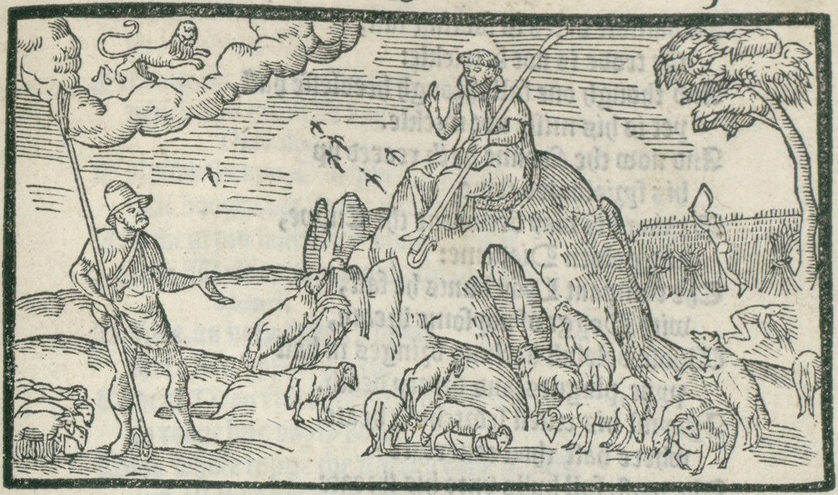
As the second of three ecclesiastical eclogues (with Maye and September), Julye specifically stages a debate on important matters of church politics. In the woodcut, the goatherd Morrell sits on a hill, with his goats scattered along its slopes, while Thomalin stands below, his sheep ordered obediently. Since the woodcut depicts Morrell as tonsured, it is natural to take E.K.’s cue in the Argument to identify the shepherd as a ‘Catholique . . . Pastour’, and thereby to identify Thomalin as ‘protestant’. In these terms, the dialogue appears as a simple Protestant condemnation of Catholic aspiration for worldly ambition in church hierarchy, and, correspondingly, a defense of the lowly life of inner Protestant faith. Yet E.K. in his Argument is perhaps more accurate when he says that the eclogue honors ‘good shepeheardes’ and dishonors ‘proud and ambitious Pastours’, which evokes a debate within the English church itself and active at Cambridge in the 1570s.
The shepherds’ dialogue divides into three parts (Cullen 1970: 56). In lines 1-56, Thomalin and Morrell debate the merits of low and high; in lines 57-124, they delineate particular hills and dales with historical and mythological significance; and in lines 125-232 they discuss the fate of the shepherd Algrind, who has been knocked off his hill by a female eagle who has accidentally dropped a shellfish on his head.
The underlying biblical text is Isaiah 40:4: ‘Everie valleie shalbe exalted, and everie mountaine and hill shalbe made low’. Yet the key pastoral source-text is Mantuan’s eighth eclogue, which introduces the locale of hill and dale in a debate about the value of each. Spenser imitates Mantuan’s landscape but emphasizes its symbolic associations, and he transposes the debate to Reformation England (Renwick, Var 7: 325).
Hence, Spenser adopts a verse-form associated with Protestantism, a divided ‘fourteener’: a single line of fourteen beats breaks into a second line after the eighth beat, but thus features a longer line followed by a shorter one, which George Turbervile had used in his 1567 translation of Mantuan (Cain in Oram 1989: 120). On the surface, Julye may seem ‘impossible’ to ‘consider felicitous’ (Palgrave, Var 7: 323)—‘in a literary sense the less distinguished of the Eclogues’ (Herford, Var 7: 323)—yet the jaunty rhythm of the alternating lines lends the eclogue a sense of playfulness, one that comes across in another way in the shellfish allegory, despite the seriousness of its ecclesiastical politics.
Indeed, Julye handles the historical milieu of the debate deftly, making it difficult to determine just what Spenser does with ‘perspective’ (Anderson 1970). Does he ‘dramatiz[e] . . . a conflict of pastoral perspectives, neither of which is without merit’ (Cullen 1970: 61); or does he rely on ‘disguise’ as a device of ‘self-protection’ (J.N. King 1990: 41-2), thereby aligning himself with a particular social, political, and ecclesiastical faction, or perhaps simply to air controversial events (Norbrook 2002: 54, 62-3; Hume 1984: 28-33)?
The most obvious event is the notorious fall of ‘Algrind’, representing Archbishop Grindal, who fell from the queen’s favor in 1577 for refusing to suppress the so-called ‘prophesyings’, private gatherings of clergy who interpreted Scripture outside the boundaries of prescribed homilies and sermonizing (Hadfield 2012: 136-8). At stake here, then, is whether Spenser is an ‘Anglican’ (Whitaker 1950; Wall 1988), a ‘Puritan’ (Hume 1984), or simply a ‘progressive Protestant’ (J.N. King 2006: 71, 1990: 233-8; cf. Norbrook 2002: 55). In any case, Spenser displays shrewdness in characterizing both Morrell and Thomalin with sympathy and insight, representing a complex meditation on the nature of religious identity: ‘If Thomalin locates the dark side of aspiration in Morrell’s pride, Morrell in turn points to the negative, withdrawing side of Thomalin’s humility’ (Snyder 1998: 39).
The ecclesiastical debate also extends to social and political issues of hierarchy and class, including questions over labor: between upper-class idleness and lower-class work (Lane 1993: 114-31), featured in the background of the woodcut, where summertime harvesters contrast with Morrell sitting on his hill and with Thomalin standing by.
Yet Julye is finally ‘central’ because it relates church and state to poetry, as intimated by the implied comparison with Colin Clout from June, as suggested by Morrell’s reference to the ‘Muses’ dwelling on Mount Parnassus (45-8), and as documented by the two other classical myths emerging in the dialogue, both identified as taking place on Mt Ida (but see note on [59]): Endymion and Phoebe (57-64) and Paris and Helen (145-52; see Stewart 1991). In fact, the eclogue presents here not merely a model of the familiar Renaissance humanist project of relating classical to biblical, but a sophisticated fiction about the merits and dangers of doing so: Thomalin ‘objects to the indiscriminate conflation of biblical and classical imagery which informs Morrell’s argument. For him, Mount Olivet [sacred to Christ and his teaching] and Mount Ida are distinct. . . . As in Maye, the two speakers inhabit conflicting imaginative, as well as moral, worlds. Accordingly, they read the pastoral landscape differently. From Thomalin’s viewpoint, Morrell appropriates the spiritual significance of mountains in support of social climbing. From Morrell’s viewpoint, Thomalin distorts the traditional symbolism of valleys in order to denigrate legitimate social eminence’ (McCabe 1999: 544).
Spenser’s evocation of his own poetic art during a debate having more overt ecclesiastical and social resonance may also work doubly: he subtly underscores Elizabethan courtly poetry’s implication in England’s political difficulties of the 1570s, represented especially by the myth of Paris and Helen (the origin of the Trojan War) but perhaps also by the myth of the sleeping Endymion (the lover of an Elizabeth-like virginal moon goddess, Cynthia), whose ‘cave’ becomes the source of an Adamic ‘fall’ (63-7); and, simultaneously, Spenser gestures to his own poetry in helping to solve such difficulties, as the specific artistic locale of Colin Clout throughout the Calender suddenly comes into view (see Apr 35-6 and note): ‘And they that con of Muses skill, / sayne most what, that they dwell / (As goteherds wont) upon a hill, / beside a learned well’ (45-8).

;)
;)
;)
;)
;)
;)
;)
;)
;)
;)
;)
;)
;)
;)
;)
;)
;)
;)
;)
;)
;)
;)
;)
;)
;)
;)
;)
;)
;)
;)
;)
;)
;)
;)
;)
;)
;)
;)
;)
;)
;)
;)
;)
;)
;)
;)
;)
;)
;)
;)
;)
;)
;)
;)
;)
;)
;)
;)
;)
;)
![1579 [E.K. gl. 118];](javascript:link_to_image('calender','1579','SC.1579.HEH','H2v','SC.1579.HEH_H2v.jpg','ect','calender.july.230.collation');)
;)
![1579 [E.K. gl. 125];](javascript:link_to_image('calender','1579','SC.1579.HEH','H2v','SC.1579.HEH_H2v.jpg','ect','calender.july.233.collation');)
;)
;)
;)
;)
;)
;)
;)
;)
;)
;)
;)
;)
;)
;)
;)
;)
;)
;)
;)
;)
;)
;)
;)
;)
;)
;)
;)
;)
;)
;)
;)
;)
;)
;)
;)
;)
;)
;)
;)
;)
;)
;)
;)
;)
;)
;)
;)
;)
;)
;)
;)
;)
;)
;)
;)
;)
;)
;)
;)
;)
;)
;)
;)
;)
;)
;)
;)
;)
;)
;)
;)
;)
;)
;)
;)
;)
;)
;)
;)
;)
;)
;)
;)
;)
;)
;)
;)
;)
;)
;)
;)
;)
;)
;)