Headnote

E.K. is the first to assign special status to November, saying in the Argument that Spenser ‘farre pass[es] . . . his reach, and in myne opinion all other the Eglogues of this booke’. November is indeed ‘the grandest poem in the sequence’ (Alpers 1972: 367): it features the ‘sacred mystery of death and rebirth’, as Spenser ‘reevaluat[es] . . . the whole enterprise [the poet’s career] in the light of eternity’ (Montrose 1979: 51-2).

Structurally, the eclogue divides into three parts. In lines 1-52, the shepherd Thenot asks Colin Clout to sing one of his famous songs, whether a love song to Rosalind or a hymn to Pan; but Colin refuses because the autumnal season ‘nis the time of merimake’ (9); Thenot agrees, and requests a song on the death of the recently deceased Queen Dido--a request that Colin grants. In lines 53-202, Colin then delivers a fifteen-stanza funeral elegy, in which he mourns the tragedy of Dido’s death but then suddenly witnesses her ascent into the afterlife: ‘I see thee blessed soule, I see, / Walke in the Elisian fieldes so free’ (178-9). Finally, in lines 203-8 Thenot praises the ‘doolfull pleasaunce’ of Colin’s song (204), and awards Colin a lamb.

November relates to previous Colin Clout eclogues: to Januarye and August, for reprising a song about desire, thereby connecting Dido with Rosalind; to Aprill, for presenting a tragic version of the epideictic celebration of a maiden queen, connecting Dido with Elisa; and to June, for offering a heightened meditation on the poet’s career. Yet November also joins October and December in forming a three-eclogue conclusion to the Calender; together, they present ‘Spenser’s trilogy . . . on poetry and its present state’ (Bernard 1989: 75).

In particular, November shows Spenser writing in the pastoral tradition of funeral elegy. This tradition begins with Theocritus, Idylls 1, an elegy on the dead shepherd Daphnis, in a tradition that goes on to include both Bion’s elegy on the dying Adonis and Moschus’ elegy on Bion. But Spenser’s two key source-texts are Virgil, Eclogues 5, and especially Marot’s elegy on the death of Queen Louise of France, mother to Marot’s patron, Francis I, Eglogue sur le Trespas de ma Dame Loyse de Savoye (1531) (Hoffman 1977: 53-61; for details on Marot, see Reamer 1969). Petrarch, Boccaccio, and Sannazaro had all written elegies as part of their pastorals, helping to Christianize the form that Marot and Spenser inherit. As a tradition, these elegies combine a rich philosophical and religious mythology of pastoral, poetry, and politics, and they follow a similar two-part structure: initial grief over loss of a beloved person, followed by consolation through the person’s apotheosis (Sacks 1985; Pigman 1985; Kay 1990; see P. Cheney 2003).

To accomplish his ‘grand’ goals, Spenser uses three sets of verse forms: for the opening dialogue, an eight-line stanza rhyming ababbcbc; for Colin’s song, a ten-line stanza alternating four kinds of lines—alexandrine, pentameter, tetrameter, dimeter—with four interlocking rhymes, ababbccdbd; and for Thenot’s coda, a sixain, rhyming ababcc. Of the most spectacular of the three forms, Colin’s song, Herford writes, this ‘admirable strophe of his own invention . . . conveys the expression of a recurring access or wave of emotion, marked at the outset (in a highly original manner) by the energetic and resonant Alexandrine, then gradually subsiding through verses of diminishing compass, until just before the close it rises in one expiring palpitation’ (Var 7: 397).

Despite this tour de force—or perhaps because of it—November is difficult to gauge. Does Spenser’s commitment to ‘transcendence’ substantiate the Christian poet’s wisdom—his use of art to express faith in the truth of a scriptural heaven (MacCaffrey 1969: 127-9, 132-3; Moore 1982: 113-4)—or does the commitment to transcendence appear as ‘escapist’ (Montrose 1979: 50-4; Berger 1988: 399, 409, 414-5)? Alternatively, does the center of November lie elsewhere, not in the transcendent ‘image’ of ‘Dido in heaven’ but rather in ‘Thenot’s words of thanks to Colin’ at the end—that is to say, in a worldly community, in contingency and song, as the poet directs his gaze to this world, not the next (Alpers 1972: 363)? To the extent that the eclogue valorizes transcendence, it serves the ‘Augustinian’ goal of a ‘celestial pastoral’, fulfilling ‘the function of funeral rites’ in society (Cain in Oram 1989: 185-6); but to the extent that November pursues a ‘pastoral of power’, it advertises political contingency as organizing Spenser’s unfolding career (Montrose 1979: 51).

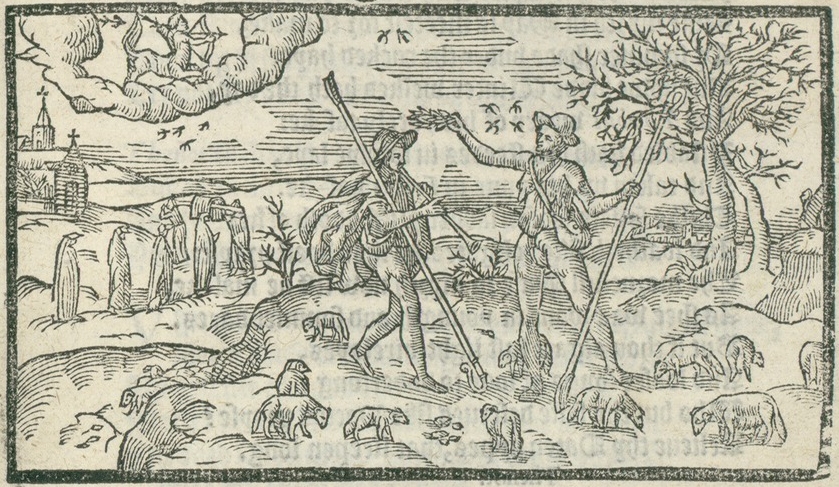
Significantly, the woodcut supports the latter possibility, for it pushes the funeral procession marching to the church bearing the bier of Dido into the background, and centers rather on Thenot’s crowning of Colin with the laurel garland. Hence, the poet plays his pipe, with his sheep grazing before him, while behind him stands a building representing the court.

In such a courtly, vocational setting, who is Dido? The name derives from the tragic Carthaginian queen of Virgil’s Aeneid. While Spenser’s Dido may represent someone in the family of Robert Dudley, earl of Leicester, as evoked through reference to ‘the greate shepheard Lobbin, how great is thy griefe’ (113) (Var 7: 395-402), inescapably the ‘mayden of greate bloud’ (Arg 1-2) evokes Queen Elizabeth: in this veiled political allegory, she would be dead to Leicester and Protestant England if she married the Catholic Duc d’Alençon (Parmenter, Var 7: 402; McLane 1961: 47-60; McCabe 1999: 565-6; Prescott 2010: 620-2; Pugh 2016: 145). The allegory about the death of a queen may also gesture to violations of the 1571 statute that illegalizes attempts on the queen’s life: Elizabeth’s ‘divine status is subtly but definitively reserved for her death’ (Lane 1993: 24). Yet the elegy’s ‘celebration of Dido’s life’ (Cullen 1970: 92n29) does not square with such a grim political critique. Dido may refer less to Virgil’s tragically passionate heroine than to an alternate tradition of a chaste queen devoted to her dead husband’s memory (Bono 1984: 67-9; see D. Cheney 1989: 155): ‘Spenser’s interest [is] in recuperative interpretations of Virgil’s female characters. He introduces Dido in “November” not to subvert his earlier tributes to Elizabeth but to suggest another way of representing relationships between the sexes in Virgilian poetry’ (Watkins 1995: 79-80).

What is striking about November, then, is its interplay between the ominous political allegory, on the one hand, and, on the other, its sublime intertextual fiction of both chaste communal desire in this life and Christian transcendence in the next—as well as one inescapable fact: in 1579, Spenser boldly presents his pastoral persona as the creator of this interplay.
0.1calender.november.0.1 0.2calender.november.0.2 0calender.november.argument.0 1calender.november.argument.1 2calender.november.argument.2 3calender.november.argument.3 4calender.november.argument.4 5calender.november.argument.5 6calender.november.argument.6 0calender.november.1.0 1calender.november.1 2calender.november.2 3calender.november.3 4calender.november.4 5calender.november.5 6calender.november.6 7calender.november.7 8calender.november.8 0calender.november.9.0 9calender.november.9 10calender.november.10 11calender.november.11 12calender.november.12 13calender.november.13 14calender.november.14 15calender.november.15 16calender.november.16 17calender.november.17 18calender.november.18 19calender.november.19 20calender.november.20 21calender.november.21 22calender.november.22 23calender.november.23 24calender.november.24 0calender.november.25.0 25calender.november.25 26calender.november.26 27calender.november.27 28calender.november.28 29calender.november.29 30calender.november.30 31calender.november.31 32calender.november.32 33calender.november.33 34calender.november.34 35calender.november.35 36calender.november.36 37calender.november.37 38calender.november.38 39calender.november.39 40calender.november.40 41calender.november.41 42calender.november.42 43calender.november.43 44calender.november.44 45calender.november.45 46calender.november.46 47calender.november.47 48calender.november.48 0calender.november.49.0 49calender.november.49 50calender.november.50 51calender.november.51 52calender.november.52 53calender.november.53 54calender.november.54 55calender.november.55 56calender.november.56 57calender.november.57 58calender.november.58 59calender.november.59 60calender.november.60 61calender.november.61 62calender.november.62 63calender.november.63 64calender.november.64 65calender.november.65 66calender.november.66 67calender.november.67 68calender.november.68 69calender.november.69 70calender.november.70 71calender.november.71 72calender.november.72 73calender.november.73 74calender.november.74 75calender.november.75 76calender.november.76 77calender.november.77 78calender.november.78 79calender.november.79 80calender.november.80 81calender.november.81 82calender.november.82 83calender.november.83 84calender.november.84 85calender.november.85 86calender.november.86 87calender.november.87 88calender.november.88 89calender.november.89 90calender.november.90 91calender.november.91 92calender.november.92 93calender.november.93 94calender.november.94 95calender.november.95 96calender.november.96 97calender.november.97 98calender.november.98 99calender.november.99 100calender.november.100 101calender.november.101 102calender.november.102 103calender.november.103 104calender.november.104 105calender.november.105 106calender.november.106 107calender.november.107 108calender.november.108 109calender.november.109 110calender.november.110 111calender.november.111 112calender.november.112 113calender.november.113 114calender.november.114 115calender.november.115 116calender.november.116 117calender.november.117 118calender.november.118 119calender.november.119 120calender.november.120 121calender.november.121 122calender.november.122 123calender.november.123 124calender.november.124 125calender.november.125 126calender.november.126 127calender.november.127 128calender.november.128 129calender.november.129 130calender.november.130 131calender.november.131 132calender.november.132 133calender.november.133 134calender.november.134 135calender.november.135 136calender.november.136 137calender.november.137 138calender.november.138 139calender.november.139 140calender.november.140 141calender.november.141 142calender.november.142 143calender.november.143 144calender.november.144 145calender.november.145 146calender.november.146 147calender.november.147 148calender.november.148 149calender.november.149 150calender.november.150 151calender.november.151 152calender.november.152 153calender.november.153 154calender.november.154 155calender.november.155 156calender.november.156 157calender.november.157 158calender.november.158 159calender.november.159 160calender.november.160 161calender.november.161 162calender.november.162 163calender.november.163 164calender.november.164 165calender.november.165 166calender.november.166 167calender.november.167 168calender.november.168 169calender.november.169 170calender.november.170 171calender.november.171 172calender.november.172 173calender.november.173 174calender.november.174 175calender.november.175 176calender.november.176 177calender.november.177 178calender.november.178 179calender.november.179 180calender.november.180 181calender.november.181 182calender.november.182 183calender.november.183 184calender.november.184 185calender.november.185 186calender.november.186 187calender.november.187 188calender.november.188 189calender.november.189 190calender.november.190 191calender.november.191 192calender.november.192 193calender.november.193 194calender.november.194 195calender.november.195 196calender.november.196 197calender.november.197 198calender.november.198 199calender.november.199 200calender.november.200 201calender.november.201 202calender.november.202 0calender.november.203.0 203calender.november.203 204calender.november.204 205calender.november.205 206calender.november.206 207calender.november.207 208calender.november.208 209calender.november.209 210calender.november.210 0calender.november.glosse.0 1calender.november.glosse.1 2calender.november.glosse.2 3calender.november.glosse.3 4calender.november.glosse.4 5calender.november.glosse.5 6calender.november.glosse.6 7calender.november.glosse.7 8calender.november.glosse.8 9calender.november.glosse.9 10calender.november.glosse.10 11calender.november.glosse.11 12calender.november.glosse.12 13calender.november.glosse.13 14calender.november.glosse.14 15calender.november.glosse.15 16calender.november.glosse.16 17calender.november.glosse.17 18calender.november.glosse.18 19calender.november.glosse.19 20calender.november.glosse.20 21calender.november.glosse.21 22calender.november.glosse.22 23calender.november.glosse.23 24calender.november.glosse.24 25calender.november.glosse.25 26calender.november.glosse.26 27calender.november.glosse.27 28calender.november.glosse.28 29calender.november.glosse.29 30calender.november.glosse.30 31calender.november.glosse.31 32calender.november.glosse.32 33calender.november.glosse.33 34calender.november.glosse.34 35calender.november.glosse.35 36calender.november.glosse.36 37calender.november.glosse.37 38calender.november.glosse.38 39calender.november.glosse.39 40calender.november.glosse.40 41calender.november.glosse.41 42calender.november.glosse.42 43calender.november.glosse.43 44calender.november.glosse.44 45calender.november.glosse.45 46calender.november.glosse.46 47calender.november.glosse.47 48calender.november.glosse.48 49calender.november.glosse.49 50calender.november.glosse.50 51calender.november.glosse.51 52calender.november.glosse.52 53calender.november.glosse.53 54calender.november.glosse.54 55calender.november.glosse.55 56calender.november.glosse.56 57calender.november.glosse.57 58calender.november.glosse.58 59calender.november.glosse.59 60calender.november.glosse.60 61calender.november.glosse.61 62calender.november.glosse.62 63calender.november.glosse.63 64calender.november.glosse.64 65calender.november.glosse.65 66calender.november.glosse.66 67calender.november.glosse.67 68calender.november.glosse.68 69calender.november.glosse.69 70calender.november.glosse.70 71calender.november.glosse.71 72calender.november.glosse.72 73calender.november.glosse.73 74calender.november.glosse.74 75calender.november.glosse.75 76calender.november.glosse.76 77calender.november.glosse.77 78calender.november.glosse.78 79calender.november.glosse.79 80calender.november.glosse.80 81calender.november.glosse.81 82calender.november.glosse.82 83calender.november.glosse.83 84calender.november.glosse.84 85calender.november.glosse.85 86calender.november.glosse.86 87calender.november.glosse.87 88calender.november.glosse.88 89calender.november.glosse.89 90calender.november.glosse.90 91calender.november.glosse.91 92calender.november.glosse.92 93calender.november.glosse.93 94calender.november.glosse.94 95calender.november.glosse.95 96calender.november.glosse.96 97calender.november.glosse.97 98calender.november.glosse.98 99calender.november.glosse.99 100calender.november.glosse.100 101calender.november.glosse.101 102calender.november.glosse.102 103calender.november.glosse.103 104calender.november.glosse.104 105calender.november.glosse.105 106calender.november.glosse.106 107calender.november.glosse.107
NouemberNovember.
Ægloga vndecimaundecima.
ARGVMENTARGUMENT.
INIn this xi. Æglogue he bewayleth the death of some mayden of greate bloud, whom he calleth Dido. The personage is secrete, and to me altogether vnknowneunknowne, albe of him selfe I often required the same. This Æglogue is made in imitation of Marot his song, which he made vponupon the death of Loys the frenche Queene. But farre passing his reache, and in myne opinion all other the Eglogues of this booke.
Thenot
.
Colin
.
COlinColin
my deare, when shall it please thee sing,
As thou were wontwere | wontwert w[oo]nt,wert wont, songs of some iouisauncejouisaunce?
Thy Muse 3. to: toototoo long slombreth in sorrowing,
Lulled a sleepe through louesloves misgouernauncemisgovernaunce,
Now somewhat sing, whose endles souenauncesovenaunce,
Emong the shepeheards swaines may aye remaine,
Whether thee list thy louedloved lasse aduaunceadvaunce,
Or honor Pan with hymnes of higher vaine.
Colin
.
Thenot
,
now nis the time of merimake.
Nor Pan to herye, nor with louelove to playe:
Sike myrth in May is meetest for to make,
Or summer shade vnderunder the cocked haye..
But nowe sadde Winter welked hath the day,
And Phœbus weary of his yerely taske:taſ-ke:taſke:taske,
YstabledY[ſt]abledY[ſt]abli[ſh]edY[ſt]abli[ſh]t hath his steedes in lowlye laye,
And taken vpup his ynne in Fishes haske.haſ-ke..haſ-ke,haske,
Thilke sollein season sadder plight doth aske:
And loatheth sike delightes, as thou doest prayse:
The mornefull Muse in myrth now list ne maske,maſ-ke,maſ-ke.maſ ke.maske,
As shee was wont in youngth and sommer dayes.
But if thou algate lust light virelayes,
And looser songs of louelove to vnderfongunderfong
Who but thy selfe deseruesdeserves sike Poetes prayse?
RelieueRelieve thy Oaten pypes, that sleepen long.
Thenot
.
The Nightingale is souereignesovereigne of song,
Before him sits the Titmose silent bee:
And I vnfitteunfitte to thrust in skilfullſ-kilfullſkilfullskilfull thronge,
Should
Colin
make iudgejudge of my fooleree.
Nay, better learne of hem, that learned bee,
And han be watered at the Muses well:
The kindlye dewe drops from the higher tree,
And wets the little plants that lowly dwell.
But if sadde winters wrathe and season chill,
Accorde not with thy Muses meriment:
To sadder times thou mayst attune thy quill,
And sing of sorrowe and deathes dreeriment.
For deade is Dido, dead alas and drent,
Dido the greate shepehearde his daughter sheene:
The fayrest May she was that euerever went,
Her like shee has not left behinde I weene.
And if thou wilt bewayle my wofull tene,tene:teene:t[ée]ne,teene,
I shall thee giuegive yond Cosset for thy payne:
And if thy rymes as rownd and rufull bene,
As those that did thy
Rosalind
complayne
,
Much greater gyfts for guerdon thou shalt gayne,
46. Then: ThanThenThan Kidde or Cosset, which I thee bynempt:
Then vpup I say, thou iollyjolly shepeheard swayne,
Let not my small demaund be so contempt..
Colin
.
Thenot
to that I choose, thou doest me tempt,
But ah 50. to: toototoo well I wote my humble vaine,
And howe my rymes bene rugged and vnkemptunkempt:
Yet as I conne, my conning I will strayne..
VPVpUPUp then Melpomene thou mournefulst Muse of nyne,
Such cause of mourning neuernever hadst afore:
Up grieslie ghostes and vpup my rufull ryme,
Matter of myrth now shalt thou hauehave no more.
For dead shee is, that myrth thee made of yore.
Dido my deare alas is dead,
Dead and lyeth wrapt in lead:
O heauieheavie herse,
Let streaming teares be poured out in store:
O carefull verse..
Shepheards, that by your flocks on Kentish downes abyde,
Waile ye this wofull waste of natures warke:
Waile we the wight, whose presence was our pryde:
Waile we the wight, whose absence is our carke.
The sonne of all the world is dimme and darke:
The earth now lacks her wonted light,
And all we dwell in deadly night,
O heauieheavie herse.
Breake we our pypes, that shrild as lowde as Larke,
O carefull verse.
Why doe we longer liuelive, (ah why liuelive we so long)
Whose better dayes death hath shut vpup in woe?
The fayrest floure our gyrlond all emong,
Is faded quite and into dust ygoe.
Sing now ye shepheards daughters, sing no moe
The songs that
Colin
made in her prayse
,
But into weeping turne your wanton layes,
O heauieheavie herse,
Now is time to dye.. Nay time was long ygoe,
O carefull verse.
Whence is it, that the flouret of the field doth fade,
And lyeth buryed long in Winters bale:
Yet soone as spring his mantle doth displaye,
It floureth fresh, as it should neuernever fayle?
But thing on earth that is of most availe,
As vertues braunch and beauties budde,budde.bud,bud,
ReliuenReliven not for any good..
O heauieheavie herse,
The braunch once dead, the budde eke needes must quaile,
O carefull verse.
She while she was,, (that was, a woful word to sayne)
For beauties prayse and plesaunce had no pere:
So well she couth the shepherds entertayne,
With cakes and cracknells and such country chere.
Ne would she scorne the simple shepheards swaine,
For she would cal hem often heme
And giuegive hem curds and clouted Creame.
O heauieheavie herse,
Als
Colin
cloute
she would not once disdayne.
O carefull verse.
But nowe sike happy cheere is turnd to heauieheavie chaunce,
Such pleasaunce now displast by dolors dint:
All Musick sleepes, where death doth leade the daunce,
And shepherds wonted solace is extinct.
The blew in black, the greene in gray is tinct,
The gaudie girlonds deck her grauegrave,
The faded flowres her corse embraueembrave.
O heauieheavie herse,
Morne nowe my Muse, now morne with teares besprint.
O carefull verse.
O thou greate shepheard Lobbin, how great is thy griefe,
Where bene the nosegayes that she dight for thee:
The colourd chaplets wrought with a chiefe,
The knotted rushrings, and gilte Rosemaree?
For shee deemed nothing too deere for thee.
Ah they bene all yclad in clay,
One bitter blast blewe all away.
O heauieheavie herse,
Thereof nought remaynes but the memoree..
O carefull verse.
Ay me that dreerie death should strike so mortall stroke,
That can vndoeundoe Dame natures kindly course:
The faded lockes fall from the loftie oke,
The flouds do gaspe, for dryed is theyr sourse,
And flouds of teares flowe in theyr stead perforse.
The mantled medowes mournemorunemourne,
Theyr sondry colours tourne.torune..tourne.
O heauieheavie herse,
The heauensheavens doe melt in teares without remorse.
O carefullcarſefullcarefull verse.
The feeble flocks in field refuse their former foode,
And hang theyr heads, as they would learne to weepe:
The beastes in forest wayle as they were woode,
Except the WoluesWolves, that chase the wandring sheepe:
Now she is gon that safely did hem keepe,
The Turtle on the bared braunch,
Laments the wound, that death did launch.
O heauieheavie herse,
And Philomele her song with teares doth steepe..
O carefull verse.
The water Nymphs, that wont with her to sing and daunce,
And for her girlond OliueOlive braunches beare,
Now balefull boughes of Cypres doen aduaunceadvaunce::
The Muses, that were wont greene bayes to weare,
Now bringen bitter Eldre braunches seare:ſeare,ſeare:ſere:
The fatall sisters eke repent,
Her vitall threde so soone was spent.
O heauieheavie herse,
Morne now my Muse, now morne with heauieheavie cheare.
O carefull verse..
O trustlesse state of earthly things, and slipper hope
Of mortal men, that swincke and sweate for nought,
And shooting wide,, doe misse the marked scope:
Now hauehave I learnd (a lesson derely bought)
That nys on earth assuraunce to be sought:
For what might be in earthlie mould,
That did her buried body hould.
O heauieheavie herse,
Yet saw I on the beare when it was brought
O carefull verse..
But maugre death, and dreaded sisters deadly spight,
And gates of hel, and fyrie furies forse:
She hath the bonds broke of eternall night,
Her soule vnbodiedunbodied of the burdenous corpse.
Why then weepes
Lobbin
so without remorse?
O
Lobb
, thy losse no longer lament,
Dido nis dead, but into heauenheaven hent.
O happye herse,
Cease nowCease uowCeaſe nowCeaſe mowCeaſe noweCeaſe now my Muse, now cease thy sorrowes sourse,
O ioyfulljoyfull verse.
Why wayle we then? why weary we the Gods with playnts,
As if some euillevill were to her betight?
She raignes a goddesse now emong the saintes,
That whilome was the saynt of shepheards light:
And is enstalled nowe in heauensheavens hight.
I see thee blessed soule, I see,
Walke in Elisian fieldes so free.
O happy herse,
Might I once come to thee (O that I might)
O ioyfulljoyfull verse.
Unwise and wretched men to weete whats good or ill,
We deeme of Death as doome of ill desert:
But knewe we fooles, what it vsus bringes vntiluntil,
Dye would we dayly, once it to expert..
No daunger there the shepheard can astert::
Fayre fieldes and pleasaunt layes there bene,
The fieldes ay fresh, the grasse ay greene::
O happy herse,
Make hast ye shepheards, thether to reuertrevert,
O ioyfulljoyfull verse.
Dido is gone afore (whose turne shall be the next?)
There liueslives shee with the blessed Gods in blisse,
There drincks she Nectar with Ambrosia mixt,
And ioyesjoyes enioyesenjoyes, that mortall men doe misse.
The honor now of highest gods she is,
That whilome was poore shepheards pryde,
While here on earth she did abyde..
O happy herse,
Ceasse now my song, my woe now wasted is.
O ioyfulljoyfull verse.
Thenot
.
Ay francke shepheard, how bene thy verses meint
With doolful pleasaunce, so as I ne wotte,
Whether reioycerejoyce or weepe for great constrainte?
Thyne be the cossette, well hast thow it gotte.
Up
Colin
vpup, ynough thou morned hast,
Now gynnes to mizzle, hye we homeward fast.
Colins
Embleme.
La mort ny mord.
GLOSSE.
IouisaunceJouisaunce) myrth.
SouenaunceSovenaunce) remembraunce.
Herie) honour.
VVelkedWelked) shortned or empayred. As the Moone being in the vvainewaine is sayde of Lidgate to vvelkwelk.
In lovvlylowly lay) according to the season of the monethNouembermonethNovembermoneth Nouembermoneth November, when the sonne dravvethdraweth low in the South toward his Tropick or returne.
In fishes haske) the sonne, reigneth that is, in the signe Pisces all NouemberNovember. a haskeA haske is a vvickerwicker pedpad, wherein they vseuse to cary fish.
Virelaies) a light kind of song.
Bee vvatredwatred) For it is a saying of Poetes, that they hauehave dronk of the Muses vvellwell CastaliasCa[ſt]liasCa[ſt]alias, vvhereofwhereof vvaswas before sufficiently sayd.
Dreriment) dreery and heauyheavy cheere.
The great shepheard) is some man of high degree, and not as some vainely suppose God Pan. The person both of the shephearde and of Dido is vnknovvenvnknowenunknowen and closely buried in the Authors conceipt. But out of doubt I am, that it is not
Rosalind
, as some imagin: for he speaketh soone after of her also.
Shene) fayre and shining.
May) for mayde.
Tene) sorrow.
Guerdon) reward.
Bynempt) bequethed.
Cosset) a lambe brought vpup without the dam.
VnkemptUnkempt) IncõptiIncompti Not comed, that is rude &and vnhansomeunhansome.
Melpomene) The sadde and waylefull Muse vsedused of Poets in honor of Tragedies: as saith Virgile Melpomene Tragico proclamat mæsta boatu.
VpUp griesly gosts) The maner of Tragicall Poetes, to call for helpe of Furies and damned ghostes: so is Hecuba of Euripides, and Tantalus brought in of Seneca. And the rest of the rest.
Herse) is the solemne obsequie in funeralles.
VVastWast of) decay of so beautifull a peece.
Carke) care.
Ah vvhywhy) an elegant Epanorthosis. asAs also soone after:after. nay time was long ago.
Flouret) a diminutiuediminutive dimumtine for a little floure. This is a notable and sententiousſententionsſententious comparison A minore ad maius.
ReliuenReliven not) liuelive not againe .s. not in theyr earthly bodies: for in heauenheaven they enioyenjoy their due reward.
The braunch) He meaneth Dido, vvhowho being, as it vverewere the mayne braunch now vvitheredwithered the buddes that is beautie (as he sayd afore) can nomore flourish.
VVithWith cakes) fit for shepheards bankets.
Heame) for home,home. after the northerne pronouncing.
Tinct)Tui[ct])Tui[ct],Tin[ct], deyed or stayned.
The gaudie) the meaning is, that the things, which vverewere the ornaments of her lyfe, are made the honor of her funerall, as is vsedused in burialls.
Lobbin
) the name of a shepherd, vvhichwhich seemeth to hauehave bene the louerlover &and deere frende of Dido.
Rushrings) agreeable for such base gyftes.gyftesgiftes.gifts.gifts,
Faded lockes) dryed leauesleaves. As if Nature her selfefelfeſelfe bewayled the death of the Mayde.
Sourse) spring.
Mantled medowes) for the sondry flowres are like a Mantle or couerletcoverlet vvroughtwrought vvithwith many colours.
Philomele) the Nightingale, vvhomewhome the Poetes faine once to hauehave bene a Ladye of great beauty, till being rauishedravished by hir sisters husbande, she desired to be turned into a byrd of her name. vvhosewhoseVVhoseWhose complaintes be very vvellwell set forth of 60. Ma.: Master60. Mr: MasterMa.Mr George Gaskin a wittie gentleman, and the very chefe of our late rymers, vvhowho and if some partes of learninglearniug wanted not (albee it is vvellwell knovvenknowen he altogyther vvantedwanted not learning) no doubt would hauehave attayned to the excellencye of those famous Poets. For gifts of vvitwit and naturall promptnesse appeare in hym aboundantlyaboundantly.
Cypresse) vsedused of the old Paynims in the furnishing of their funerall Pompe,Pompe.pompe, and properly the signe ofthe ofthe ſigne of all sorow and heauinesseheavinesse.
The fatall sisters) Clotho Lachesis and Atropos, daughtersAtropodas,ughtersAtropodas, ughtersAtropos, daughters of Herebus and the Nighte, whom the Poetes fayne to spinne the life of man, as it were a long threde, which they dravvedrawe out in length, till his fatal hovvrehowre &and timely death be come; but if by other casualtie his dayes be abridged, then one of them, that is Atropos, is sayde to hauehave cut the threde in twain. Hereof commeth a common verse. Clotho colum baiulat, lachesis trahit, AtroposAtrhposAtrhposAtropos occat.
O trustlesse) a gallant exclamation moralized vvithwith great vvisedomwisedom and passionate wyth great affection.
Beare) a frame, wheron they vseuse to lay the dead corse.
Furies) of Poetes be feyned to be three, Persephone Alecto and Megera, vvhichwhich are sayd to be the Authours of all euillevill and mischiefe.
Eternall night)might)might,night, Is death or darknesse of hell.
Betight) happened.happened,
I see) A liuelylively Icon, or representation as if he saw her in heauenheaven present.
Elysian fieldes) be deuiseddevised of Poetes to be a place of pleasure like Paradise, where the happye soules doe rest in peace and eternal happynesse.
Dye would) The very expresseepre[ſſ]eexpre[ſſ]e saying of Plato in Phædone.
Astert]Astert) befall vnvvaresunvvaresvnwaresunwares.
Nectar and Ambrosia) be feigned to be the drink and foode of the gods: Ambrosia they liken to Manna in scripture and Nectar to be vvhitewhite like Creme, vvhereofwhereof is a proper tale of Hebe, that spilt a cup of it, and stayned the heauensheavens, as yet appeareth. But I hauehave already discoursed that at large in my Commentarye vponupon the dreames of the same Authour.
Meynt) Mingled.
Embleme.
VVhichWhich is as much to say, as death biteth not. For although by course of nature we be borne to dye, and being ripened with age, as vvithwith a timely haruestharvest, vvewe must be gathered in time, or els of our seluesselves vvewe fall like rotted ripe fruite fro the tree: yet death is not to be counted for euilevil, nor (as the Poete sayd a little before) as doome of ill desert.deſert)deſert.)deſert. For though the trespasse of the first man brought death into the world, as the guerdon of sinne, yet being ouercomeovercome by the death of one, that dyed for al, it is novvnow made (as Chaucer sayth) the grene path way to lyfe. So that it agreeth vvellwell vvithwith that vvaswas sayd, that Death byteth not (that is) hurteth not at all.
2. some mayden of greate bloud: 'A virgin of noble family'
3. required: asked, requested
2. iouisaunce: E.K.
4. misgouernaunce: misconduct, dissipation
5. somewhat: something
5. souenaunce: remembrance, fame
5. endles souenaunce . . . aye remaine: E.K.
7. aduaunce: praise
8. vaine: kind
9. nis: is not
10. herye: E.K.
11. make: A term also for the making of poetry.
12. cocked: gathered into conical stacks or cocks
13. welked: E.K.
15. lowlye laye: E.K.
15. laye: shelter, lee
16. Fishes haske: E.K.
22. vnderfong: undertake
23. Poetes prayse: praise of the poet(s)
24. Relieue: take up once more; restore to use, raise up
26. sits: it is proper that
26. Titmose: tomtit
30. han be: have been
30. be watered: E.K.
35. quill: reed, pipe
36. dreeriment: E.K.
37. drent: drowned
38. the greate shepehearde: E.K.
38. sheene: E.K.
39. May: E.K.
41. tene: E.K.
43. rownd: fluent, perfectly constructed
43. rufull: doleful
45. guerdon: E.K.
46. Cosset: E.K.
46. bynempt: E.K.
48. contempt: disdained
50. vaine: talent, poetic style
51. rugged: rough, harsh, unpolished
51. vnkempt: E.K.
52. conning: cunning, learning;strayne: stretch to the limit, put into verse
61. store: plenty
62. carefull: care-worn; carefully composed
64. warke: work
66. carke: E.K.
76. quite: entirely
76. ygoe: gone
77. moe: more
79. wanton: lively
83. flouret: E.K.
84. bale: misery
91. quaile: perish, fade, wither
96. With cakes: E.K.
96. cracknells: light, crisp biscuits
96. chere: food
98. heme: E.K.
99. clouted: clotted
103. chaunce: circumstance, happening, (mis)fortune
107. tinct: E.K.
108. The gaudie: E.K.
109. embraue: beautify, embellish
111. besprint: sprinkled
113. Lobbin: E.K.
115. chaplets: garlands
115. chiefe: head, top
116. rushrings: wreaths of rushes; E.K.
116. gilte Rosemaree: a gold-variegated variety of rosemary
127. flouds: streams
128. The mantled medowes mourne: E.K.
129. tourne: change
131. without remorse: without mitigation, respite, or hesitation
138. Turtle: turtledove
139. launch: pierce, transfix
145. Cypres: E.K.
146. bayes: laurel
147. Eldre: black-berried elder
148. The fatall sisters: E.K.
153. O trustlesse: E.K.
153. slipper: slippery
154. swincke: labor
155. scope: target
158. mould: form, frame
161. beare: E.K.
163. maugre: in spite of
164. furies: E.K.
167. remorse: mitigation, compunction
178. I see: E.K.
184. of: for
185. vntil: unto
186. expert: experience
187. astert: E.K.
188. layes: leas, meadows
203. francke: generous; free
203. meint: E.K.
205. constrainte: distress
206. gotte: earned
208. mizzle: drizzle
9. ped: hamper, basket
16. conceipt: knowledge
25. Incompti Not comed: ‘Unkempt, not combed’.
31. obsequie: Religious ritual for the dead.
47. vsed: customary
66. Paynims: pagans, in this case Greeks and Romans.
91. proper: appropriate, relevant
2.were wont] were|wont 1579, 1581; ~ 1586, 1591; wert w[oo]nt, 1597; wert wont, 1611
14.taske:] taſ-ke: 1579, 1581, 1586; taſke: 1591, 1597; taske, 1611
15.Ystabled] Y[ſt]abled 1579, 1581, 1586, 1591; Y[ſt]abli[ſh]ed 1597; Y[ſt]abli[ſh]t 1611
16.haske.] haſ-ke. 1579, 1581, 1586, 1597; haſ-ke, 1591; haske, 1611
19.maske,] maſ-ke, 1579, 1581, 1586; maſ-ke. 1591; maſ ke. 1597; maske, 1611
27.skilfull] ſ-kilfull 1579, 1581, 1586; ſkilfull 1591, 1597; skilfull 1611
41.tene,] tene: 1579, 1581; teene: 1586, 1591; t[ée]ne, 1597; teene, 1611
88.budde,] budde. 1579, 1581; bud, 1586, 1591, 1597; bud 1611
128.mourne,] morune, 1579, 1581; ~ 1586, 1591, 1597; mourne, 1611
129.tourne.] torune. 1579, 1581; ~ 1586, 1591, 1597; tourne. 1611
132.carefull] carſefull 1579; ~ 1581, 1586, 1591, 1597; carefull 1611
147.seare:] ſeare, 1579, 1581, 1586, 1591; ſeare: 1597; ſere: 1611
171.Cease now] Ceaſe uow 1579; Ceaſe now 1581, 1586; Ceaſe mow 1591; Ceaſe nowe 1597; Ceaſe now 1611
12.Castalias,] Ca[ſt]lias, 1579, 1581; Ca[ſt]alias, 1586, 1591, 1597; Ca- [|] ſtalias, 1611
34.after:] after. 1579, 1581, 1586, 1591, 1597, 1611
36.diminutiue] dimumtine 1579, 1581; ~ 1586, 1591, 1597, 1611
37.sententious] ſententions 1579; ſententious 1581, 1586, 1591, 1597, 1611
44.home,] home. 1579, 1591; ~ 1581, 1586, 1597, 1611
45.Tinct)] Tui[ct]) 1579; Tui[ct], 1581; Tin[ct], 1586, 1591, 1597; 1611
51.gyftes.] gyftes 1579; giftes. 1581; gifts. 1586, 1597, 1611; gifts, 1591
52.selfe] felfe 1579; ſelfe 1581, 1586, 1591, 1597, 1611
62.learning] learniug 1579; ~ 1581, 1586, 1591, 1597, 1611
67.Pompe,] Pompe. 1579; ~ 1581, 1586, 1591, 1597; pompe, 1611
67.the signe of] the of 1579, 1581; the ſigne of 1586, 1591, 1597, 1611
68.Atropos. daughters] Atropodas,ughters 1579; Atropodas, ughters 1581; Atropos, daughters 1586, 1591, 1597, 1611
74.Atropos] Atrhpos 1579; Atrhpos 1581; Atropos 1586, 1591, 1597, 1611
80.night)] might) 1579; might, 1581; night, 1586, 1591, 1597, 1611
81.happened.] happened, 1579, 1581; ~ 1586, 1591, 1597, 1611
87.expresse] epre[ſſ]e 1579; expre[ſſ]e 1581, 1586, 1591, 1597, 1611
102.desert.] deſert) 1579, 1591; deſert.) 1581, 1586; deſert. 1597, 1611
1 bewayleth the death: Identifies the genre of the eclogue as a pastoral funeral elegy.
2 Dido: The name of Virgil’s heroine in the Aeneid, especially Books 1-6. She is the widowed Queen of Carthage, and falls in love with, and is loved by, the hero Aeneas, who must nonetheless forsake her to carry out his divine destiny, the founding of Rome. Dido’s tragic death by suicide occupies Book 4; at Aen 4.335, Aeneas calls Dido by her alternate name, ‘Elissa’ (‘Elissae’), which Ovid remembers famously (Her 7.102 and 193; see Pugh 2005: 18-9). Dido becomes the West’s most poignant casualty of empire (see L.S. Johnson 1990: 175; Watkins 1995: 79-82; Horton 1996; Helfer 2012: 31-4).
2 The personage is secrete: E.K. identifies himself as the first to inquire about the symbolic mystery of Dido’s ‘personage’, but his failure to learn the truth from the author has not prevented centuries of speculation. The case remains unsolved. The prime candidate continues to be Queen Elizabeth, in danger of undergoing a figurative death if she were to marry Alençon (see headnote). Like Aeneas visiting Carthage, Alençon was a foreign visitor at Elizabeth’s court in the late 1570s, when Spenser’s dedicatee, Philip Sidney, and his patron, Leicester, vociferously opposed the match.
4 imitation: Identifies the poet’s method of invention, the imitation of previous literary works---well established in Renaissance poetics.
4–5 Marot . . . Queene: Cf. Marot, Eglogue sur le Trespas de ma Dame Loyse de Savoye. November constitutes a careful imitation of Marot’s Eglogue (Reamer 1968/9; Prescott 1978: 10-12): Spenser borrows the main frame of the fiction, along with several of its details; but he changes Marot radically. In particular, he borrows the fiction of a male poet singing a two-part funeral elegy on the death of a beloved queen (lamentation at her death followed by joy at her immortality), punctuated by a refrain, as well as the introductory and concluding dialogue between two shepherds named Thenot and Colin, the first an inferior poet awarding a prize to the second, superior one. Yet Spenser changes Marot most glaringly by concealing the overt national topicality of the elegy, including the dead queen’s identity. Whereas Marot situates the pastoral fiction in ‘France’ (142, 151, and 218), and names members of Francis I’s royal family (both his mother ‘Madame Loyse’ [title] and her daughter ‘Margot’ (Marguerite de Navarre [60, 109]), Spenser nowhere mentions England (or even Kent), and he conceals the identity of the deceased queen. This changes the nature of the fiction from panegyric to (likely) allegory (see 67n) but also the self-presentation of the poet himself. Whereas Marot clearly presents himself as the nation’s premier funeral poet to his king—he is patriotic, sympathetic, learned, artful—Spenser accepts this role but adds to it that of royal counselor, warning Elizabeth about a dangerous French alliance. In this way, E.K.’s reference to Immerito’s imitation of a French poet gestures to a French political context and opens the way to an English one. (Other debts and changes appear below.)
5 farre passing his reache: ‘Surpassing his limit or skill’. The word ‘reach’ could mean ‘Of the mind or mental faculties: range, scope; penetration; capacity for knowledge’ (OED). The phrasing urges the reader to lend special attention to this eclogue among the twelve.
1.0 Thenot: Appears also in Februarie and Aprill (see, respectively). Here Thenot assumes the role of an inferior poet to the superior Colin Clout, but he also courteously serves as the pastoral host of Colin’s art.
1.0 Colin: After breaking his pipe in Januarye, Colin returns for the first time in nine eclogues to sing a song in the present tense of the fiction; yet no longer does he sing about Rosalind. In Aprill, Colin is absent but Hobbinol records his Song of Elisa; in June, Colin and Hobbinol converse on the poet’s career, but Colin does not sing a song per se; and in August Cuddie rehearses Colin’s sestina of unrequited love for Rosalind. Colin’s funeral elegy here constitutes a third and final form of courtship; after his ‘amorous courtship of Rosalind’ and his ‘social courtship of Eliza’, he engages in ‘spiritual courtship of Dido’: ‘Each . . . is also Spenser’s exploration of a particular mode of poetic power and form: each is a manifestation of the arduous courtship of the Muse’ (Montrose 1979: 35). (In December, Colin will return a final time, but instead of delivering an intricate inset song about another, he offers a complaint of self-analysis leading to a pastoral farewell.)
1–8 Colin . . . higher vaine: ‘These lines have no counterpart in Marot’ (Renwick, Var 7: 404). In fact, they replace Marot’s lines 1-16, where Thenot describes the locus amoenus and urges Colin to engage in a singing contest with Pan, the first part of which Spenser saves for June 1-8, and the second for various parts of the Calender (see Jan 73, Apr 73-81, and notes). Also, Spenser presents Thenot rehearsing details about Colin’s past career, as presented in previous eclogues: in his sorrow over unrequited love for Rosalind, Colin has stopped singing songs of pleasure valued by the shepherd community for their ‘endles sovenaunce’ (5)—eternal renown—whether he has sung love poems to Rosalind or divine hymns to Pan. The topics of love, pleasure, sorrow, fame, community, and genre receive significant attention in this eclogue.
4 loues misgouernaunce: Can mean both that love has misguided Colin and that he has misguided love. Cf. the religious connotation in Chaucer, CT Monk 3201-3: ‘Hadde nevere worldly man so heigh degree / As Adam til he for mysgovernaunce / Was dryven out of hys hye prosperitee’. The word could also have political resonance, perhaps referring to the Alençon affair: ‘Misgovernment of a country, state, or (occas.) of a public authority or other institution’ (OED), citing Gower, Confessio Amantis 7.4566: ‘So that the lustes ignorance / Be cause of no misgovernance, / Thurgh which that he be overthrowe.’ See Jan 45n and Maye 121n.
5–6 endles souenaunce . . . aye remaine: E.K. glosses ‘sovenaunce’ as ‘remembrance’. Both words speak to the topic of poetic fame.
5 somewhat: Could have qualitative resonance (OED): ‘sing something important’.
7–8 Whether . . . vaine: Spenser imitates Virgil, Ecl 5.10-11: Incipe, Mopse, prior, si quos aut Phyllidis ignis / aut Alconis habes laudes aut iurgia Codri (‘Begin first, Mopsus, if you have any strains on your flame Phyllis, or in praise of Alcon, or in raillery at Codrus’). Whereas Virgil identifies three kinds of songs—love lyric, encomium, satire—Spenser identifies two: love lyric and hymn---songs addressing an earthly beloved and a deity. In Januarye, Colin turns from singing love songs to Rosalind to singing a hymn to Pan, although in November Pan signifies principally Christ (Berger 1988: 414). The phrase ‘higher vaine’ puts the two kinds into a hierarchy, derived from Renaissance poetics, which identifies the hymn as a higher genre than love lyric. In Marot’s Eglogue, Thenot is not generically precise, encouraging Colin to enter into a singing contest with Pan to produce great art. Spenser repeats his own two-genre paradigm at 10 and (more nebulously) at 21-2 (see notes on each).
8 Pan: Cf. Jan 17 and note.
8 vaine: Vein, here meaning ‘kind’ or ‘species’ but also ‘A special or characteristic style of language or expression in writing or speech’ (OED, citing Oct 23). The word recurs at 50.
9–12 now nis the time of merimake . . . cocked haye: Colin rejects the two kinds of songs that Thenot proposes at 7-8, love lyric and hymn, because both are of ‘merimake’.
10 herye: The word ‘herye’ is the verb form of the noun ‘herse’ in the refrain of Colin’s elegy, meaning praise (Berger 1988: 401). The word could also evoke ‘harry’, torment (Pugh 2016: 137).
15 lowlye laye: While Spenser's laye may take color from a term for 'fallow ground' or 'meadow', the primary sense is related to that of modern 'lee' (which derives from an OE word for 'haven'; cf. 'your parte ys to obaye and wyllyngly to dwell in that place where he wyll haue you And there to remayne in lea dynge a christean lyffe' [Pownall, 1556]). But not only is the sun-god stabled low in the heavens, the god of poetry is taking shelter in lowly pastoral poems, or lays, unmoved by Thenot's urgings of 'hymnes of higher vaine' (8).
16 Fishes haske: A basket carrying a fish, and a major crux of the Calender, because ‘Fishes haske’ refers to Pisces, the zodiacal sign of February, not to Sagittarius, the sign of November, as depicted in the woodcut and mentioned by E.K. in his gloss (see Richardson 1989: 504). The phrase could be a remnant of a pre-calendrical stage of the poem (Renwick 1930: 184); or it could allusively criticize the prospect of Elizabeth’s marriage with Alençon, the French dauphin (dolphin, fish) (McLane 1961: 54). Supporting the latter: Alençon was born on 18 March 1554, ‘under the sign of Pisces’ (Pugh 2016: 151). For a contemporary imitation, see the second edition of Francis Davison’s Poetical Rhapsody (1608): ‘The joyfull Sunne, whom cloudy winters spight / Had shut from us in watry Fishes haske, / Returnes againe’ (38). Perhaps we should take Davidson’s cue, and see Pisces as metonymically a sign for winter.
17 Thilke . . . aske: ‘This sullen season requires a sadder mood, state of mind, or literary approach’; also, a principle of poetic decorum.
19–20 The mornefull Muse . . . dayes: At 53, Colin identifies the Muse as Melpomene, Muse of Tragedy (see Nov gl 26 and Teares 115-74); to make sense of these lines together, they need to be paraphrased: ‘the Muse who is mournful now does not wear her once mirthful countenance, the way she used to do when she was younger’. The word ‘maske’ refers to the stage prop worn by tragic actors in antiquity. Shakespeare appears to imitate these lines at Sonnet 102.6-8 (P. Cheney 2004: 233-6): ‘When I was wont to greet it with my lays, / As Philomel in summer’s front doth sing, / And stops [her] pipe in growth of riper days’. November refers twice to Philomela: ‘Nightingale’ at 25 and ‘Philomele’ at 141 (see notes on each).
21–22 light virelayes . . . looser songs of loue: Colin again evokes the Renaissance hierarchy of genres, but it is not clear whether he refers to one or both kinds mentioned at 7-8 and at 10: hymn and love poetry. Although the conjunction ‘And’ suggests two kinds, Colin’s description of the virelays as ‘light’ supports E.K.’s gloss: ‘a light kind of song’. Long ago, Herford saw the import: ‘The virelay (O. F. "virer," to turn, veer) was properly a lyric with a continuous rhyme-system founded upon a periodical return to the same rhymes. Chaucer mentions among his works (Leg. of G. W. 423): "Many an ympne for your haly dayes / That highten Balades, Roundels, Virelayes"’ (Var 7: 405). Colin’s adjective for virelay, ‘light’, can be seen to disparage the kind of songs he once sung to Pan. The word also appears at Apr [33] (see note) but is rare in Spenser. Marot does not use the word ‘virelay’; cf. ‘chansons’ at Eglogue de ma Dame Loyse de Savoye 9 and 18.
22 vnderfong: Medievalism. OED cites as a transformation of the verb underfo. Cf. June 103, where the word means ‘seduce’.
24 Relieue: Medievalism.
25–28 The Nightingale is souereign . . . fooleree: A clear imitation of Marot, Eglogue de ma Dame Loyse 29-32, which compares the nightingale to the woodpecker: Le Rossignol de chanter est le maistre; / Taire convient devant luy les Pivers. / Aussi estant, là où tu pourras estre / Taire feray mes Chalumeaulx divers (‘The nightingale is the master of song, / Silencing, as is proper, the woodpeckers before him. / Also, there where you could be / Will he silence my restless reeds’; trans. Meyers). For Colin’s connection with the nightingale, Philomela, see Aug 183-6, Nov 141, and Dec 79 (P. Cheney 1993: 80). In an eclogue featuring ‘some mayden queen of greate bloud’, Spenser’s identification of his persona as a ‘sovereigne’ is audacious, yet discreetly indirect, referring to a bird, not a bard. Marot’s word is ‘maistre’, which can mean variously ‘mistress’, ‘ruler’, or ‘lady’, but Spenser’s diction goes further by drawing attention to the poet’s special relationship with the queen. In the Calender, Spenser uses the word ‘sovereign’ at Feb 33, 163, June 83, and Dec 7, the latter two especially having vocational significance.
26 Titmose: For the commonplace opposition of nightingale and tit, see Gascoigne, Complaint of Philomene (1576), 25-6, where Philomel sings, ‘sometimes I wepe / To see Tom Tyttimouse, so much set by’. Spenser changes Marot’s woodpecker.
37 drent: On the odd detail of Dido's drowning, see 16n. Cf. Virgil, Aen 4.642-705, where Dido mounts her funeral pyre and kills herself with Aeneas’ sword. (In Theocritus, Idylls 1.139-41, Daphnis is drowned in what appears to be Acheron, the river of death in the classical underworld.) Yet in Ovid’s Fasti, Dido’s sister, Anna, drowns herself in the river Numicius because she fears the wrath of Aeneas’ wife, Lavinia (3.645-56), and thereby provides a close parallel with Spenser’s Dido (D. Cheney 1989: 156-61; Nicholson 2014: 117).
38 the greate shepehearde: Perhaps Leicester, but more likely, in an allegory of Elizabeth, her father, Henry VIII.
41–46 And if . . . bynempt: For the promise of a gift for song, cf. Marot, Eglogue de ma Dame Loyse de Savoye 37-44; Theocritus, Idylls 1.23-8.
41 tene: Archaic.
42 I shall . . . payne: Cf. Nov gl 46.
44 As those that did thy Rosalind complayne: Links Colin’s songs about Rosalind with his song about Dido: ‘Dido is, in part, a foil to Rosalind’ (Cullen 1970: 395); ‘for Colin rejected love and death converge’ (Berger 1988: 403).
49 Thenot . . . tempt: Cf. Marot, Eglogue de ma Dame Loyse de Savoye 49: Tu me requiers de ce dont j’ay envie (‘You request of me that which I desire’; trans. Meyers).
50 vaine: See 8n.
52 as. . .strayne.: While strain implies effort, the primary sense here is a rare one, 'to make music' either by means of an instrument or one's voice; cf. Euphues, where Fidus 'strayned his olde pipe, and thus began' [II:58]. A learned poet, Spenser's Colin strains his 'conning', not his pipe.
53–202 Vp then . . . verse: Colin’s song divides into two sections, adapting the convention of the funeral elegy: in the first eleven stanzas, he mourns Dido’s death; in the last four, he witnesses her soul breaking from its corpse to ascend to heaven. In the first section, Colin addresses several figures (his Muse, the shepherds, the shepherds’ daughters, Lobbin); he recalls Dido’s care of her shepherds, including himself; he witnesses various figures in nature weeping over her loss (from flocks, forest beasts, and the dove and nightingale to water nymphs, the Nine Muses, and the Three Fates); and he offers a meditation on the transitoriness of all ‘earthly things’ (153). In the second section, he bursts out in joy at seeing Dido’s resurrection; he re-addresses Lobbin; he describes Dido walking in the Elysian Fields; he sees death as a good; and he calls on his song to cease its mourning and find joy in Dido’s sainthood. Altogether, the song serves the social and psychological function of the funeral elegy as a literary form, the ‘work of mourning’ (Sacks 1985; cf. Kay 1990), self-consciously identified in its penultimate line: ‘my woe now wasted is’ (201; see note). While an elegy about a queen named Dido carries the valences identified in the headnote, it also has application to Spenser’s unfolding career: ‘The death of Dido . . . stands for the death of an ideal, that Spenser will write a Virgilian epic for England’ (Helfer 2012: 131; cf. Horton 1996: 113-4).
53–62 Vp then . . . verse: The imperative anticipates Dido’s ascent in the song itself. In The first set of English Madrigalls (1597), George Kirbye set these lines to music.
53–57 Vp then . . . yore: Cf. Marot, Eglogue de ma Dame Loyse de Savoye 50-2: Sus donc mes Vers, chantez chants doloreux / Puis que la Mort a Loise ravie / Qui tant tenoit noz Courtilz vigoreux (‘So rush on, my verses, sing mournful songs, / For death has ravished Louise, / Who kept our gardens full of life’; trans. Meyers); for Melpomene, cf. 265-6: Quand tout est dit, Melpomene allume / Ton stille doulx à tristement chanter (‘When all is said, Melpomene ignites / Your sweet style to sadly sing’; trans. Meyers).
53 Melpomene: Spenser here does not appear to imagine tragedy as specifically a genre for performance on the stage; e.g., Colin does not wear buskins. Yet see 55n.
55 Up grieslie ghostes: E.K.’s gloss referring to the classical tragedians Euripides and Seneca identifies the pastoral elegy with the dramatic genre of tragedy, effectively showing Colin fulfilling Cuddie’s failed wish in October to write in this high genre.
59 wrapt in lead: A verbal repetition from Oct 63, which refers to Augustus, Maecenas, and other worthies; and from June 89, which refers to Chaucer. Lead is the metal of Saturn, god of melancholy and death.
60 herse: Not merely the funeral bier, but, as E.K. notes, the obsequies, including the song ‘rehearsed’ by Colin, as its refrain-rhyme with ‘verse’ intimates. See note on ‘herye’ at 10. Cf. Aug 193.
63–66 Shepheards . . . carke: Cf. Marot, Eglogue de ma Dame Loyse de Savoye 53-4.
64 warke: The spelling ‘alerts us to the war in nature’s work’ (Berger 1988: 408).
67–69 The sonne . . . night: Cf. Marot, Eglogue de ma Dame Loyse de Savoye 102-4.
67 The sonne of all the world is dimme and darke: ‘The extreme language with which Colin sings her [Dido’s] loss—not only does the natural world decay and fall but even the "sonne of all the world is dimme and darke"—seems to push the verse beyond seasonal exactitude toward a hidden meaning of some sort that makes this death more mysterious than that of Louise’ (Prescott 1978: 11).
71 Breake . . . pypes: Cf. Marot, Eglogue de ma Dame Loyse de Savoye 105. The image recurs at Jan 72 and Apr 3.
71 Larke: Bird of dawn, hence the traditional opposite of the nightingale, which is mentioned at 141 and 225 (see Romeo and Juliet 3.5.2-7 on both birds). For the lark and its link with transcendence, see June 51 and note. Here the image functions doubly: as a reference to a past joy now lost; and as a premonition of Christian ascent. Marot includes many bird species in his Eglogue, but he does not mention the lark.
75 gyrlond: From It ghirlanda and Gr gyros (γῦρος), ‘circle’, but punning on ‘girl’.
77 sing no moe: A topos, derived from Theocritus, Idylls 1.116-7; see Moschus, Idylls 3.20-1.
78 The songs that Colin made in her prayse: Indicates that Colin used his art to court not just Rosalind and Elisa but Dido, as identified in the next line through the phrase ‘wanton layes’.
83–92 Whence . . . verse: A biblical and classical topos: flowers die but live again; man dies forever. Cf. Job 14:7-9; 1 Pet 1:24 (‘all flesh is as grasse, and all the glorie of man is as the flower of grasse. The grass withereth, and the flower falleth away’); Moschus, Idylls 3.99-104; Marot, Eglogue de ma Dame Loyse de Savoye 178-81.
91 braunch: Cf. Job 14:7: ‘For there is hope of a tre, if it be cut downe, that it will yet sproute, and the branches thereof wil not cease’.
96 cracknells: Cf. Jan 58.
99–101 clouted Creame . . . Colin cloute: The repetition of the word ‘cloute’ suggests a reciprocal relation between poet and sovereign: through the maternal nourishment of clotted cream, she has given Colin his name, his identity, and thus his art. By praising her in his songs (78 and note), he returns the life-giving source to her. At 106, this source is called ‘solace’. The word ‘cream’ was ‘a mediaeval variant of chrism, the mixture of oil and balm used in sacramental anointing, including extreme unction even after it had ceased to be a sacrament in the English Church’, citing OED (Brooks-Davies 1995: 178). Cf. E.K.’s gloss at [195] on ‘Nectar with Ambrosia mixt’ (195): ‘Ambrosia they [the poets] liken to Manna in scripture and Nectar to be white like Creme’.
103–112 But nowe . . . verse: Cf. Marot, Eglogue de ma Dame Loyse de Savoye 93-6.
105 death . . . daunce: The late medieval topos of the dans macabre, Dance of Death.
107 blew . . . gray: The colors of life and hope are replaced by the colors of death and grief.
107 tinct: A likely neologism, from L tinctus.
109 embraue: Since the word means ‘to adorn splendidly; to embellish, beautify’ (OED), it functions as an aesthetic term.
113 O . . . griefe: Translating Marot, Eglogue de ma Dame Loyse de Savoye 61: O grand Pasteur, que tu as de soucy (‘O great shepherd, how laden you are with woe!’; trans. Meyers), but transposing the address from Frances I to ‘Lobbin’ (see note below).
113 Lobbin: The name refers to Robert Dudley (Robbin), earl of Leicester. Spenser will resurrect the name at CCCHA 735-6, which identifies Lobbin as a ‘worthie’ at ‘Princes Court’ (737-8).
114–121 Where . . . memoree: Spenser changes Marot considerably, taking the tasks that Loyse’s maids of honor used to perform for her and having Dido perform them for Lobbin; cf. Eglogue de ma Dame Loyse de Savoye 87-90: L’une plantoit herbes en ung Verger, / L’autre paissoit Coulombs et Tourterelles, / L’autre à l’Aiguille ouvroit choses nouvelles, / L’autre (en après) faisoit Chappeaux de fleurs (‘One planted herbs in an orchard, / Another fed doves and turtle doves. / Another wrought new needlework / Another made of them afterwards garlands of flowers’; trans. Meyers).
114 the nosegayes that she dight: The line and the following ones may gesture to Elizabeth’s well-known contemporary role as a poet, as the nosegay was a common trope for poetry, and perhaps a female poetry, as witnessed in the title of Isabella Whitney’s A Sweet Nosegay, or Pleasant Posy (1573). At Teares 576-9, Polyhymnia, Muse of Rhetoric, says of ‘Elisa, sacred Emperesse’, that she ‘is her selfe a peereles Poëtresse. / Most peereles Prince, most peereles Poëtresse’. Spenser often uses the word ‘dight’ when referring to the making of poetry; see June 1-8n, as well as Apr 29, ‘hys ditties bene so trimly dight’, said of Colin.
116 rushrings: Dido’s ‘gifts . . . to . . . Lobbin . . . do not necessarily imply marriage or betrothal. . . . But they do suggest something more intimate than a patron’s relationship to her retainer’ (Watkins 1995: 80).
116 gilte Rosemaree: Cf. Marot, Eglogue de ma Dame Loyse de Savoye 231, where romarin vert, ‘green rosemary’, are brought to adorn Loyse’s coffin.
123–124 Ay me . . . course: Cf. Virgil, Ecl 5.34-5: postquam te Fata tulerunt, / ipsa Pales agros atque ipse reliquit Apollo (‘Since the Fates bore thee off, even Pales has left our fields, and even Apollo’).
125–128 The faded . . . mourne: Cf. Marot, Eglogue de ma Dame Loyse de Savoye 99-104: Les petis Ventz alors n’ont hallené, / Mais les fors Vents encores en souspirent; / Fueilles & Fruictz des arbres abbatirent; / Le cler Soleil chaleur plus ne rendit; / Du manteau vert les prez se devestirent; / Le Ciel obscur larmes en respendit (‘The little winds possessed no more breath, / But the strong winds still sigh for her. / They cast to the ground leaves and fruit from the trees; / The bright sun gave out no more heat. / Of their green cloak the fields disrobed themselves, / The dark sky overflowed with tears’; trans. Meyers).
125 oke: A tree of permanence, but also a symbol of power, famous from Lucan, Civil War 1.136-43, in a simile describing the aged Pompey, reworked in Du Bellay’s simile for Rome in Les Antiquitez de Rome, and translated by Spenser at Rome 379-92. Cf. Februarie for Thenot’s fable of the Oak and the Briar, especially 102-116 on the decrepit Oak, once ‘King of the field’ (113). The oak is Spenser’s addition to the Marot passage cited at 125-9.
128 The mantled medowes mourne: A deft imitation of Marot, Eglogue de ma Dame Loyse de Savoye 103: Du manteau vert les Prez se desvestirent (‘Of their green cloak the fields disrobed themselves’; trans. Meyers). Cf. Barnfield, The Affectionate Shepheard (1594), sig. B1v: ‘The mantled meaddowes, and the fields so fayre’.
133 The feeble . . . foode: Cf. Virgil, Ecl 5.25-6: nulla neque amnem / libavit quadrupes nec graminis attigit herbam (‘no four-footed beast tasted the brook or touched a blade of grass’).
133–139 For examples of the natural world lamenting the loss of a beloved, see Bion, Idyll 1-39; Moschus, Idylls 3.1-9; Virgil, Ecl 5.20-8, 7.51-6, 10.9-18; Mantuan, Ecl 3.180-7; Marot, Eglogue de ma Dame Loyse de Savoye 107-9.
138–142 The Turtle . . . verse: Cf. Marot, Eglogue de ma Dame Loyse de Savoye 125-8: Sus Arbre sec s’en complaint Philomene; / L’aronde en faict cryz piteux & tranchans;/ La Tourterelle en gemit, & en meine / Semblable dueil; & j’accorde à leurs chants (‘Beneath the dried-up tree laments Philomela, / The Swallow released wretched and piercing cries; / The turtle dove sobbed and carried on / Similar mourning. And I harmonize with their songs’; trans. Meyers). Whereas Spenser mentions Philomela and the turtledove, Marot adds the swallow; for Spenser, however, the swallow is not a bird of lamentation but rather one that either peeps out of its nest to signal the arrival of spring (Mar 11 and E.K.’s note) or flies swiftly and often precariously (Dec 20).
138 Turtle: The turtledove is a figure of fidelity in love; it is also a figure for the poet as faithful lover (Am 89.1-8).
141 Philomele: E.K.’s gloss, by citing Gascoigne, draws attention to a genealogy for the nightingale as a figure for the poet, also revealed in Spenser’s reference to ‘song’ (141).
141 steepe: Cf. Mar 116.
143–147 The water . . . seare: Cf. Virgil, Ecl 5.20-1: Exstinctum Nymphae crudeli funere Daphnin / flebant (vos coryli testes et flumina Nymphis) (‘For Daphnis, cut off by a cruel death, the Nymphs wept—ye hazels and rivers bear witness to the Nymphs’); Marot, Eglogue de ma Dame Loyse de Savoye 229-40: Portez Rameaulx parvenus à croissance, / . . . / Et n’oubliez force branches d’Olive, / Car elle estoit la Bergere de Paix (‘Carry boughs newly grown, / . . . / And do not forget the olive branches, / For she was the shepherdess of peace’; trans. Meyers). In Marot, Colin calls on the nymphs to bring flower-filled baskets to scatter on Loyse’s tomb, amplified in a flower catalogue that includes laurel, and the nymphs are reminded to bring olive branches to commemorate her role as a figure of peace. In Spenser, Colin laments how the water nymphs who once made olive garlands for Dido now bring cypress boughs, and how the Muses who once wore laurel now bring elder branches, while the Three Fates stand by, repenting that they cut Dido’s life short.
146 bayes: Emblem of poetic fame.
147 Eldre: Judas was said to have hanged himself on an elder tree. The berries are bitter. Cf. ‘Clorinda’ 42, which also refers to this tree. ‘Clorinda’ 37-42 offers a reprise of Nov 143-7, for both passages represent a funereal change of garlands for branches of cypress and elder.
148 The fatall sisters: Referred to again at 163.
153–162 O trustlesse state . . . carefull verse: ‘The traditional reversal stanza’ relies on a ‘series of aphorisms, Chaucerian in tone and sentiment’ (Hoffman 1977: 60). Colin’s attention to Dido’s ‘body’ laid out on the funeral bier has no correlate in Marot (see 163-72n).
158 mould: A complex word with multiple meanings: pattern, form, frame; soil, earth; body.
163–172 But maugre . . . verse: Signaled by the transitional word ‘But’, this is the moment contradicting the fact of death via the poet’s vision of the deceased’s apotheosis. Cf. Marot, Eglogue de ma Dame Loyse de Savoye 191: Elle est aux champs Elisiens receue (‘She is received into the Elysian fields’; trans. Meyers). Whereas Marot presents Colin recording an apotheosis that has already happened, Spenser presents Colin himself undergoing a vision of the apotheosis.
165 She hath the bonds broke: Spenser’s phrasing, ‘She hath the bonds broke’, gives agency to Dido; she appears messianic.
170–172 O happye . . . verse: For the traditional change in the elegiac refrain, cf. Theocritus Idylls 1.127; Moschus, Idylls 3.119-20; Marot, Eglogue de ma Dame Loyse de Savoye 216.
175–176 saintes . . . saynt: See Maye 15n.
179 Elisian fieldes so free: The phrase translates Marot’s champs Elisiens at Eglogue de ma Dame Loyse de Savoye 191, which equates the eternal pagan afterlife with a political Christian place, the Elysium Fields with the Champs-Élysées in Paris (which is named after the Elysium Fields). In classical culture, the Elysium Fields were a divine abode of heroic individuals but also a place of immortalizing song (Homer, Od 4.563; Hesiod, Works and Days 170; Pindar, Odes 2.59-75; Virgil, Aen 6.637-59, 743-7; Ovid, Met 14.111; see also Dante, Paradiso 15.25-7; Chaucer, Tr 4.789-91). Yet Spenser’s spelling of the word ‘Elisian’ evokes the name ‘Elisa’, connecting Dido with Queen Elizabeth (cf. Berger: ‘Elisa . . . centers and embodies Elisium’ [1988: 410]). Like Marot, Spenser politicizes the afterlife in terms of the nation, but he adds the word ‘free’, making the Elisian Fields a place of eternal freedom (see Introduction and notes below).
183–187 Unwise . . . astert: Jortin long ago found these lines to be ‘Lucan [translated] very beautifully’ (Var 7: 413); see Civil War 4.517-20: Agnoscere solis / Permissum, quos iam tangit vicinia fati, / Victurosque dei celant, ut vivere durent, / Felix esse mori (‘None but those whom the approach of death already overshadows are suffered to know that death is a blessing; from those who have life before them the gods conceal this, in order that they may go on living’).
186 Dye . . . dayly: Cf. 1 Cor 15:31: ‘By our rejoicing which I have in Christ Jesus our Lord, I dye daily’.
188–189 Fayre fieldes . . . the grasse ay greene: Cf. Marot, Eglogue de ma Dame Loyse de Savoye 193-6, Là où elle est n’y a rien defloré; / Jamais le jour & les plaisirs n’y meurent; / Jamais n’y meurt le Vert bien coloré, / Ne ceulx avec qui là dedans demerent (‘There where she is, nothing is without beauty. / Never do the day nor pleasures there die. / Never does the full-colored forest there die / Nor those who reside within it’; trans. Meyers); 201-2: En ces beaulx Champs et nayves maisons / Loyse vit (‘In these beautiful fields and naive house / Louise dwells’; trans. Meyers).
187 astert: Cf. Chaucer, CT Knight 1.1595.
188 layes: See 15n.
194–196 There lives . . . misse: Cf. Marot, Eglogue de ma Dame Loyse de Savoye 197, 206-7: Car toute odeur Ambrosienne y fleurent . . . / Là mange fruict d’inestimable pris, / Là boyt liqueur, qui toute soif appaise (‘For every ambrosial smell there blooms . . . / There she eats fruit of immeasurable price, / There she partakes of drinks that allay any thirst’; trans. Meyers). Cf. Drayton, who imitates Spenser at Shepherds Garland, Eclogue 4.143, where the deceased Elphin is in heaven ‘Tasting sweete Nectar, and Ambrosia’.
203–208 Ay francke . . . fast: Thenot’s six-line coda imitates the rhyme scheme of Januarye (ababcc) to anticipate the rhyme scheme of December.
203–205 Ay francke . . . constrainte?: Cf. Marot, Eglogue de ma Dame Loyse de Savoye 261-2: O franc Pasteur, combine tes Vers sont pleins / De grand doulceur & de grand amertume (‘Oh honest shepherd, how full are your verses / Of great sweetness and great bitterness’; trans. Meyers).
203 Ay francke shepheard: At once a translation and a quotation of Marot’s Eglogue de ma Dame Loyse de Savoye 261: O franc Pasteur (‘Oh honest shepherd’). In addition to changing the ‘O’ to ‘Ay’, Spenser translates ‘pasteur’ as ‘shepherd’, but he simultaneously translates and quotes the French word ‘franc’ as ‘francke’. Spenser’s word can mean either ‘generous’ or ‘free’ or perhaps ‘unburdened’. In English, however, ‘frank’ can also mean ‘open’ as well as ‘candid’, referring to ‘speech’, and even ‘free in condition; not in serfdom or slavery’ (OED). Morley was the first to see a pun: ‘The "frank Shepherd" in his mind was Clement [sic] Marot’ (Var 7: 414). To be a ‘francke shepheard’ is to be what November so openly declares, a Marotian poet of religious, political, and poetic freedom, able to speak his mind (see Introduction).
204 doolful pleasaunce: Mournful pleasure. Spenser compresses the attributes conjoined in Marot’s Eglogue de ma Dame Loyse de Savoye 261-2 (see 203-5n above) into an oxymoron descriptive of Colin’s entire elegy: ‘When Thenot says he does not know whether to rejoice or weep, he is referring not simply to his double feeling about Dido’s death, but to his reactions to Colin’s poem. Its power as a technical performance is essential to its spiritual use—which is to enable men to endure, accept, celebrate, not to transcend’ (Alpers 1972: 363; for a rebuttal, see Berger 1988: 395-6).
205 constrainte: Cf. Marot, Eglogue de ma Dame Loyse de Savoye 263: mon cueur tu contraincts (‘my heart you compel’; trans. Meyers).
206 cossette: See 42, 46 and 46n. Cf. Marot, Eglogue de ma Dame Loyse de Savoye 270-2, where Thenot supplements his earlier promise of a flute with a vert Laurier (‘cap of green laurels’; trans. Meyers).
210 La . . . mord: ‘Death does not bite.’ Marot used the phrase as his personal emblem in the 1539 edition of his Œuvres. The emblem becomes Spenser’s final seal as a ‘francke shepheard’. Cf. 1 Cor 15.55: ‘O death, where is thy sting!’
8–9 in the signe Pisces all Nouember: A much-discussed error, since the sun is in Pisces in February. See 16n.
12 Castalias: The fountain of poetic inspiration on Mount Parnassus, sacred to Apollo and the Nine Muses. Cf. Virgil, Geor 3.291-3; Apr 41.
15 Pan: Identified with Henry VIII at Apr [50].
16 closely buried in the Authors conceipt: ‘Thus Eliza is indeed "buried", figuratively speaking, "in the Authors conceipt"’ (McCabe 1999: 565).
27 Melpomene . . . boatu: ‘Melpomene cries aloud with the echoing voice of gloomy tragedy’; not in Virgil but from the epigram Nomina musarum, formerly attributed to Ausonius.
29–30 Hecuba . . . Seneca: The ghost of Polydorus appears in Euripides’ Hecuba and the ghost of Tantalus appears in Seneca’s Thyestes.
34 Epanorthosis: Rhetorical figure that recalls a word in order to substitute a more correct word.
37 A . . . maius: ‘From less to greater’--- a rhetorical technique of comparison, and specifically a topos in Virgil pointing to the cursus or course of his literary career (Coolidge 1965).
58 sisters husbande: Tereus.
60 Gaskin: George Gascoigne, in his Complainte of Philomene. Gascoigne, England’s reigning poet before Spenser, died just before the Calender was published. The remembrance here forms an elegy within an elegy, and thus momentarily gestures to authorship as the center of November. E.K. gives credit where credit is due, identifying Gascoigne as England’s leading figure for the nightingale myth, and transacts a passing of the literary torch, with Spenser as Gascoigne’s heir, as revealed at 25, when Thenot calls Colin ‘The Nightingale . . . sovereigne of song’ (see 25n).
74 Clotho . . . occat: ‘Clotho bears the distaff; Lachesis draws out the thread; Atropos cuts it’ (Anthologia Latina 729R).
78 Persephone: Mistake for Tisiphone, perhaps confusing their names from Virgil, Culex 218-9 with 261-2, an error repeated at Teares 164. ‘This is one of the arguments for the identity of E.K. and Spenser’ (Renwick, Var 7: 416).
84 Elysian fieldes: Home of the blessed in Virgil’s underworld (Aen 6.637-59, 743-7); yet Virgil’s Dido is consigned to the Mourning Fields (6.440-66; see McCabe 1999: 570).
87 Plato in Phædone: E.K. is likely thinking of Phaedo 61b-c for the idea that death is a good.
90 Manna in scripture: See Exod 16:4-35.
91 Hebe: Cupbearer to the gods. The source for E.K.’s ‘tale of Hebe’ has not been identified. He is troping the Milky Way.
93 Commentarye . . . dreames: Not extant. Spenser tells Gabriel Harvey that he plans to publish the work: ‘I take best my Dreames shoulde come forth alone, being growen by meanes of the Glosse . . . full as great as my Calendar. Therein be some things excellently, and many things wittily discoursed of E.K. and the Pictures so singularly set forth, and purtrayed, as if Michael Angelo were there, he could (I think) nor amende the best, nor reprehende the worst’ (Let 1.81-6).
102–104 trespasse . . . one: Cf. 1 Cor 15:21-2. The ‘first man’ is Adam.
105 Chaucer: Cf. the opening of CT Parson, quoting Jer 6:16.
Building display . . .
Re-selecting textual changes . . .

Introduction

The toggles above every page allow you to determine both the degree and the kind of editorial intervention present in the text as you read it. They control, as well, the display of secondary materials—collational notes, glosses, and links to commentary.

Textual Changes

The vagaries of early modern printing often required that lines or words be broken. Toggling Modern Lineation on will reunite divided words and set errant words in their lines.

Off: That a large share it hewd out of the rest, (blest.And glauncing downe his shield, from blame him fairely (FQ I.ii.18.8-9)On: That a large share it hewd out of the rest,And glauncing downe his shield, from blame him fairely blest.

Toggling Expansions on will undo certain early modern abbreviations.

Off: Sweet slõbring deaw, the which to sleep them biddes:(FQ I.i.36.4)On: Sweet slombring deaw, the which to sleep them biddes:

Toggling Modern Characters on will convert u, v, i, y, and vv to v, u, j, i, and w. (N.B. the editors have silently replaced ſ with s, expanded most ligatures, and adjusted spacing according contemporary norms.)

Off: And all the world in their subiection held,Till that infernall feend with foule vprore(FQ I.i.5.6-7)On: And all the world in their subjection held,Till that infernall feend with foule uprore

Toggling Lexical Modernizations on will conform certain words to contemporary orthographic standards.

Off: But wander too and fro in waies vnknowne(FQ I.i.10.5)On: But wander to and fro in waies vnknowne.

Toggling Emendations on will correct obvious errors in the edition on which we base our text and modernize its most unfamiliar features.

Most lothsom, filthie, foule, and full of vile disdaine(FQ I.i.14.9)14.9. Most lothsom] this edn.;Mostlothsom 1590

(The text of 1590 reads Mostlothsom, while the editors’ emendation reads Most lothsom.)

Apparatus

Toggling Collation Notes on will highlight words that differ among printings.

And shall thee well rewarde to shew the place,(FQ I.i.31.5)5. thee] 1590; you 15961609

(The text of 1590 reads thee, while the texts of 1596 and 1609 read you.)

Toggling Commentary Links on will show links to the editors’ commentary.

Toggling Line Numbers on will show the number of the line within each stanza.

Toggling Stanza Numbers on will show the number of the stanza within each canto.

Toggling Glosses on will show the definitions of unfamiliar words or phrases.

To my long approoved and singular good frende, Master G.H.(Letters I.1)1. long aprooved: tried and true,found trustworthy over along period
v2026-4-14_13:20