
In December, Spenser ends the The Shepheardes Calender as he began it: with an eclogue about solitary figure of the shepherd-poet Colin Clout. As in Januarye, Spenser tells a two-part story, with an opening frame spoken by a narrator (this time, one stanza instead of two), giving way to a long lament sung by Colin himself (the number of lines for the eclogue doubles, from 76 to 158). As in Januarye as well, Spenser uses a sixain stanza in both the narrative frame and the song, rhyming ababcc, in generally iambic pentameters—a conjunction that once again draws attention to the interconnectedness between author and persona. The return to the form and format of Januarye sets the terms for genuine complexity: does the artistic principle of recursion show Colin trapped within the calendric cycle of nature, taking him down the path to death? Or does it show the poet released into the perfect circle of immortality? An answer to this question is important for the Calender as a whole.
Primarily, the question results because Spenser juxtaposes a fiction about Colin’s maturation from the spring to the winter of his life with a second fiction, told by ‘Immerito’, which emerges in the 12-line Envoy printed after the Glosses (see note below on Envoy). The author of the book proclaims that he has written an immortalizing ‘Calender for every yeare’, one that ‘shall continue to the worlds dissolution’: ‘That steele in strength, and time in durance shall outweare . . . / . . . if I marked well the starres revolution’ (1-4). The claim of the Envoy is the grandest that poetry can make, for ‘the master topos of post-classical European literature [is the] unprecedented union . . . of subjective vision and objective fact’ (Braden 1999: 60). In this topos, on display from Dante to Milton, the poet presents his poem as an artifact in the shape of the cosmos; he compares his own ‘poetic production’ with ‘that of the creator of the universe’ (Curtius 1953: 400; see 379). In December, the key becomes whether to interpret Colin’s song in and of itself, as its own artifact, exhibiting the poet’s failure on the road to death, or to place Colin’s song within the larger frame of Immerito’s work, in which poetry qualifies as a cosmological art having a cosmological function. For a conclusion to Spenser’s inaugural publication, the juxtaposition of a fiction of death with a fiction of immortality should hardly be surprising. Spenser makes it clear that he throws down the gauntlet, to England, to the international community, and to Western poetry, in defense of poetry’s vital role in time and beyond it.
Yet it proves challenging to interpret the double-fiction. In the eclogue fiction, is Colin in a moribund state of ‘despondency’ (Cullen 1970: 79-81) singing an ‘elegy for himself’ (McCabe 1999: 570; see McCabe 1995: 39-40) modeled on Ovid’s myth of Narcissus (L.S. Johnson 1990: 109-14); or is Colin in a mature state of resignation before he dies (Montrose 1979: 62; Moore 1982: 112-5; Shore 1985: 94-102; Cain in Oram 1989: 201-2)? From the perspective of the Envoy, how does Spenser as an author relate back to Colin as a character? Does Spenser use Colin with his ‘pathological pleasure in the rhetoric of self-pity’ to transact a ‘metapastoral critique’ of a failed art (Berger 1989: 387, 379); or does Spenser ‘transform . . . what might have been a despairing epitaph into a celebration of artistic achievement’, asserting ‘the triumph of art over time’ (McCabe 1999: 571).
In the eclogue proper, Spenser imitates Marot’s Eglogue au Roy soubz les noms de Pan et Robin (1539). On the one hand, Spenser borrows the French poet’s basic narrative conceit, the poet’s review of his life as the passing of the four seasons, as well as considerable detail for each season (see individual notes below). On the other hand, Spenser once more changes Marot considerably (see 1-18n). For instance, the French persona figure, Robin, directs his song to his patron, Pan, in order to address Francis I, who at the close of the eclogue gives the poet royal patronage. In this way, Eglogue au Roy transacts a successful model relating poet and sovereign, showing the poet to be a monarchical dependent, and the sovereign willing to advance that dependency (Marot barely mentions Robin’s love-life). In contrast, Colin does not address Queen Elizabeth, who has no formal role in his song (even if his ‘death’ in December resonates with Dido’s death in November); instead, Colin relieves Rosalind of blame and engages in ‘self-reliance’, lending ‘semi-divine status’ not to the monarch but to the poet (McCabe 1995: 39).
How, then, are we to read the politics of poetry in December, with its ‘greene cabinet’ (17) as at once the Elizabethan cabinet of government and the artifact of this cabinet made by the poet (see 17n)? Are we to ‘translate . . . a personal explanation of Colin’s melancholy into a national one’, seeing December as ‘a pastoral of state’ addressing ‘those in power’ but offering ‘two versions of nationalism, that which could be expressed in whole-hearted appreciation of Elizabeth, and that which admitted the anxieties of the Protestant activists grouped around Sidney, Leicester, and Walsingham’ (Patterson 1987: 124, 119, 121); or are we to see ‘Colin less as Spenser’s mouthpiece than as his target’, since Spenser writes ‘a political critique of paradisal poetics’, with its misguided yearning for Edenic repose (Berger 1988: 386)? Perhaps we are to turn the formulation around: ‘it is the private dimension of public grief that is characterized in Colin’s melancholy’ (McCabe 1995: 40).
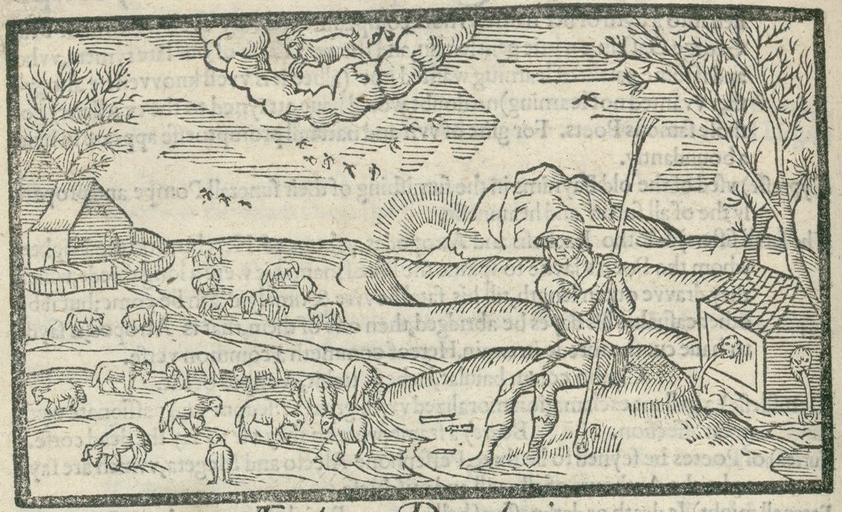
The woodcut suggests this latter reading, because it features a ‘portrayal of personal desolation, a stark image of the despondent “ego” that haunts Arcadia’ (McCabe 1995: 40). In particular, the woodcut shows Colin sitting in his signature locale, beside a stream and under a shade tree, with his flock scattered before him. Yet directly behind him is a tall mountain, from which the sun radiates brightly (whether rising or setting); December is one of only three woodcuts to include the sun (the others are Aprill and Maye), and it is the only woodcut to place the orb directly in the center of the picture. The mountain is arguably Mount Parnassus, the place of higher poetry, especially epic. Four other notable features appear. First, to the far left is a path leading from Colin and his sheep to a small building, which may be the ‘home’ referred to at the conclusion of ten of the twelve eclogues (but not December), or perhaps the ‘house’ of Rosalind in Colin’s August sestina (161; see 181). Second, a cistern sits in the right foreground, beside Colin, with its ‘leonine gargoyles . . . suggest[ing] . . . a diminishing of the monarchical lion inherited by the Tudors from Aeneas’s descendant Brutus’ (Brooks-Davies 1995: 188), a political detail noticeably absent in the eclogue itself. Third, the birds winging across the sky look to the Envoy, suggesting the ‘famous flight’ (Oct 88) in which Spenser departs from the pastoral landscape. And fourth, especially curious, is a broken pipe lying on the ground near Colin’s feet, contrasting again with the eclogue’s fiction, which shows Colin hanging his pipe in a tree.
This last image—which is the crowning action of the eclogues—epitomizes December’s complexity, because it leads in different directions (see 141n). At the end, does Colin renounce his career as a public poet, or does Spenser renounce his career as a pastoral poet in order to move on to epic? The Envoy suggests the latter, for it is ‘written in “epic” hexameters and describ[es] . . . [Spenser’s] accomplishment as if it were already a canonical text’ (Kinney 2010: 163). In December, then, as especially in June and October, Spenser both complicates a Virgilian career and transacts it. More accurately, perhaps, Spenser uses pastoral to heighten the drama around Immerito’s fitness to become England’s new poet.

;)
;)
;)
;)
;)
;)
;)
;)
;)
;)
;)
;)
;)
;)
;)
;)
;)
;)
;)
;)
;)
;)
;)
;)
;)
;)
;)
;)
;)
;)
;)
;)
;)
;)
;)
;)
;)
;)
;)
;)
;)
;)
;)
;)
;)
;)
;)
;)
;)
;)
;)
;)
;)
;)
;)
;)
;)
;)
;)
;)
;)
;)
;)
;)
;)
;)
;)
;)
;)
;)
;)
;)
;)
;)
;)
;)
;)
;)
;)
;)
;)
;)
;)
;)
;)
;)
;)
;)
;)
;)
;)
;)
;)
;)
;)
;)
;)
;)
;)
;)
;)
;)
;)
;)
;)
;)
;)
;)
;)
;)
;)
;)
;)
;)
;)
;)
;)
;)
;)
;)
;)
;)
;)
;)
;)
;)
;)
;)
;)
;)
;)
;)
;)
;)
;)
;)
;)
;)
;)
;)
;)
;)
;)
;)
;)
;)
;)
;)
;)
;)
;)
;)
;)
;)
;)
;)
;)
;)
;)
;)
;)
;)
;)
;)
;)
;)
;)
;)
;)
;)
;)
;)
;)
;)
;)
;)
;)
;)
;)
;)
;)
;)
;)
;)
;)
;)
;)