Headnote

August is unique in the Calender for its formal complexity—in structure, rhyme scheme, tone, and thus in function and significance. It becomes not merely the ‘ultimate comic distillation of Virgilian pastoral in The Shepheardes Calender’ (Bernard 1989: 68) but more precisely the book’s register for the genre of pastoral itself, unfolding the poet’s skilled authority before the nation.

The eclogue consists of four main parts: 1) in lines 1-52, Perigot and Willye engage in a dialogue over Perigot’s debilitating love for a ‘bouncing Bellibone’ (61) and select Cuddie as their judge for a singing contest; 2) in lines 53-124, the two shepherds engage in the singing contest, with Perigot voicing his suffering and Willye offering a response; 3) in lines 125-50, Cuddie then awards the prize to both shepherds and offers to ‘rehearse’ (194) Colin Clout’s song of unrequited love for Rosalind; and 4) in lines 151-95, Cuddie records Colin’s song, followed by Perigot’s ‘admir[ing]’ response (191) and Cuddie’s call for the shepherds to go ‘home’ (194).

Each of the four parts has its own rhyme scheme. The opening dialogue redeploys the six-line stanza of Januarye (ababcc), with its iambic pentameter line, although it orchestrates the layout of the rhyme scheme quite differently and with considerable complexity: in lines 1-24, Willye speaks the quatrain and Perigot the couplet; in lines 25-42, Willye speaks the six-line stanza twice and Perigot once; and then in lines 43-52 the shepherds alternate two-line units, until Cuddie concludes by voicing the stanza’s last two lines. The roundelay sung during the singing contest—arguably pastoral’s defining event—relies on a tetrameter line and consists of thirty quatrains rhyming abab, with Perigot singing the ‘a’ lines’ and Willye the ‘b’. The follow-up conversation awarding the prizes and leading up to Colin’s song redistributes the six-line stanza, with Cuddie singing all the quatrains but one and with the other two shepherds singing the couplets. Colin’s song, the showpiece of August, is an English sestina, using an unrhymed, iambic pentameter line spread across six stanzas, concluded with a three-line envoy. The form of the sestina traces to Arnaut Daniel, Dante, Petrarch, Sannazaro, and the French Pléiade, with Spenser and Sidney (in ‘Ye goteheard Gods’) vying for the title of English inventor, although Spenser’s sestina is the first to appear in print (cf. Shapiro 1980). The placement of a six-stanza poem with six lines in each stanza is appropriate to an eclogue about the sixth month of the year, according to the old calendar, which begins in March (Brooks-Davies 1995: 128). Yet it was Petrarch in the Rime Sparse who had featured the number six in his sestinas as a ‘particularly clear example of a cyclical form expressing the embeddedness of human experience in time’: the ‘recurrence of the six rhyme-words expresses the soul’s obsession with its inability to transcend time’ (Durling 1976: 17).

Nonetheless, as E.K. points out in his Argument, the key subtexts for August are the singing contests in Theocritus and Virgil, Idylls 5 and 6 and Eclogues 3 and 7. While the singing contest, known as ‘amoeboean song’, was ‘destined to become a hallmark of the bucolic poetry of Theocritus and his imitators’ (Halperin 1983: 178), it forms an unusually precise model for the imitative methodology of pastoral poetry. For the fiction of two singers competing with each other in rivalry for a prize models the way that pastoral poets produce their art in rivalry with preceding poets, the way Theocritus does with the epics of Homer (Halperin 1983: 170-89, 223-30, 237-43, 250-3). E.K. encapsulates this model—scripting a precise mimesis identifying imitation with representation—when he calls the singing contest ‘a delectable controversie, made in imitation of that in Theocritus: whereto also Virgile fashioned his third and seventh Æglogue’ (Arg 1-3).

The Theocritean link of pastoral with epic appears in displaced form in the singing contest, which notably replaces war with art, and often resolves the competition peacefully. The generic paradigm appears on one of the traditional prizes of the contest, the drinking cup, which constitutes a miniature ekphrasis (one that, for Theocritus, originates in the famed decorated shield of Achilles in the Iliad, Book 18): the self-conscious artifact of the cup represents not merely pastoral as an art form (cf. Halperin 1983: 185-7) but the agonistic epic dynamic of pastoral. Thus the ‘mazer’ that Willye offers contains two scenes, each representing a version of the epic dynamic of Spenser’s pastoral. The first depicts an ivy vine taming the ‘fiers warre’ of ‘Beres and Tygres’ (28)—‘fiers warre’ to appear in Spenser’s programmatic phrase for epic in the opening stanza of The Faerie Queene: ‘Fierce warres and faithfull loves shall moralize my song’ (I.pr.1.9). The second scene depicts a ‘shepherd swayne’ stepping in to ‘save’ a ‘Lambe in the Wolves jawes’, an act of pastoral bravery evocative of the epic heroes of Scripture, David and Christ. When Spenser says that his cup is fit for ‘any harvest Queene’ (36), he gestures to the public utility of his pastoral for Elizabeth (see 25-36n).

Spenser’s insertion of the sestina into an eclogue with a singing contest is original in the pastoral tradition, and demonstrates his competitive overgoing of the very tradition he imitates, modeled in the way that the sestina triumphs over the roundelay of Willye and Perigot. Yet it is not clear how the two songs finally relate. Do they ‘occur in the same eclogue because they work out two extremes of the pastoral assumption that love suffering is appeased or stabilized by song’ (Alpers 1985: 92)? Or do they form evidence of Spenser’s critique of such a paradise principle: ‘erotic obsession’ may be ‘the means to poetic expression’, but ‘[m]isogyny is the dark side of recreative narcissism’ (Berger 1988: 393). However construed, the eclogue does create a counterpoint on the Petrarchan theme of unrequited love as it affects the poet’s art: between the ‘light-hearted . . . mock-tragic’ tone of the roundelay, characterized by Perigot’s naïve lovelorn-ness and Willye’s splendid cynicism, and the ‘serious . . . tragedy’ of the sestina (Cullen 1970: 106-7). Whereas Perigot can be spurred into song by Willye, Colin has abandoned his art, and thus his song can only be rehearsed (see Hoffman 1977: 84). The ‘grief becomes something of a performance art’ (McCabe 1999: 549), but that art reveals something unexpected: embedded in time amid the isolated world of the forest, Colin suddenly sympathizes with Rosalind, whose ‘voyces silver sound’ (181) inspires his verse, which, unlike in Januarye or June, now recognizes the ‘misdeede, that bred her woe’ (186).

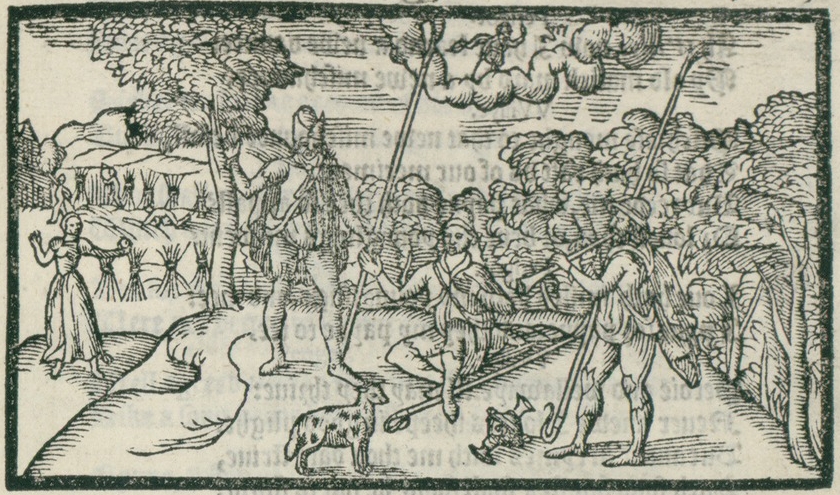
Unlike the woodcut for June, the woodcut for August is relatively straightforward, though impressively detailed. In the center are the three shepherds involved in the singing contest, with leafy foliage in the background, while in the foreground are the prizes of a ‘spotted Lambe’ (37) and a maplewood cup or ‘mazer ywrought’ (26). To the left is Venus holding the ‘golden Apple’ that E.K. identifies in his gloss on Willye’s reference to the Judgment of Paris (137-8). Since Paris had awarded the fruit to the love goddess rather than to Juno or Athena, causing the Trojan War, the reference lets a tragic tenor intrude into the narrative. Likely, Spenser alludes to the marriage between Queen Elizabeth and the French duc d’Alençon, since August is the month of Virgo (as the woodcut displays) and thus of the Virgin Queen: the depiction of the danger of desire in the woodcut, as well as in the dialogue, roundelay, and sestina, warns Elizabeth against marriage in favor of virginity (Brooks-Davies 1995: 128-9). Yet one detail is especially striking. In the upper-left corner, a male figure walks toward a building; presumably, the figure is Colin Clout, returning to the ‘house’ from which Rosalind ‘did part’ (161).

The detail suggests that August is important partly because it includes the second of three inset-songs sung by Colin, joining the Aprill lay of Queen Elisa and the November elegy on Queen Dido; thereby, it makes apparent a central question raised by the Calender: how does the ‘authour’ of the ‘book’ deploy his own self-image within the eclogue-fiction? If Colin in August is a ‘failed Orpheus’ (Brown 1972-3: 15), Spenser’s own virtuoso performance of an Orphic sestina suggests that his poetry functions as a ‘transformative . . . art’ (McCabe 1999: 550), one that builds a bridge between the individual’s faith in nature from earlier eclogues (e.g., Januarye) and a transcendent vision of the divine in November (P. Cheney 1993: 98-100). Colin’s sympathy with Rosalind forms that bridge, represented metaphorically in his identification with Philomela, who has been raped by her brother-in-law, Tereus, but who produces piercing song out of pain: ‘Hence with the Nightingale will I take part, / That blessed byrd, that spends her time of sleepe / In songs and plaintive pleas’ (183-5; see notes to 180-6). Remarkably, Colin feels sympathy for Rosalind despite the fact that—or perhaps because—his love for her remains unrequited: it is a stunning breakthrough in Petrarchan poetry, although it has a precedent in Petrarch’s discovery, voiced imaginatively after Laura dies, when she assumes status as an angel in heaven: pur per nostro ben dura ti fui (RS 341.13: ‘“still for our good was I cruel to you”’).

Finally, the sophisticated artistry of August illustrates Spenser’s competitive worthiness to address the nation of Queen Elizabeth on the relation between eros and art.
0.1calender.august.0.1 0.2calender.august.0.2 0calender.august.argument.0 1calender.august.argument.1 2calender.august.argument.2 3calender.august.argument.3 4calender.august.argument.4 5calender.august.argument.5 0calender.august.1.0 1calender.august.1 2calender.august.2 3calender.august.3 4calender.august.4 0calender.august.5.0 5calender.august.5 6calender.august.6 0calender.august.7.0 7calender.august.7 8calender.august.8 9calender.august.9 10calender.august.10 0calender.august.11.0 11calender.august.11 12calender.august.12 0calender.august.13.0 13calender.august.13 14calender.august.14 15calender.august.15 16calender.august.16 0calender.august.17.0 17calender.august.17 18calender.august.18 0calender.august.19.0 19calender.august.19 20calender.august.20 21calender.august.21 22calender.august.22 0calender.august.23.0 23calender.august.23 24calender.august.24 0calender.august.25.0 25calender.august.25 26calender.august.26 27calender.august.27 28calender.august.28 29calender.august.29 30calender.august.30 31calender.august.31 32calender.august.32 33calender.august.33 34calender.august.34 35calender.august.35 36calender.august.36 0calender.august.37.0 37calender.august.37 38calender.august.38 39calender.august.39 40calender.august.40 41calender.august.41 42calender.august.42 0calender.august.43.0 43calender.august.43 44calender.august.44 0calender.august.45.0 45calender.august.45 46calender.august.46 0calender.august.47.0 47calender.august.47 48calender.august.48 0calender.august.49.0 49calender.august.49 50calender.august.50 0calender.august.51.0 51calender.august.51 52calender.august.52 53calender.august.53 54calender.august.54 55calender.august.55 56calender.august.56 57calender.august.57 58calender.august.58 59calender.august.59 60calender.august.60 61calender.august.61 62calender.august.62 63calender.august.63 64calender.august.64 65calender.august.65 66calender.august.66 67calender.august.67 68calender.august.68 69calender.august.69 70calender.august.70 71calender.august.71 72calender.august.72 73calender.august.73 74calender.august.74 75calender.august.75 76calender.august.76 77calender.august.77 78calender.august.78 79calender.august.79 80calender.august.80 81calender.august.81 82calender.august.82 83calender.august.83 84calender.august.84 85calender.august.85 86calender.august.86 87calender.august.87 88calender.august.88 89calender.august.89 90calender.august.90 91calender.august.91 92calender.august.92 93calender.august.93 94calender.august.94 95calender.august.95 96calender.august.96 97calender.august.97 98calender.august.98 99calender.august.99 100calender.august.100 101calender.august.101 102calender.august.102 103calender.august.103 104calender.august.104 105calender.august.105 106calender.august.106 107calender.august.107 108calender.august.108 109calender.august.109 110calender.august.110 111calender.august.111 112calender.august.112 113calender.august.113 114calender.august.114 115calender.august.115 116calender.august.116 117calender.august.117 118calender.august.118 119calender.august.119 120calender.august.120 121calender.august.121 122calender.august.122 123calender.august.123 124calender.august.124 0calender.august.125.0 125calender.august.125 126calender.august.126 127calender.august.127 128calender.august.128 0calender.august.129.0 129calender.august.129 130calender.august.130 0calender.august.131.0 131calender.august.131 132calender.august.132 133calender.august.133 134calender.august.134 0calender.august.135.0 135calender.august.135 136calender.august.136 0calender.august.137.0 137calender.august.137 138calender.august.138 0calender.august.139.0 139calender.august.139 140calender.august.140 141calender.august.141 142calender.august.142 0calender.august.143.0 143calender.august.143 144calender.august.144 0calender.august.145.0 145calender.august.145 146calender.august.146 147calender.august.147 148calender.august.148 0calender.august.149.0 149calender.august.149 150calender.august.150 151calender.august.151 152calender.august.152 153calender.august.153 154calender.august.154 155calender.august.155 156calender.august.156 157calender.august.157 158calender.august.158 159calender.august.159 160calender.august.160 161calender.august.161 162calender.august.162 163calender.august.163 164calender.august.164 165calender.august.165 166calender.august.166 167calender.august.167 168calender.august.168 169calender.august.169 170calender.august.170 171calender.august.171 172calender.august.172 173calender.august.173 174calender.august.174 175calender.august.175 176calender.august.176 177calender.august.177 178calender.august.178 179calender.august.179 180calender.august.180 181calender.august.181 182calender.august.182 183calender.august.183 184calender.august.184 185calender.august.185 186calender.august.186 187calender.august.187 188calender.august.188 189calender.august.189 0calender.august.190.0 190calender.august.190 191calender.august.191 192calender.august.192 193calender.august.193 0calender.august.194.0 194calender.august.194 195calender.august.195 196calender.august.196 197calender.august.197 198calender.august.198 199calender.august.199 200calender.august.200 201calender.august.201 0calender.august.glosse.0 1calender.august.glosse.1 2calender.august.glosse.2 3calender.august.glosse.3 4calender.august.glosse.4 5calender.august.glosse.5 6calender.august.glosse.6 7calender.august.glosse.7 8calender.august.glosse.8 9calender.august.glosse.9 10calender.august.glosse.10 11calender.august.glosse.11 12calender.august.glosse.12 13calender.august.glosse.13 14calender.august.glosse.14 15calender.august.glosse.15 16calender.august.glosse.16 17calender.august.glosse.17 18calender.august.glosse.18 19calender.august.glosse.19 20calender.august.glosse.20 21calender.august.glosse.21 22calender.august.glosse.22 23calender.august.glosse.23 24calender.august.glosse.24 25calender.august.glosse.25 26calender.august.glosse.26 27calender.august.glosse.27 28calender.august.glosse.28 29calender.august.glosse.29 30calender.august.glosse.30 31calender.august.glosse.31 32calender.august.glosse.32 33calender.august.glosse.33 34calender.august.glosse.34 35calender.august.glosse.35 36calender.august.glosse.36 37calender.august.glosse.37 38calender.august.glosse.38 39calender.august.glosse.39 40calender.august.glosse.40 41calender.august.glosse.41 42calender.august.glosse.42 43calender.august.glosse.43 44calender.august.glosse.44 45calender.august.glosse.45
August.
Ægloga octauaoctava.
ARGVMENTARGUMENT.
INIn this Æglogue is setforthset forth a delectable controuersiecontroversie, made in imitation of that in Theocritus: whereto also Virgile fashioned his third &and seuenthseventh Æglogue. They choose for vmpereumpere of their strife,
Cuddie
a neatheards boye, who hauinghaving ended their cause, reciteth also himselfe a proper song, whereof
Colin
he sayth was Authour.
VVillyeWillye
.
Perigot.
Cuddie
.
TEllTell me
Perigot
,
what shalbe the game,
Wherefore with myne thou dare thy musick matche?
Or bene thy Bagpypes renne farre out of frame?
Or hath the Crampe thy ioyntsjoynts benomd with ache?
Perigot
.
Ah
Willye
,
when the hart is ill assayde,
How can Bagpipe, or ioyntsjoynts be well apayd?
VVillyeWillye
.
What the foule euillevill hath thee so bestadde?
Whilom thou was peregall to the best,
And wont to make the iollyjolly shepeheards gladde
With pyping and dauncing, didst passe the rest..
Perigot
.
Ah
Willye
now I hauehave learnd a newe daunce
:
My old musick mard by a newe mischaunce.
VVillyeWillye
.
Mischiefe mought to that newe mischaunce befall,
That so hath raft vsus of our meriment.
But reede me, what payne doth thee so appall?
Or louestlovest thou, or bene thy younglings miswent?
Perigot.Perigor.Perigot.Perigot.PERIGOT.
LoueLove hath misled both my younglings, and mee:
I pyne for payne, and they my payne to see.ſee,ſ[ée].ſee.ſee.
VVillyeWillye
.
Perdie and wellawaye: ill may they thriuethrive:
NeuerNever knewe I louerslovers sheepe in good plight.
But and if in rymes with me thou dare striuestrive,
Such fond fantsies shall soone be put to flight.
Perigot
.
That shall I doe, though mochell worse I fared:
NeuerNever shall be sayde that
Perigot
was dared..
VVillyeWillye
.
Then loe
Perigot
the Pledge, which I plight:
A mazer ywrought of the Maple warre:
Wherein is enchased many a fayre sight
Of Beres and Tygres, that maken fiers warre:
And ouerover them spred a goodly wild vine,
Entrailed with a wanton YuieYvie twine.
Thereby is a Lambe in the WoluesWolves iawesjawes:
But see, how fast renneth the shepheard swayne,
To sauesave the innocent from the beastes pawes:
And here with his shepehooke hath him slayne.
Tell me, such a cup hast thou euerever sene?
Well mought it beseme any haruestharvest Queene.
Perigot
.
Thereto will I pawne yonder spotted Lambe,
Of all my flocke there nis sike another:
For I brought him vpup without the Dambe.
But
Colin Clout
rafte me of his brother,
That he purchast of me in the playne field:
Sore against my will was I forst to yield.
VVillyeWillye
.
Sicker make like account of his brother.
But who shall iudgejudge the wager wonne or lost?
Perigot
.
That shall yonder heardgrome, and none other,
Which ouerover the pousse hetherward doth post..
VVillyeWillye
.
But for the Sunnebeame so sore doth vsus beate,
Were not better, to shunne the scortching heate?
Perigot
.
Well agreed
Willy
:
then sitte thee downe swayne:
Sike a song neuernever heardest thou, but
Colin
sing.
Cuddie
.
Gynne, when ye lyst, ye iollyjolly shepheards twayne:
Sike a iudgejudge, as
Cuddie
,
were for a king.
Perigot
.
ITIt fell vponupon a holly eueeve,
Willye
.
hey ho hollidaye,
Per.
When holly fathers wont to shrieueshrieve::
Wil
.
now gynneth this roundelay.
Per.
Sitting vponupon a hill so hye,
Wil.
hey ho the high hyll,
Per.
The while my flocke did feede thereby,
Wil.
the while the shepheard selfe did spill:
Per.
I saw the bouncing Bellibone,
Wil.
hey ho Bonibell,
Per.
Tripping ouerover the dale alone,
Wil.
she can trippe it very well:
Per.
Well decked in a frocke of gray,
Wil.
hey ho gray is greete,
Per.
And in a Kirtle of greene saye,
Wil.
the greene is for maydens meete:
Per.
A chapelet on her head she wore,
Wil.
hey ho chapelet,
Per.
Of sweete UioletsViolets therein was store,
Wil.
she sweeter 72. then: thanthenthan the UioletViolet..
Per.
My sheepe did leaueleave theyr wonted foode,
Wil.
hey ho seely sheepe,
Per.
And gazd on her, as they were wood,
Wil.
woodeWoodeWoodwood as he, that did them keepe.
Per.
As the bonilasse passed bye,
Wil.
hey ho bonilasse,
Per.
She rovderoude at me with glauncing eye,
Wil.
as cleare as the christall glasse:
Per.
All as the Sunnye beame so bright,
Wil.
hey ho the Sunne beame,
Per.
Glaunceth from Phœbus face forthright,
Wil.
so louelove into mythy hart did streame:
Per.
Or as the thonder cleauescleaves the cloudes,
Wil.
hey ho the Thonder,
Per.
Wherein the lightsome leuinlevin shroudes,
Wil.
so cleauescleaves thy soule a sonderasonder::
Per.
Or as Dame Cynthias siluersilver raye
Wil.
hey ho the Moonelight,
Per.
Upon the glyttering wauewave doth playe:
Wil.
such play is a pitteous plight.
Per.
The glaunce into my heart did glide,
Wil.
hey ho the glyder,
Per.
Therewith my soule was sharply gryde,
Wil.
such woundes soone wexen wider.
Per.
Hasting to raunch the arrow out,
Wil.
hey ho
Perigot
,
Per.
I left the head in my hart roote:
Wil.
it was a desperate shot..
Per.
There it ranckleth ay more and more,
Wil.
hey ho the arrowe,
Per.
Ne can I find saluesalve for my sore:
Wil.
louelove is a curelessecarele[ſſ]ecarelescarele[ſſ]e sorrowe.
Per.
And though my bale with death I bought,bought.bought,
Wil.
hey ho heauieheavie cheere,
Per.
Yet should thilk lasse not from my thought:
Wil.
so you may buye gold 108. to: toototoo deare.
Per.
But whether in paynefull louelove I pyne,
Wil.
hey ho pinching payne,
Per.
Or thriuethrive in welth, she shalbe mine,mine.mine.
Wil.
but if thou can her obteine.
Per.
And if for gracelesse greefe I dye,
Wil.
hey ho gracelesse griefe,
Per.
Witnesse, shee slewe me with her eye:
Wil.
let thy follye be the priefe..
Per.
And you, that sawe it, simple shepe,
Wil.
hey ho the fayre flocke,
Per.
For priefe thereof, my death shall weepe,
Wil.
and mone with many a mocke..
Per.
So learnd I louelove on a hollye eueeve,
Wil.
hey ho holidaye,
Per.
That euerever since my hart did greue.greve. greue,grieue,
Wil.
Will
WILL
nowNownowenow endeth our roundelay.
Cuddye.Cuddye,Cuddie.CVDDY.
Sicker sike a roundle neuernever heard I none.
Little lacketh
Perigot
of the best.
And
Willye
is not greatly ouergoneovergone,
So weren his vndersongsundersongs well addrest.
VVillyeWillye
.
Herdgrome, I feare me, thou hauehave a squint eye:
Areede vprightlyuprightly, who has the victorye?
Cuddie
.
Fayth of my soule, I deeme ech hauehave gayned..
For thy let the Lambe be
Willye
his owne:
And for
Perigot
so well hath hym payned,
To himhmhim be the wroughten mazer alone.
Perigot
.
Perigot
is well pleased with the doome:
Ne can
Willye
wite the witelesse herdgroome.
VVillyeWillye
.
NeuerNever dempt more right of beautye I weene,
The shepheard of Ida, that iudgedjudged beauties Queene.
Cuddie
.
But tell me shepherds, should it not yshend
Your roundels fresh, to heare a doolefull verse
Of
Rosalend
(who knowes not
Rosalend
?)
That
Colin
made, ylke can I you rehearse.
Perigot
.
Now say it
Cuddie
, as thou art a ladde::
With mery thing its good to medle sadde..
VVilly.Willy.
Fayth of my soule, thou shalt ycrouned be
In
Colins
stede, if thou this song areede:
For neuernever thing on earth so pleaseth me,
As him to heare, or matter of his deede.deede,d[ée]de.deed.
Cuddie
.
Then listneth ech vntounto my heauyheavy laye,
And tune your pypes as ruthful, as ye may..
YEYe wastefull woodes beare witnesse of my woe,
Wherein my plaints did oftentimes resound:
Ye carelesse byrds are priuieprivie to my cryes,
Which in your songs were wont to make a part:apart:
Thou pleasaunt spring hast luld me oft a sleepe,asleepe,
Whose streames my tricklinge teares did ofte augment.
Resort of people doth my greefs augment,
The walled townes do worke my greater woe:
The forest wide is fitter to resound
The hollow Echo of my carefull cryes,
I hate the house, since thence my louelove did part,
Whose waylefull want debarres myne eyes from sleepe.[ſl]eepe[ſl][ée]pe[ſl][ée]pe.ſleepe.
Let stremes of teares supply the place of sleepe:
Let all that sweete is, voyd: and all that may augment
My doole, drawe neare.. More meete to wayle my woe,
Bene the wild woddes my sorrowes to resound,
167. Then: ThanThenThan bedde, or bowre, both which I fill with cryes,
When I them see so waist, and fynd no part
Of pleasure past. Here will I dwell apart
In gastfull grouegrove therefore, till my last sleepe
Doe close mine eyes: so shall I not augment
With sight of such a chaunge my restlesse woe:
Helpe me, ye banefullbanefnllbaneful byrds, whose shrieking sound
Ys signe of dreery death, my deadly cryes
Most ruthfully to tune. And as my cryes
(Which of my woe cannot bewray least part)
You heare all night, when nature crauethcraveth sleepe,
Increase, so let your yrksome yells augment..
Thus all the night in plaints, the daye in woe
I vowed hauehave to wayst, till safe and sound
She home returne, whose voyces siluersilver sound
To cheerefull songs can chaunge my cherelesse cryes.
Hence with the Nightingale will I take part,
That blessed byrd, that spends her time of sleepe
In songs and plaintiueplaintive pleas, the more taugment
The memory of hys misdeede, that bred her woe:
And you that feele no woe, | when as the sound
Of these my nightly cryes | ye heare apart,
Let breake your sounder sleepe | and pitie augment.
Perigot
.
O
Colin
,
Colin
,
the shepheards ioyejoye,
How I admire ech turning of thy verse:
And
Cuddie
,
fresh
Cuddie
the liefest boye,
How dolefully his doole thou didst rehearse.
Cuddie
.
Then blowe your pypes shepheards, til you be at home:
The night nigheth fast, yts time to be gone.
Perigot
his Embleme.
Vincenti gloria victi.
Willyes
Embleme.
Vinto non vitto.
Cuddies
Embleme.
Felice chichj puo.
GLOSSEGLOSSE.GLOSSE.
Bestadde) disposed, ordered.
Peregall) equall.
VVhilomeWhilome) once.
Rafte) bereft, depriueddeprived.
MisvventMiswent) gon a strayeastraye.
Ill may) according to Virgile.
In felixInfelix o semper ouisovis pecus.
A mazer) So also do Theocritus and Virgile feigne pledges of their strife.
Enchased) engrauenengraven. Such pretie descriptions eueryevery vvherewhere vsethuseth Theocritus, to bring in his Idyllia. For which speciall cause indede he by that name termeth his Æglogues: for Idyllion in Greke signifieth the shape or picture of any thyng, vvherofwherof his booke is ful. And not, as I hauehave heard some fondly guesse, that they be called not Idyllia, but Hædilia, of the Goteheards in them.
Entrailed) vvroughtwrought betvvenebetwene.
HaruestHarvest Queene) The manner of country folke in haruestharvest tyme.
Pousse.)Pousse) Pease.
It fell vponupon)
Perigot
maketh hys song in prayse of his louelove, to vvhõvvhomwhõwhom VVillyWilly answereth eueryevery vnderunder verse. By
Perigot
vvhowho is meant, I can not vprightlyuprightly say: but if it be, vvhowho is supposed, his love deseruethdeserveth no lesse prayse, 22. then: thanthenthan he giuethgiveth her.
Greete) weeping and complaint.
Chaplet) a kind of Garlond lyke a crovvnecrowne.
LeuenLeven) Lightning.
Cynthia) vvaswas sayd to be the Moone.
Gryde) perced.
But if) not vnlesseunlesse.
Squint eye) partiall iudgementjudgement.
Ech hauehave) so saith Virgile.
Et vitula tu dignus, et hic &c.etc.
So by enterchaunge of gyfts
Cuddie
pleaseth both partes.
Doome) iudgementjudgement.
Dempt) for deemed, iudgedjudged.
VViteWite the vvitelessewitelesse) blame the blamelesse.
The shepherd of Ida) vvaswas sayd to be Paris.
Beauties Queene) Venus, to vvhomewhome Paris adiudgedadjudged the goldengoldden Apple, as the pryce of her beautie.
Embleme.
The meaning hereof is very ambiguous: for
Perigot
by his poesie claming the cõquestconquest, &and
VVillyeWillye
not yeelding,
Cuddie
the arbiter of theyr cause, and Patron of his own, semeth to chalenge it, as his devvdew, saying, that he, is happy vvhichwhich can, so abruptly ending but hee meaneth eyther him, that can vvinwin the beste, or moderate him selfe being best, and leaueleave 45. of: offofoff vvithwith the best.
1. delectable: delightful
3. vmpere: umpire
4. neatheards: cowherd’s
4. cause: contest
5. proper: excellent; belonging distinctively to someone; fitting the circumstance
1. game: prize, reward for victory
2. Wherefore: for which
3. renne: run
3. frame: tune; order
7. bestadde: E.K.
8. Whilom: E.K.
8. peregall: E.K.
10. passe: surpass
14. raft: E.K.
16. younglings: young lambs
16. miswent: E.K.
19. Perdie . . . plight: E.K.
19. wellawaye: alas
21. But and if: but if
23. mochell: much
24. dared: daunted, paralyzed (with fear)
25. Pledge: promise
26. mazer: E.K.
26. warre: knot, burr, i.e., burr-maple
31. Thereby: nearby
32. renneth: runs
36. haruest Queene: E.K.
38. nis sike another: ‘Is not another like him’.
39. Dambe: dam, mother
46. pousse: E.K.
47. But for: because
53. It fell vpon: E.K.
53. holly: holy
60. selfe did spill: spent his time--or speech--fruitlessly
61. Bellibone: girl, bonny lass, fair maid
67. Kirtle: skirt
67. saye: good cloth
70. chapelet: E.K.
79. rovde at: roved at, pierced, assaulted
89. Cynthias: E.K.
92. pitteous plight: moving effect; pathetic state of affairs
95. gryde: E.K.
97. raunch: pull, pluck
99. hart roote: bottom of the heart
100. desperate: causing despair
104. curelesse: incurable
107. should . . . thought: ‘The girl would not leave my thoughts’.
110. pinching: biting; distressful
112. but if: E.K.
120. mocke: scornful gesture or utterance
125. Sicker sike: certain such
125. roundle: roundelay
126. lacketh: needs; falls short
127. ouergone: surpassed
128. vndersongs: burdens, (poetic) refrains
128. addrest: ordered, arranged; dressed
129. squint eye: E.K.
130. Areede vprightly: judge fairly
131. ech haue: E.K.
131. gayned: won
133. for: because;payned: taken such pains
134. wroughten: fashioned, ornamented
134. alone: exclusively
135. doome: E.K.
136. wite the witelesse: E.K.
137. dempt: E.K.
138. shepheard of Ida: E.K.
138. beauties Queene: E.K.
139. should: would
139. yshend: put to shame
140. fresh: novel, lively, invigorating
142. ylke: the same
142. rehearse: recite, perform
144. medle: mix
145. ycrouned: crowned
148. matter . . . deede: 'subject matter of his making'
154. make a part: contribute a constituent voice.
161. part: depart
162. want: lack, absence
164. voyd: withdraw, clear away
165. doole: sorrow
167. bowre: bedchamber
170. gastfull: dreadful, frightful
174. deadly: deathly, mortal
175. ruthfully: pitiably
188. apart: in the distance; away from others
189. sounder: sound, deep, or profound
191. admire: feel wonder
18. Pousse: Pulse, field of peas (dialect).
32. enterchaunge: exchange
38. pryce of: award or trophy for
43. dew: due
45. leaue of with: be content with, end with
0.Perigot.] Perigor. 1579; ~ 1581, 1591, 1597; Perigot. 1586; PERIGOT 1611
18.see.] ſee, 1579; ſ[ée]. 1581, 1591, 1597; ſee. 1586; ſee. 1611
76.woode] Woode 1579, 1581, 1586; W[oo]d 1591, 1597; wood 1611
84.my] 1579, 1581, 1586, 1591, 1597; thy 1611
104.curelesse] carele[ſſ]e 1579, 1581, 1586, 1597; careles 1591; carele[ſſ]e 1611
105.bought,] bought. 1579; ~ 1581, 1586, 1591, 1597; bought, 1611
111.mine,] mine. 1579, 1581, 1586, 1597; ~ 1591; mine. 1611
123.greue. [|] Wil. Now] greue. [|] Wil.now 1579; greue. [|] Wil. nowe 1591; greue. [|] Wil. now 1586; greue, [|] Will. now 1591, 1597; grieue, [|] WILL now 1611
0.Cuddye.] Cuddye, 1579; Cuddie. 1581, 1586, 1591, 1597; CVDDY. 1611
134.him] hm 1579; ~ 1581, 1586, 1591, 1597; him 1611
148.deede.] deede, 1579, 1581; d[ée]de. 1586, 1597; deede. 1591; deed. 1611
173.banefull] banefnll 1579; ~ 1581, 1586, 1591, 1597; baneful 1611
201.chi] chj 1579; ~ 1581, 1586, 1591, 1597, 1611
0.GLOSSE] 1579; GLOSSE. 1581, 1586, 1591, 1597; GLOSSE. 1611
37.goldden] 1579; golden 1581, 1586, 1591, 1597, 1611
1 delectable controuersie: The oxymoron draws attention to the function of the singing match, delight intermixed with instruction (a humorous version of Horace’s famous dictum). The phrase also puns on the form of the counter-verses, and, in its own way, emphasizes the motif of harmony-from-conflict illustrated in the first of the mazer's two scenes.
1 made in imitation: The first Argument to identify the poet’s artistic method: ‘imitation’ (see also Nov Arg).
2 Theocritus: Cf. Idylls 5 and 6 but also 8, 9, and 27 (see headnote).
2 Virgile: In addition to Ecl 3 and 7, see 5, 8, and 9 (see headnote).
3 vmpere: Cf. ‘judge’ at 53. Perhaps a play on ‘peer’; cf. ‘peregall’ at line 8.
4 reciteth: See ‘rehearse’ at 142 and 193.
2 dare . . . matche: Spenser’s language of poetic rivalry recurs at 21-4.
3 frame: For ‘frame’ as always part of Spenser’s language of poetic craft in the Calender, see Jan 10; June 55 and 78; Oct 25; Dec 68, 77, and 115.
3 Bagpypes: Cf. the woodcut, which depicts a shawm.
8 peregall: Cf. Chaucer, TC 5.839-40: ‘His herte ay with the first and with the beste / Stood paregal, to durre don that hym leste’.
10 passe: Cf. June 74.
11 Ah . . . daunce: While recurrent in literature (‘almost proverbial’ [Renwick, Var 7: 341), Perigot’s phrase ‘newe daunce’ may more directly speak to the idiom of the medieval tradition of ‘the old daunce’ (the game of love), as at Chaucer, GP 477-8, said of the Wife of Bath: ‘Of remedies of love she knew per chaunce, / For she koude of that art the old daunce’.
14 raft: The spelling raft occurs here and again at 40. The word reft appears many times elsewhere (e.g., Daph, where it is repeated distinctively at l159, 160, 162, then a final time at 220).
26–36 Cf. Theocritus, Idylls 1.27-56; Virgil, Ecl 3.36-48. Willye’s cup depicts two emblematic scenes: in the first, an ivy vine creates harmony out of the havoc wreaked by bears and tigers; in the second, a shepherd saves a lamb from the jaws of a wolf. The two-scene emblem presents a ‘familiar aesthetic’: ‘art acquires the power to draw harmony out of conflict by removing itself from the world, but this withdrawal must be followed by a renewed commitment to action. More simply, art must teach as well as please’ (D.L. Miller 1979: 229). The details of the scenes, so intricate and lifelike, suggest that Spenser may have inspected ‘actual mazers’ (Tuve, Var 7: 342).
28–30 Of Beres . . . twine: Bears and tigers, often linked but also opposed as enemies (cf., e.g., FQ II.ii.22.5-9), signify both wrath and sexual energy (Rowland 1973: 33, 151). The vine and ivy evoke Bacchus, god of wine, lust, and amorous excess. The vine here also performs the traditional role of Orpheus, taming wild beasts by art.
28 fiers warre: Cf. FQ I.pr.1.9: ‘Fierce warres and faithfull loves shall moralize my song’ (see headnote).
32 shepheard swayne: The phrase describes both Immerito at To His Booke 9 and Colin at Apr 98 (Lane 1993: 177n5). The phrase appears subsequently (e.g., at Julye 5 and Dec 44).
33 saue the innocent from the beastes pawes: Inescapably evokes Christ the Good Shepherd, thus suggesting a salvific role for art.
37 Thereto . . . Lambe: Cf. Virgil, Ecl 3.29-31.
40–42 raft me . . . forst to yield: The detail anticipates mention of Colin at 50 and the singing of his song later, as well as highlighting his superiority as a community singer. The eclogue fictionalizes a complex hierarchy of poetic authority, in this order: Tityrus, Colin, Cuddie, Perigot, Willye.
41 purchast . . . playne field: ‘Won from me on level ground’, i.e., fairly.
43 Sicker . . . brother: ‘Assume that the same will happen to his brother’.
45 heardgrome: Cf. the description of Cuddie at Feb 35.
53–124 It fell vpon a holly eue . . . endeth our roundelay: ‘Spenser was writing with a popular tune in his mind’, probably ‘an old tune called “Heigh ho, holiday” to which one of the songs in Deloney’s Garland of Good Will (1593) is to be sung’ (Pattison, Var 7: 346). The roundelay was reprinted in England’s Helicon (1600), and ‘became speedily popular and aided in correcting the roughness and gravity of our earlier style’, the ‘dialogue in rhyme . . . a feat greatly more difficult than the “stichometry” of the Athenian drama’ (Palgrave, Var 7: 338). For Henry Constable’s imitation of the roundelay, see Var 7: 339.
55 wont . . . shrieue: ‘[C]ustomarily hear confession: the feast could be that . . . under the auspices of Virgo, the Nativity of the Blessed Virgin, 8 September, on the eve of which Queen Elizabeth was born. Note that this roundelay . . . is thus located in a Cranmerian rather than progressive Protestant landscape’ (Brooks-Davies 1995: 132).
57–63 hill . . . dale: The landscape especially of June and Julye.
61 I saw the bouncing Bellibone: Perigot’s Petrarchan sight of a beautiful female recalls Colin’s epiphany of Queen Elisa in Aprill and anticipates that of Queen Dido in November. Spenser uses the word ‘Bellibone’ earlier only at Apr 92; together, the two examples are the first of three cited by OED, which adds: ‘corruption of French belle bonne or belle et bonne fair and good; if not a humorous perversion of bonnibel’.
66 hey ho . . . greete: Cf. Drayton, Pastorals, Eclogue 4, on Dowsabell: ‘She ware a Frock of frollicke green, / Might well become a Mayden Queene, / Which seemly was to see’ (Var 7: 346).
71 Uiolets: Flower of love and modesty.
81–92 All as the Sunnye beame . . . piteous plight: A sustained set of similes, comparing the effect of the Bellibone’s ‘glauncing eye’ (itself compared to crystal at 81) on Perigot: first to a sunbeam, next to lightning, and finally to moonlight striking a wave. The elaborate comparison draws attention to the way erotic desire creates poetic art.
87 lightsome leuin shroudes: ‘Radiant lightning hides itself’ (McCabe 1999: 551).
89 Cynthias: Cf. Apr 82.
93 glaunce . . . glide: The two words form a familiar link in battle descriptions (see FQ III.ix.25.5n).
94 glyder: An unusual word in English at this time, used uniquely to describe the glance as an object performing an action (cited OED).
95 gryde: Cf. Apr 82.
103–104 Ne can I find salue . . . curelesse sorrowe: Pinpoints a key question raised by the eclogue, both here and regarding Colin’s sestina: can singing about unfulfilled desire be therapeutic (‘find salve’)? At 143-4, Perigot appears to change his mind; see note on these lines and on 190-3. Cf. Oenone’s complaint to Paris in Ovid, Heroides 5.149: me miseram, quod amor non est medicabilis herbis! (‘Alas, wretched me, that love may not be healed by herbs!’). For Paris, cf. 137-8, Julye 146-7.
104 curelesse The reading in 1579, although traditionally unchallenged, sharply contradicts the theme of the psychological burdens of love, hence our emendation, which extends the figure in the previous line.
110 pinching: Cf. Apr 18.
113 gracelesse greefe: ‘Grief’ that ensues when ‘grace’ or favor is withheld.
125 roundle: Cf. Chaucer, LGW F 422-3: ‘And many an ympne, for your halydayes, / That highten balades, roundels, virelayes’. See Apr [33]n.
128 vndersongs: cf. ‘overgone’ in the preceding line. Spenser will go on to use the word ‘undersong’ distinctively, e.g., Daph 245; CCCHA 169; Proth 110.
136 wite the witelesse: Cf. June 100 and E.K.’s gloss.
138 shepheard of Ida: See Julye 145-52.
141 Of Rosalend (who knowes not Rosalend?): Spenser will re-deploy the rhetorical device famously at FQ VI.x.16.4: ‘Of Colin Clout (who knowes not Colin Clout?)’; TCM VII.vi.36.6: ‘Of Arlo-hill (Who knowes not Arlo-hill?)’. Puttenham, Arte of English Poesy, discusses erotesis under erotema or the questioner, ‘speaking indeed by interrogation which we might as well say by affirmation’ (296).
142 rehearse: Cf. 193.
143 ladde: According to OED, both a ‘young shepherd’ in ‘pastoral poetry’ and ‘a man of spirit and vigour’.
144 With mery thing its good to medle sadde: Identifies the love sickness of Perigot and Willye’s roundelay as ‘mery’ in comparison to the sadness of Colin’s sestina (Cullen 1970: 108). Cf. Apr 68, Maye 263, and Julye 209.
151–189 Ye wastefull . . . pitie augment: The sestina modifies the Petrarchan sestina at RS 22, 30, 66, 80, 142, 214, 237, 239, and 332 [a double sestina]), where the rhyme scheme of six words—e.g., at RS 237, Italian words for waves (‘onde’) moon (‘luna’), night (‘notte’), woods (‘boschi’), meadow (‘piaggia’), evening (‘sera’)--follows no particular order after the first stanza, except for the repetition in the first line of the second stanza of the last line in the first (e.g., 123456 615243 364125). In contrast, Colin’s rhyme scheme follows the strict order of its six rhyme-words—woe, resound, cryes, part, sleepe, augment—in this order: 123456 612345 561234, etc. The final tercet uses only 246, a direct imitation of Petrarch’s tercet. Possibly, ‘Spenser’s simple end-word scheme . . . is . . . borrowed from the sixteenth-century Spanish poet Gutierre de Cetina’ (Brooks-Davies 1995: 136). Nowhere in the Calender is the contrast between the fiction of a dejected Colin and the virtuosity of Spenser greater. E.K. does not gloss Colin’s sestina, suggesting that Spenser may have added it late in the process of publication, perhaps in response to Sidney’s sestina, ‘Ye Goteherd gods’.
151–156 Ye wastefull woodes . . . ofte augment: The image of Colin singing his songs in the natural locale of woods, birds, and spring recalls his habitual position throughout the Calender (see especially Apr 33-6, June 1-8 and 49-64).
157–174 Resort of people . . . my deadly cryes: Colin turns from society and community to self and alienation, from ‘walled townes’ (158) to ‘gastfull grove’ (170), from the domain of epic to that of pastoral, concluding, ‘Here will I dwell apart’ (169).
159–160 resound . . . Echo: The Orphic formula of the woods resounding. See 180-6n.
161 I hate the house, since thence my loue did part: A domestic parallel to Orpheus’ loss of Eurydice.
173–174 byrds . . . death: Owls and ravens were birds of ill omen.
180–186 till safe and sound . . . bred her woe: A significant change from June 97-101, where Colin imagines his complaint harming Rosalind. Here the graceful poetry imagines Rosalind coming home again and using her beautiful voice to ‘chaunge’ Colin’s ‘cherelesse cryes’ to ‘cheerefull songs’. This fantasy, which never materializes in the fiction of the Calender, prepares for Colin’s identification with Philomela: ‘Hence with the Nightingale will I take part’. Philomela is the Athenian princess raped by her brother-in-law, Tereus; after she and her sister, Procne, take revenge on him, they escape, and metamorphose into birds: Philomela, into the nightingale; Procne, into the swallow. Because Philomela uses harmonious song to express deep sorrow, she becomes a Western icon of the poet’s power to convert tragedy into art. See Ovid, Met 6.424-674; yet Spenser’s key source-texts are Virgil, Georg 4.511-3; Petrarch, RS 311; Gascoigne, Complaint of Philomene. The Georgics is most important for associating Orpheus, a poet who has lost his wife, with Philomela, a woman who has been raped, thus making Spenser’s representation ‘Orphic’ (Brown 1972-3: 14-6). Yet Spenser differs from his sources in transposing the nightingale to pastoral, where the bird becomes especially associated with Colin (Nov 25, 141, and Dec 79), and evokes a poet progressing from pastoral to epic (P. Cheney 1993: 98-107). The phrase ‘blessed byrd’ draws attention to Colin’s sympathy with the raped nightingale and with the departed Rosalind (see headnote).
181 siluer sound: On this phrase, see June 61n. There, the Muses, and especially Calliope, Muse of epic, hear a ‘silver sound’, drop their musical instruments, and rush to find the cause of it, but are taken aback when they find a lowly shepherd, Colin Clout. Here in August, Spenser traces the origin of Colin’s silver art—a trope for the paradox that a lowly pastoral poet can sound the heightened note of epic—to Rosalind, with her ‘voyces silver sound’. Cf. Apr 46 and note, where Spenser links Colin’s ‘silver song’ with Queen Elisa.
189 pitie augment: Colin’s address to ‘you that feele no woe’, and his request that they augment their pity for him, constitutes a change: now he uses song to express his willingness to rejoin the pastoral community.
191 turning . . . verse: ‘Frame your verse line endings’ in accord with the sestina form (McCabe 1999: 552).
197 Vincenti gloria victi: ‘The glory of the vanquished goes to the conqueror’.
199 Vinto non vitto: It, ‘Conquered, not defeated’.
201 Felice . . . puo: ‘Let him be happy who can be', although, as E.K. observes, the meaning is ambiguous.
7 Infelix . . . pecus: ‘Poor sheep, ever luckless flock!’ (Virgil, Ecl 3.3).
8 Theocritus and Virgile: Theocritus, Idylls 1.23-56, 5.20-30; Virgil, Ecl 3.35-48.
29 Squint eye: A sign of envy.
31 Et . . . hic: ‘You deserve the heifer, and he also’ (Virgil, Ecl 3.109).
Building display . . .
Re-selecting textual changes . . .

Introduction

The toggles above every page allow you to determine both the degree and the kind of editorial intervention present in the text as you read it. They control, as well, the display of secondary materials—collational notes, glosses, and links to commentary.

Textual Changes

The vagaries of early modern printing often required that lines or words be broken. Toggling Modern Lineation on will reunite divided words and set errant words in their lines.

Off: That a large share it hewd out of the rest, (blest.And glauncing downe his shield, from blame him fairely (FQ I.ii.18.8-9)On: That a large share it hewd out of the rest,And glauncing downe his shield, from blame him fairely blest.

Toggling Expansions on will undo certain early modern abbreviations.

Off: Sweet slõbring deaw, the which to sleep them biddes:(FQ I.i.36.4)On: Sweet slombring deaw, the which to sleep them biddes:

Toggling Modern Characters on will convert u, v, i, y, and vv to v, u, j, i, and w. (N.B. the editors have silently replaced ſ with s, expanded most ligatures, and adjusted spacing according contemporary norms.)

Off: And all the world in their subiection held,Till that infernall feend with foule vprore(FQ I.i.5.6-7)On: And all the world in their subjection held,Till that infernall feend with foule uprore

Toggling Lexical Modernizations on will conform certain words to contemporary orthographic standards.

Off: But wander too and fro in waies vnknowne(FQ I.i.10.5)On: But wander to and fro in waies vnknowne.

Toggling Emendations on will correct obvious errors in the edition on which we base our text and modernize its most unfamiliar features.

Most lothsom, filthie, foule, and full of vile disdaine(FQ I.i.14.9)14.9. Most lothsom] this edn.;Mostlothsom 1590

(The text of 1590 reads Mostlothsom, while the editors’ emendation reads Most lothsom.)

Apparatus

Toggling Collation Notes on will highlight words that differ among printings.

And shall thee well rewarde to shew the place,(FQ I.i.31.5)5. thee] 1590; you 15961609

(The text of 1590 reads thee, while the texts of 1596 and 1609 read you.)

Toggling Commentary Links on will show links to the editors’ commentary.

Toggling Line Numbers on will show the number of the line within each stanza.

Toggling Stanza Numbers on will show the number of the stanza within each canto.

Toggling Glosses on will show the definitions of unfamiliar words or phrases.

To my long approoved and singular good frende, Master G.H.(Letters I.1)1. long aprooved: tried and true,found trustworthy over along period
v2026-4-14_13:20