Headnote

Aprill is the second of six Colin Clout eclogues (with Jan, June, Aug, Nov, and Dec), and features a narrative about the role of the shepherd-poet in his rural community. Whereas Januarye has presented Colin’s private, amorous courtship of Rosalind, Aprill presents his professional, political courtship of Queen Elisa, identified in the Argument as a representation of Queen Elizabeth (Montrose 1979: 39). The relationship between poet and monarch comes front and center, emphasizing their reciprocity in the making of each other: poetry shapes monarchy; and monarchy shapes poetry (Montrose 1986).

Spenser represents this relationship through a complex three-part structure. In lines 1-36, two shepherds who have appeared previously, Thenot and Hobbinol, engage in a dialogue about Colin: whereas Hobbinol weeps that his friend has turned away from him to Rosalind and now has abandoned his art, Thenot cheerfully asks to hear one of Colin’s songs. In lines 37-153, Hobbinol then ‘recorde[s]’ (Arg and line 30) Colin’s ‘laye / Of fayre Elisa, Queene of shepheardes all’ (33-4). Finally, in lines 154-61 Thenot and Hobbinol agree that Colin has been foolish to sacrifice his art to unrequited love.

To offset the inset-lay from the dialogue, Spenser modulates prosody intricately. The dialogue proceeds through a four-line stanza (or quatrain) of often rough-sounding alliterative verse (the opening line reads, ‘what garres thee greete?’) in a generally iambic pentameter line, rhyming abab. In contrast, Colin’s lay proceeds through an elaborately devised thirteen-stanza unit with each stanza having nine lines, rhyming ababccddc, alternating long and short lines: the first, third, fifth, and sixth are generally in iambic pentameter; the second, fourth, seventh, and eighth, generally in iambic dimeter; and the ninth, generally in iambic tetrameter. It is a remarkable premonition of the nine-line stanza of The Faerie Queene (known as ‘the Spenserian stanza’), and is original to English literature. The effect of the eclogue’s full metrical design is to draw attention to the superiority of the poet—both Colin and Spenser—in the presence of his peers (and sovereign).

Clearly, then, the showpiece of the eclogue is Colin’s lay of Elisa. The lay had a substantial contemporary reception, discussed, e.g., by Abraham Fraunce in his 1588 The Lawiers Logike (sig. Jiiir-Jiiijv) and anthologized in the 1600 England’s Helicon (sig. Cb). In the 1586 Discourse of English Poetrie, William Webbe discusses the lay and curiously turns it into Sapphics (sig. Jiir-Jiiijr), while in his Lay to Beta, on Elizabeth (Shepheards Garland, Eclogue 3), Michael Drayton offers a clear imitation. Milton, too, was attracted to Aprill, as revealed by both Lycidas and Arcades (Var 7: 280). Indeed, Colin’s lay qualifies as ‘one of the chief beauties of The Shepheards Calender, and of Elizabethan verse at large’ (Herford, Var 7: 275). Further, the ‘blazon of Elisa in the “April” eclogue has become one of the most famous of all the poetic images of the Virgin Queen. But retrospect has made it hard to remember that the cult of Elizabeth as maiden goddess was still a relatively new phenomenon’ (Norbrook 2002: 74). In particular, Colin’s lay joins his August sestina on Rosalind and his elegy on Dido in November in ‘stand[ing] out as staking an English claim in the poetry of the European Renaissance’ (Alpers 1996: 182).

Colin’s lay is the first version of what will recur famously throughout the Spenser canon: a detailed masculine representation of the female body (cf. Micros 1993), indebted to European traditions of the blazon, which here traces to the Song of Solomon and to Petrarch’s Rime Sparse (e.g., 90, 157, and 200). Yet Spenser’s specific precedents for celebrating a monarch come from classical pastoral, Scripture, and continental pastoral: the praise of a ruler in Theocritus, Idylls 17, the ‘Encomium to Ptolemy’; the celebration of the princely Roman babe as the herald of the return of the Golden Age in Virgil, Eclogues 4 (the so-called ‘Messianic eclogue’, because Christians interpreted the babe as Jesus); the lovely description of the beloved’s female body in the Song of Solomon; and the lament for the death of a beloved sovereign in Marot’s Complainct de Madame Loyse. In the background as well may be Richard Mulcaster’s The passage of our most drad Soueraigne Lady Quene Elyzabeth, through the citie of London (1558 = 1559), which ‘describes Elizabeth’s passage past a succession of elaborate symbolic pageants’ that emphasize ‘the mutuality of the love displayed by Elizabeth and her people’: ‘Mulcaster’s pamphlet has much in common with Virgil’s fourth eclogue, joyously heralding a reign which promises to bring peace and prosperity to the nation’ (Pugh 2016: 117, 122; see 116-24). As the scriptural precursor text hints, Colin’s lay, while formally a praise poem, is indebted to the tradition of the wedding hymn or ode, known as the epithalamium. Yet the eclogue’s double structure of dialogue-and-song suggests a compound depiction of the poet in relation with the monarch. On the one hand, Aprill tells a triumphal story about Colin’s use of his art to praise his sovereign, depicting an idealized poet-monarch relation, which presumably becomes useful to Spenser in advertising his address to the queen and important to the leadership he offers to other poets. On the other hand, Aprill tells a disastrous story about the poet’s unrequited love for Rosalind as impeding this very model, thereby tempering the idealization through lament.

Is Aprill, then, a praise poem (Cain 1978: 14-24), or a poem of ‘resistance’ relying on ‘the “doubleness”’ of ‘camouflage’ (Norbrook 2002: 78-80)? For that matter, is the subject of the eclogue Elizabeth as ‘queen of England and head of the English church’, with ‘the panegyric ode . . . the closest The Shepheardes Calender comes to expressing a complete and idyllic unity of nation and church’ (Halpern 1991: 205); or does Aprill present the political leader as ‘a personification of pastoral poetry’, with Spenser emphasizing ‘Elizabeth’s status as an ideal image created by the poet’ (Montrose 1979: 40-1)?

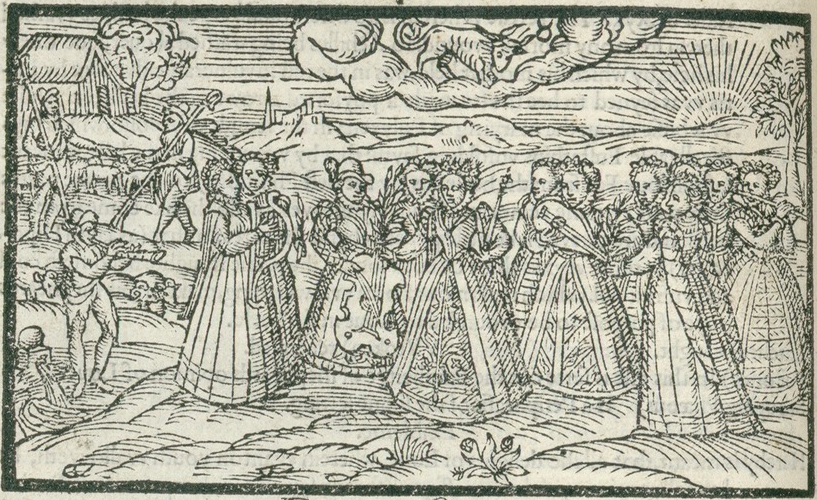
Although the eclogue is rich enough to sustain affirmative answers to all of these questions, the woodcut emphasizes the latter interpretation. It presents the queen standing in the center, surrounded by ten dancing ladies holding musical instruments, suggesting the classical Muses, while Colin stands off to the left, facing the dance and playing his pipe, his smaller scale suggesting that he conjures up the vision with his art. Above Colin, in the background, are Thenot and Hobbinol, with their sheep in front of them and the house to which they return at the end behind them (160). Yet even further in the background, toward the middle and on a hill, stands an imperial city, reminding viewers that ‘“Aprill” serves to predict the heroic poem that was already being composed’ (Oram 1989: 69). At the top, and centered, is the zodiacal sign of Taurus, the Bull, a reference to the myth of Jupiter disguising himself as a bull to carry off the beautiful girl Europa, which Ovid uses to tell how ‘“majesty and love” do not go well together’, a warning to Elizabeth about the dangers of marrying the French Duc d’Alençon (McCabe 1999: 530, quoting Met 2.846-7; see Brooks-Davies 1995: 64).

For its complex artistic design, its bifurcated representation of a relationship at the heart of sixteenth-century literature, and its importance within a long reception history, Aprill commands attention as a set piece of the Calender and of English poetry.
0.1calender.april.0.1 0.2calender.april.0.2 0calender.april.argument.0 1calender.april.argument.1 2calender.april.argument.2 3calender.april.argument.3 4calender.april.argument.4 5calender.april.argument.5 6calender.april.argument.6 7calender.april.argument.7 8calender.april.argument.8 9calender.april.argument.9 10calender.april.argument.10 11calender.april.argument.11 0calender.april.1.0 1calender.april.1 2calender.april.2 3calender.april.3 4calender.april.4 5calender.april.5 6calender.april.6 7calender.april.7 8calender.april.8 0calender.april.9.0 9calender.april.9 10calender.april.10 11calender.april.11 12calender.april.12 13calender.april.13 14calender.april.14 15calender.april.15 16calender.april.16 0calender.april.17.0 17calender.april.17 18calender.april.18 19calender.april.19 20calender.april.20 0calender.april.21.0 21calender.april.21 22calender.april.22 23calender.april.23 24calender.april.24 25calender.april.25 26calender.april.26 27calender.april.27 28calender.april.28 0calender.april.29.0 29calender.april.29 30calender.april.30 31calender.april.31 32calender.april.32 0calender.april.33.0 33calender.april.33 34calender.april.34 35calender.april.35 36calender.april.36 37calender.april.37 38calender.april.38 39calender.april.39 40calender.april.40 41calender.april.41 42calender.april.42 43calender.april.43 44calender.april.44 45calender.april.45 46calender.april.46 47calender.april.47 48calender.april.48 49calender.april.49 50calender.april.50 51calender.april.51 52calender.april.52 53calender.april.53 54calender.april.54 55calender.april.55 56calender.april.56 57calender.april.57 58calender.april.58 59calender.april.59 60calender.april.60 61calender.april.61 62calender.april.62 63calender.april.63 64calender.april.64 65calender.april.65 66calender.april.66 67calender.april.67 68calender.april.68 69calender.april.69 70calender.april.70 71calender.april.71 72calender.april.72 73calender.april.73 74calender.april.74 75calender.april.75 76calender.april.76 77calender.april.77 78calender.april.78 79calender.april.79 80calender.april.80 81calender.april.81 82calender.april.82 83calender.april.83 84calender.april.84 85calender.april.85 86calender.april.86 87calender.april.87 88calender.april.88 89calender.april.89 90calender.april.90 91calender.april.91 92calender.april.92 93calender.april.93 94calender.april.94 95calender.april.95 96calender.april.96 97calender.april.97 98calender.april.98 99calender.april.99 100calender.april.100 101calender.april.101 102calender.april.102 103calender.april.103 104calender.april.104 105calender.april.105 106calender.april.106 107calender.april.107 108calender.april.108 109calender.april.109 110calender.april.110 111calender.april.111 112calender.april.112 113calender.april.113 114calender.april.114 115calender.april.115 116calender.april.116 117calender.april.117 118calender.april.118 119calender.april.119 120calender.april.120 121calender.april.121 122calender.april.122 123calender.april.123 124calender.april.124 125calender.april.125 126calender.april.126 127calender.april.127 128calender.april.128 129calender.april.129 130calender.april.130 131calender.april.131 132calender.april.132 133calender.april.133 134calender.april.134 135calender.april.135 136calender.april.136 137calender.april.137 138calender.april.138 139calender.april.139 140calender.april.140 141calender.april.141 142calender.april.142 143calender.april.143 144calender.april.144 145calender.april.145 146calender.april.146 147calender.april.147 148calender.april.148 149calender.april.149 150calender.april.150 151calender.april.151 152calender.april.152 153calender.april.153 0calender.april.154.0 154calender.april.154 155calender.april.155 156calender.april.156 157calender.april.157 0calender.april.158.0 158calender.april.158 159calender.april.159 160calender.april.160 161calender.april.161 162calender.april.162 163calender.april.163 164calender.april.164 165calender.april.165 0calender.april.glosse.0 1calender.april.glosse.1 2calender.april.glosse.2 3calender.april.glosse.3 4calender.april.glosse.4 5calender.april.glosse.5 6calender.april.glosse.6 7calender.april.glosse.7 8calender.april.glosse.8 9calender.april.glosse.9 10calender.april.glosse.10 11calender.april.glosse.11 12calender.april.glosse.12 13calender.april.glosse.13 14calender.april.glosse.14 15calender.april.glosse.15 16calender.april.glosse.16 17calender.april.glosse.17 18calender.april.glosse.18 19calender.april.glosse.19 20calender.april.glosse.20 21calender.april.glosse.21 22calender.april.glosse.22 23calender.april.glosse.23 24calender.april.glosse.24 25calender.april.glosse.25 26calender.april.glosse.26 27calender.april.glosse.27 28calender.april.glosse.28 29calender.april.glosse.29 30calender.april.glosse.30 31calender.april.glosse.31 32calender.april.glosse.32 33calender.april.glosse.33 34calender.april.glosse.34 35calender.april.glosse.35 36calender.april.glosse.36 37calender.april.glosse.37 38calender.april.glosse.38 39calender.april.glosse.39 40calender.april.glosse.40 41calender.april.glosse.41 42calender.april.glosse.42 43calender.april.glosse.43 44calender.april.glosse.44 45calender.april.glosse.45 46calender.april.glosse.46 47calender.april.glosse.47 48calender.april.glosse.48 49calender.april.glosse.49 50calender.april.glosse.50 51calender.april.glosse.51 52calender.april.glosse.52 53calender.april.glosse.53 54calender.april.glosse.54 55calender.april.glosse.55 56calender.april.glosse.56 57calender.april.glosse.57 58calender.april.glosse.58 59calender.april.glosse.59 60calender.april.glosse.60 61calender.april.glosse.61 62calender.april.glosse.62 63calender.april.glosse.63 64calender.april.glosse.64 65calender.april.glosse.65 66calender.april.glosse.66 67calender.april.glosse.67 68calender.april.glosse.68 69calender.april.glosse.69 70calender.april.glosse.70 71calender.april.glosse.71 72calender.april.glosse.72 73calender.april.glosse.73 74calender.april.glosse.74 75calender.april.glosse.75 76calender.april.glosse.76 77calender.april.glosse.77 78calender.april.glosse.78 79calender.april.glosse.79 80calender.april.glosse.80 81calender.april.glosse.81 82calender.april.glosse.82 83calender.april.glosse.83 84calender.april.glosse.84 85calender.april.glosse.85 86calender.april.glosse.86 87calender.april.glosse.87 88calender.april.glosse.88 89calender.april.glosse.89 90calender.april.glosse.90 91calender.april.glosse.91 92calender.april.glosse.92 93calender.april.glosse.93 94calender.april.glosse.94 95calender.april.glosse.95 96calender.april.glosse.96 97calender.april.glosse.97 98calender.april.glosse.98 99calender.april.glosse.99 100calender.april.glosse.100 101calender.april.glosse.101 102calender.april.glosse.102 103calender.april.glosse.103 104calender.april.glosse.104 105calender.april.glosse.105 106calender.april.glosse.106 107calender.april.glosse.107 108calender.april.glosse.108 109calender.april.glosse.109 110calender.april.glosse.110 111calender.april.glosse.111 112calender.april.glosse.112 113calender.april.glosse.113 114calender.april.glosse.114 115calender.april.glosse.115 116calender.april.glosse.116 117calender.april.glosse.117 118calender.april.glosse.118 119calender.april.glosse.119 120calender.april.glosse.120 121calender.april.glosse.121 122calender.april.glosse.122 123calender.april.glosse.123 124calender.april.glosse.124 125calender.april.glosse.125 126calender.april.glosse.126 127calender.april.glosse.127 128calender.april.glosse.128 129calender.april.glosse.129 130calender.april.glosse.130 131calender.april.glosse.131 132calender.april.glosse.132 133calender.april.glosse.133 134calender.april.glosse.134 135calender.april.glosse.135 136calender.april.glosse.136 137calender.april.glosse.137 138calender.april.glosse.138 139calender.april.glosse.139 140calender.april.glosse.140 141calender.april.glosse.141 142calender.april.glosse.142 143calender.april.glosse.143 144calender.april.glosse.144 145calender.april.glosse.145 146calender.april.glosse.146 147calender.april.glosse.147 148calender.april.glosse.148 149calender.april.glosse.149 150calender.april.glosse.150 151calender.april.glosse.151 152calender.april.glosse.152 153calender.april.glosse.153 154calender.april.glosse.154 155calender.april.glosse.155 156calender.april.glosse.156 157calender.april.glosse.157 158calender.april.glosse.158 159calender.april.glosse.159 160calender.april.glosse.160 161calender.april.glosse.161 162calender.april.glosse.162 163calender.april.glosse.163 164calender.april.glosse.164 165calender.april.glosse.165 166calender.april.glosse.166 167calender.april.glosse.167 168calender.april.glosse.168 169calender.april.glosse.169 170calender.april.glosse.170 171calender.april.glosse.171 172calender.april.glosse.172 173calender.april.glosse.173 174calender.april.glosse.174 175calender.april.glosse.175 176calender.april.glosse.176 177calender.april.glosse.177 178calender.april.glosse.178 179calender.april.glosse.179 180calender.april.glosse.180 181calender.april.glosse.181 182calender.april.glosse.182 183calender.april.glosse.183 184calender.april.glosse.184 185calender.april.glosse.185 186calender.april.glosse.186 187calender.april.glosse.187 188calender.april.glosse.188 189calender.april.glosse.189 190calender.april.glosse.190 191calender.april.glosse.191 192calender.april.glosse.192
Aprill.
Ægloga Quarta.
ARGVMENTARGUMENT.
THisThis Æglogue is purposely intended to the honor and prayse of our most gracious souereignesovereigne, Queene Elizabeth. The speakers herein be
Hobbinoll
and
Thenott
, two shepheardes: the which
Hobbinoll
being before mentioned, greatly to hauehave louedloved
Colin
, is here set forth more largely, complayning him of that boyes great misaduenturemisadventure in LoueLove, whereby his mynd was alienate and with drawen not onely from him, who moste louedloved him, but also from all former delightes and studies, aswell in pleasaunt pyping, as conning ryming and singing, and other his laudable exercises. Whereby he taketh occasion, for proofe of his more excellencie and skill in poetrie, to recorde a songe, which the sayd
Colin
sometime made in honor of her MaiestieMajestie, whom abruptely he termeth Elysa.
Thenot.
Hobbinoll.
TEllTell me good
Hobbinoll
, what garres thee greete?
What? hath some Wolfe thy tender Lambes ytorne?
Or is thy Bagpype broke, that soundes so sweete?
Or art thou of thy louedloved lasse forlorne?
Or bene thine eyes attempred to the yeare,
Quenching the gasping furrowes thirst with rayne?
Like April shoure, so stremes the trickling teares
Adowne thy cheeke, to quenche thy thristye payne.
Hobbinoll
.
Nor thys, nor that, so muche doeth make me mourne,
But for the ladde, whome long I lovd so deare,
Nowe louesloves a lasse, that all his louelove doth scorne::
He plongd in payne, his tressed locks dooth teare.
Shepheards delights he dooth them all forsweare,
Hys pleasaunt Pipe, whych made vsus meriment,
He wylfully hath broke, and doth forbeare
His wonted songs, wherein he all outwent.
Thenot
.
What is he for a Ladde, you so lament?
Ys louelove such pinching payne to them, that proueprove?
And hath he skill to make so excellent,
Yet hath so little skill to brydle louelove?
Hobbinoll
.
Colin
thou kenst, the Southerne shepheardes boye:
Him LoueLove hath wounded with a deadly darte.
Whilome on him was all my care and ioyejoye,
Forcing with gyfts to winne his wanton heart..
But now from me hys madding mynd is starte,
And woes the Widdowes daughter of the glenne:
So nowe fayre
Rosalind
hath bredde hys smart,
So now his frend is chaunged for a frenne.
Thenot
.
But if hys ditties bene so trimly dight,
I pray thee
Hobbinoll
,
recorde some one:
The whiles our flockes doe graze about in sight,
And we close shrowded in thys shade alone.
Hobbinol
.
Contented I: then will I singe his laye
Of fayre Elisa, Queene of shepheardes all:
Which once he made, as by a spring he laye,
And tuned it vntounto the Waters fall.
YEYe dayntye Nymphs, that in this blessed Brooke
doe bathe your brest,
For sake your watry bowres, and hether looke,
at my request:
And eke you UirginsVirgins, that on Parnasse dwell,
Whence floweth Helicon the learned well,
Helpe me to blaze
Her worthy praise,
Which in her sexe doth all excell..
Of fayre Elisa be your siluersilver song,
that blessed wight:
The flowre of UirginsVirgins, may shee florish long,
In princely plight..
For shee is Syrinx daughter without spotte,
Which Pan the shepheards God of her begot:
So sprong her grace
Of heauenlyheavenly race,
No mortall blemishe may her blotte.
See, where she sits vponupon the grassie greene,
(O seemely sight)
Yclad in Scarlot like a mayden Queene,
And Ermines white.
Upon her head a Cremosin coronet,
With Damaske roses and Daffadillies set:
BayleauesBayleaves betweene,
And Primroses greene
Embellish the sweete UioletViolet.
Tell me, hauehave ye seene her angelick face,
Like Phœbe fayre?
Her heauenlyheavenly haueourhaveour, her princely grace
can you well compare?
The Redde rose medled with the White yfere,
In either cheeke depeincten liuelylively chere..
Her modest eye,
Her MaiestieMajestie,
Where hauehave you seene the like, but there?
I sawe Phœbus thrust out his golden hedde,
vponupon her to gaze:
But when he sawe, how broade her beames did spredde,
it did him amaze..
He blusht to see another Sunne belowe,
Ne durst againe his fyrye face out showe:
Let him, if he dare,
His brightnesse compare
With hers, to hauehave the ouerthroweoverthrowe.
Shewe thy selfe Cynthia with thy siluersilver rayes,
and be not abasht:
When shee the beames of her beauty displayes,
O how art thou dasht?
But I will not match her with Latonaes seede,
Such follie great sorow to Niobe did breede.
Now she is a stone,
And makes dayly mone,
Warning all other to take heede.
Pan may be proud, that euerever he begot
such a Bellibone,
And Syrinx reioyserejoyse, that euerever was her lot
to beare such an one.
Soone as my younglings cryen for the dam,
To her will I offer a milkwhite Lamb:
Shee is my goddesse plaine,
And I her shepherds swayne,
Albee forswonck and forswatt I am.
I see Calliope speede her to the place,
where my Goddesse shines:
And after her the other Muses trace,
with their UiolinesViolines.
Bene they not Bay braunches, which they doe beare,
All for Elisa in her hand to weare?
So sweetely they play,
And sing all the way,
That it a heauenheaven is to heare.
Lo how finely the graces can it foote
to the Instrument:
They dauncen deffly, and singen soote,
in their meriment.
Wants notnot notnot a fourth grace, to make the daunce eueneven?
Let that rowme to my Lady be yeuenyeven:
She shalbe a grace,
To fyll the fourth place,
And reigne with the rest in heauenheaven.
And whither rennes this beuiebevie of Ladies bright,
raunged in a rowe?
They bene all Ladyes of the lake behight,
that vntounto her goe..
Chloris, that is the chiefest Nymph of al,
Of OliueOlive braunches beares a Coronall:
OliuesOlives bene for peace,
When wars doe surcease:
Such for a Princesse bene principall..
Ye shepheards daughters, that dwell on the greene,
hye you there apace:
Let none come there, but that UirginsVirgins bene,
to adorne her grace..
And when you come, whereas shee is in place,
See, that your rudenesse doe not you disgrace:
Binde your fillets faste,
And gird in your waste,
For more finesse, with a tawdrie lace.
Bring hether the Pincke and purple Cullambine,
With Gelliflowres:
Bring Coronations, and Sops in wine,
worne of Paramoures.
Strowe me the ground with Daffadowndillies,
And Cowslips, and Kingcups, and louedloved Lillies:
The pretie Pawnce,
And the Cheuisaunce,Chevisaunce, Cheuiſaunce.Cheuiſaunce,Cheuiſaunce,
Shall match with the fayre flowre Delice.Delice,Delice.
Now ryse vpup Elisa, decked as thou art,
in royall aray:
And now ye daintie Damsells may depart
echeone her way,
I feare, I hauehave troubled your troupes 149. to: toototoo longe:
Let dame Eliza thanke you for her song.
And if you come hether,
When Damsines I gether,
I will part them all you among.
ThenotThenot.
And was thilk same song of
Colins
owne making?
Ah foolish boy, that is with louelove yblent:
Great pittie is, he be in such taking,
For naught caren, that bene so lewdly bent.
Hobbinol
.
Sicker I hold him, for a greater fon,
That louesloves the thing, he cannot purchase.
But let vsus homeward: for night draweth on,
And twincling starres the daylight hence chase.
Thenots
Embleme.
O quam te memorem virgo?vìrgo?virgo!
Hobbinols
Embleme.
O dea certe.
GLOSSE.
Gars thee greete]greete) causeth thee vveepeweepe and complain.
Forlorne]Forlorne) left &and forsaken.
Attempred to the yeare]yeare) agreeable to the season of the yeare, that is Aprill, vvhichwhich moneth is most bent to shoures and seasonable rayne: to quench, that is, to delaye the drought, caused through drynesse of March vvyndeswyndes.
The Ladde]Ladde)
Colin
Clout.Clout]
The Lasse]Lasse)
Rosalinda
.
Tressed locks) wrethed &and curledcurled.
Is he for a ladde]ladde) A straunge manner of speaking .s. vvhatwhat maner of Ladde is he?
To make]make) to rime and versifye. For in this vvordword making, our olde Englishe Poetes were vvontwont to comprehend all the skil of Poetrye, according to the Greeke vvoordewoorde ποιεῖν, to make, whence commeth the name of Poetes.
Colin
thou kenst]kenst) knowest. Seemeth hereby that
Colin
perteyneth to some Southern noble man, and perhaps in Surrye or Kent, the rather bicause he so often nameth the Kentish dovvnesdownes, and before, As lythe as lasse of Kent.
The VVidovves]VVidovves)Widowes]Widowes) He calleth
Rosalind
the VVidowesWidowes daughter of the glenne, that is, of a country Hamlet or borough, which I thinke is rather sayde to coloure and concele the person, 22. then: thanthenthan simply spoken. For it is vvellwell knowen, eueneven in spighte of
Colin
and
Hobbinoll
, that shee is a Gentle vvomanwoman of no meane house, nor endewed vvithwith anye vulgare and common gifts both of nature and manners: but suche indeede, as neede nether
Colin
be ashamed to hauehave her made knowne by his verses, nor
Hobbinol
be greued, that so she should be commended to immortalitie for her rare and singular Vertues: Specially deseruingdeserving it no lesse, 29. then: thanthenthan eyther Myrto the most excellẽtexcellent Poete Theocritus his dearling, or Lauretta the diuinedivine Petrarches Goddesse, or Himera the vvorthyeworthye Poete Stesichorus hys Idole: VponUpon vvhomwhom he is sayd so much to hauehave doted, that in regard of her excellencie, he scorned &and wrote against the beauty of Helena. For which his præsumptuous and vnheedieunheedie hardinesse, he is sayde by vengeaunce of the Gods, thereat being offended, to hauehave lost both his eyes.
Frenne]Frenne) a straunger. The word I thinke vvaswas first poetically put, and aftervvardeafterwarde vsedused in commen custome of speach for forenne.
Dight]Dight) adorned.
Laye]Laye) a songe. asAs Roundelayes and Virelayes.Virelayes In all this songe is not to be respected, vvhatwhat the worthinesse of her MaiestieMajestie deserueth,deserveth, nor vvhatwhat to the highnes of a Prince is agreeable, but vvhatwhat is moste comely for the meanesse of a shepheards vvittewitte, or to conceiueconceive, or to vtterutter. And therefore he calleth her Elysa, as through rudenesse tripping in her name: &and a shepheards daughter, it being very vnfitunfit, that a shepheards boy brought vpup in the shepefold, should know, or euerever seme to hauehave heard of a Queenes roialty.
Ye daintie]daintie) is, as it vverewere an Exordium ad preparandos animos.
Virgins]Virgins) the nine Muses, daughters of Apollo &and Memorie, vvhosewhose abode the Poets faine to be on Parnassus, a hill in Grece, for that in that countrye specially florished the honor of all excellent studies.
Helicon]Helicon) is both the name of a fountaine at the foote of Parnassus, and also of a mounteine in BœotiaBæotiaBoætia, out of which floweth the famous Spring Castalius, dedicate also to the Muses: of vvhichwhich spring it is sayd, that vvhenwhen Pegasus the winged horse of Perseus (whereby is meant fame and flying renowme) strooke the grovvndegrownde with his hoofe, sodenly thereout sprange a vvelwel of moste cleare and pleasaunte water, vvhichwhich fro thẽcethence forth was consecrate to the Muses &and Ladies of learning.
Your siluersilver song]song) seemeth to imitate the lyke in Hesiodus ἀργυρέον μέλος.
Syrinx]Syrinx) is the name of a Nymphe of Arcadie, whom when Pan being in louelove pursued, she flying frõflying from him, of the Gods was turned into a reede. So that Pan catching at the Reedes in stede of the Damosell, and puffing hard (for he vvaswas almost out of wind) with hys breath made the Reedes to pype: vvhichwhich he seeing, tooke of them, and in remembraunce of his lost louelove, made him a pype thereof. But here by Pan and Syrinx is not to bee thoughte, that the shephearde simplye meante those Poetical Gods: but rather supposing (as seemeth) her graces progenie to be diuinedivine and immortall (so as the Paynims were wont to iudgejudge of all Kinges and Princes, according to Homeres saying. ΘυμόςΘυμòς δὴ μέγας ἐστὶ διοτρεφέων βασιλήων, τιμὴ δ᾽ ἐκ διός ἐστι, φιλεῖ δέ ἑ μητίετα Ζεύς.) Θυμός δὴ [μέ][γα]ς ἐστὶ [δι]ο[τρ]εφέως βασιλήως, τι[μὴ] δ᾽ [ἐκ] διός ἐ[στι], φιλεῖ δέ ἑ μη[τί]ε[τα] Ζεύς.) could deuisedevise no parents in his iudgementjudgement so vvorthyworthy for her, as Pan the shepeheards God, and his best belouedbeloved Syrinx. So that by Pan is here meant the most famous and victorious King, her highnesse Father, late of worthy memorye 76. K.: KingK.King Henry the eyght. And by that name, oftymes (as hereafter appeareth) be noted kings and mighty Potentates: And in some place Christ himselfe, who is the verye Pan and god of Shepheardes.
Cremosin coronet]coronet) he deuisethdeviseth her crowne to be of the finest and most delicate flowers, instede of perles and precious stones, wherevvithwherewith Princes Diademes vseuse to bee adorned and embost.
Embellish]Embellish) beautifye and set out.
Phebe]Phebe) the Moone, whom the Poets faine to be sister vntounto Phœbus,Phæbus,Phœbus,Phœbus, that is the Sunne.
Medled]Medled) mingled.
Yfere]Yfere) together. By the mingling of the Redde rose and the VVhiteWhite, is meant the vnitinguniting of the two principall houses of Lancaster and of Yorke: by vvhosewhose longe discord and deadly debate, this realm many yeares was sore traueiledtraveiled, &and almost cleane decayed. Til the famous Henry the seuenthseventh, of the line of Lancaster, taking to vvifewife the most vertuous Princesse Elisabeth, daughter to the fourth EdvvardEdward of the house of Yorke, begat the most royal Henry the eyght aforesayde, in vvhomwhom vvaswas the firste vnionunion of the VVhyteWhyte Rose and the Redde.
Calliope]Calliope) one of the nine Muses: to vvhomewhome they assigne the honor of all Poetical Inuention,Invention, &and the firste glorye of the Heroicall verse. otherOther say, that shee is the Goddesse of Rhetorick: but by Virgile it is manifeste, that they mystake the thyng. For there in hys Epigrams, that arte semeth to be attributed to Polymnia, saying:
Signat cuncta manu, loquiturque Polymnia gestu.
which seemeth specially to be meant of Action and elocution, both special partes of Rhetorick: besyde that her name, vvhichwhich (as some construe it) importeth great remembraunce, conteineth another part. butBut I holde rather vvithwith them, vvhichwhich call her Polymnia or Polyhymnia of her good singing.
Bay branches]branches) be the signe of honor &and victory, &and therfore of myghty Conquerors worn in theyr triumphes, &and eke of famous Poets, as saith Petrarch in hys Sonets.
Arbor vittoriosa triomphale,
Honor d’ Imperadori &and di Poëti, &c.etc.
The Graces]Graces) be three sisters, the daughters of IupiterJupiter, (whose names are Aglaia, Thalia, Euphrosyne, &and Homer onely addeth a fourth .s. Pasithea) otherwise called Charites, that is thanks. vvhõvvhomwhõVVhõWhom the Poetes feyned to be the Goddesses of al bountie &and comelines, vvhichwhich therefore (as sayth Theodontius) they make three, to wete, that men first ought to be gracious &and bountiful to other freely, then to receiuereceive benefits at other mens hands curteously, and thirdly to requite them thankfully: vvhichwhich are three sundry Actions in liberalitye. And Boccace saith, that they be painted naked, (as they were indeede on the tombe of C. IuliusJulius Cæsar) the one hauinghaving her backe toward vsus, and her face fromwarde, as proceeding from vsus: the other tvvotwo toward vsus, noting double thanke to be due to vsus for the benefit, we hauehave done.
Deaffly]Deaffly) Finelye and nimbly.
Soote]Soote) Sweete.
Meriment]Meriment) Mirth.
Beuie]Beuie)Bevie]Bevie) A beauie of Ladyes, is spoken figuratiuelyfiguratively for a company or troupe. theThe terme is taken of Larkes. For they say a BeuieBevie of Larkes, eueneven as a CoueyCovey of Partridge, or an eye of Pheasaunts.
Ladyes of the lake]lake) be Nymphes. For it vvaswas an olde opinion amongste the Auncient Heathen, that of eueryevery spring and fountaine vvaswas a goddesse the SoueraigneSoveraigne. VVhicheWhiche opinion stucke in the myndes of men not manye yeares sithence, by meanes of certain fine fablers and lowd lyers, such as were the Authors of King Arthure the great and such like, who tell many an vnlavvfullvnlawfullunlavvfullunlawfull leasing of the Ladyes of the Lake, that is, the Nymphes. For the word Nymphe in Greeke signifieth VVellWell water, or othervviseotherwise a Spouse or Bryde.
Behight)Bedight]Bedight,Behight, called or named.
Cloris]Cloris) the name of a Nymph, and signifieth greenesse, of vvhomewhome is sayd, that Zephyrus the VVesterneWesterne wind being in louelove with her, and couetingcoveting her to wyfe, gauegave her for a dowrie, the chiefedome and soueraigntyesoveraigntye of al flowres and greene herbes, growing on earth.
OliuesOlives bene]bene) The OliueOlive vvaswas vvontwont to be the ensigne of Peace and quietnesse, eyther for that it cannot be planted and pruned, and so carefully looked to, as it ought, but in time of peace: or els for that the OliueOlive tree, they say, vvillwill not grovvegrowe neare the Firre tree, vvhichwhich is dedicate to Mars the God of battaile, and vsedused most for speares and other instruments of warre. VVhereuponWhereupon is finely feigned, that vvhenwhen Neptune and MineruaMinerva strouestrove for the naming of the citie of Athens, Neptune striking the ground with his mace, caused a horse to come forth, that importeth vvarrewarre, but at MineruaesMinervaes stroke sprong out an OliueOlive, to note that it should be a nurse of learning, and such peaceable studies.
Binde your]your) Spoken rudely, and according to shepheardes simplicitye.
Bring]Bring) all these be names of flovversflowers. Sops in vvinewine a flovvreflowre in colour much like to a Coronation, but differing in smel and quantitye. Flowre delice, that which they vseuse to misterme, FlovvreFlowre de luce, being in Latine called Flos delitiarum.
A Bellibone]Bellibone) or a Bonibell. homelyHomely spoken for a fayre mayde or Bonilasse.
ForsvvonckForswonck and forswatt]forswatt) ouerlabouredoverlaboured and sunneburnt.
I savvsaw Phœbus)Phæbus]Phœbus,Phæbus, the sunne. A sensible Narration, &and present view of the thing mentioned, which they call παρουσία.
Cynthia]Cynthia) the Moone so called of Cynthus a hyll, vvherewhere she was honoured.
Latonaes seede]seede) VVasWas Apollo and Diana. VVhomWhom vvhenwhen as Niobe the vvifewife of Amphion scorned, in respect of the noble fruict of her wombe, namely her seuenseven sonnes, and so many daughters, Latona being therewith displeased, commaunded her sonne Phœbus to slea al the sonnes, and Diana all the daughters: whereatwhereat the vnfortunateunfortunate Niobe being sore dismayed, and lamenting out of measure, vvaswas feigned of the Poetes, to be turned into a stone vponupon the sepulchre of her children. forFor which cause the shepheard sayth, he vvillwill not compare her to them, for feare of like mysfortune.
Now rise]rise) is the conclusion. For hauinghaving so decked her vvithwith prayses and comparisons, he returneth all the thanck of hys laboure to the excellencie of her MaiestieMajestie.
VVhenWhen Damsins]Damsins) A base revvardreward of a clovvnishclownish giuergiver.
Yblent]Yblent) Y, is a poeticall addition. blentBlent blinded.
Embleme.
This Poesye is taken out of Virgile, and there of him vsedused in the person of Æneas to his mother Venus, appearing to him in likenesse of one of Dianaes damosells: being there most diuinelydivinely set forth. To vvhichwhich similitude of diuinitiedivinitie
Hobbinoll
comparing the excelency of Elisa, and being through the worthynes of
Colins
song, as it were, ouercomeovercome with the hugenesse of his imagination, brusteth out in great admiration, (O quam te memorẽmemorem virgo?) being otherwise vnhableunhable, 188. then: thanthenthan by soddein silence, to expresse the vvorthinesseworthinesse of his conceipt. VVhomWhom
Thenot
answereth vvithwith another part of the like verse, as confirming by his graunt and approuaunceapprovaunce, that Elisa is no vvhitwhit inferiour to the MaiestieMajestie of her, of vvhomewhome that Poete so boldly pronounced, O dea certe.
10. recorde: narrate, register, recall, repeat
11. abruptely: in brief, by way of abbreviation
1. garres thee greete: E.K.
4. forlorne: E.K.
8. thristye: thirsty
10. the ladde: E.K.
11. a lasse: E.K.
12. tressed locks: E.K.
17. is . . . Ladde: E.K.
18. pinching: painful, distressing
19. to make: E.K.
21. kenst: E.K.
24. Forcing: attempting, pressing, urging
24. wanton: rebellious
26. woes: woos
26. glenne: glen, wild valley
27. bredde: occasioned
28. frenne: E.K.
29. trimly dight: neatly ornamented, intricately composed
35. laye: E.K.
37. Ye dayntye: E.K.
41. Uirgins: E.K.
54. blotte: spot, stain, tarnish
63. Embellish: E.K.
65. Phœbe: E.K.
66. haueour: bearing
68. medled: E.K.
69. depeincten: depict, paint
69. liuely: lifelike
81. haue the ouerthrowe: be defeated
92. Bellibone: E.K.
102. trace: tread
109. the graces: E.K.
109. foote: dance
110. Instrument: shepherd’s pipe.
111. deffly: E.K.
111. soote: E.K.
112. meriment: E.K.
114. yeuen: given
118. rennes: runs
118. beuie: E.K.
120. behight: E.K.
123. Coronall: wreath
131. whereas: where
133. Binde your: E.K.
133. fillets: ribbons worn in the hair
135. finesse: elegance
136. Cullambine: columbine
137. Gelliflowres: gillyflowers
138. Coronations: carnations
138. Sops in wine: A spicy variety of clove-pink.
141. Kingcups: buttercups
142. Pawnce: pansy
144. flowre Delice: E.K.
152. Damsines: damsons, small dark plums
153. part: share
155. yblent: E.K.
156. taking: condition, plight
157. lewdly bent: foolishly inclined; set on baseness
158. fon: fool
5. delaye: temper with moisture, alleviate
14. ποιεῖν: Grpoiein, to make
158. quantitye: size
163. sensible: perceptible, striking
113.not] not not 1579, 1581; ~ 1586, 1591, 1597; not 1611
143.Cheuisaunce,] Cheuiſaunce. 1579, 1581, 1586, 1591; Cheuiſaunce, 1597; Cheuiſaunce, 1611
144.Delice.] Delice, 1579, 1581, 1586, 1591, 1597; ~ 1611
163.virgo?] 1579, 1581, 1586, 1591; virgo! 1597, 1611
7.Clout.] Clout] 1579; ~ 1581, 1586, 1591, 1597, 1611
39.Virelayes.] Virelayes 1579; ~ 1581, 1586, 1591, 1597, 1611
73.Θυμός . . . Ζεύς.)] Θυμός δὴ μέγας ἐστὶ διοτρεφέως βασιλήως, [|] τιμὴ δ᾽ ἐκ διός ἐστι, φιλεῖ δέ ἑ μητίετα Ζεύς.) 1579; Thumos de megas eſti diotrepheos baſileos, [|] Time d’’ek dios eſti, philei de è metieta Zeu,) 1581; Thumos de megas eſti diotrepheos baſileos. [|] Time d’’ek dios eſti, philes de è metieta Zeu,) 1586, 1591, 1597; Thumos de megas eſti diotrepheos baſileos. [|] Time d’ek dioσ eſti, philes de emetieta Zeu,) 1611
84.Phœbus,] Phæbus, 1579; ~ 1581, 1591, 1611; Phæbus 1586; Phœbus, 1597
140.Behight)] Bedight] 1579; behight, 1579 (April 120); Bedight, 1581, 1586, 1591, 1597; Behight, 1611
163.Phœbus)] Phæbus 1579; Phœbus, 1581, 1586, 1591, 1611; Phœbus, 1597
2 Queene Elizabeth: The first historical personage mentioned in a SC Argument. The only others mentioned are poets: Theocritus and Virgil in August; Marot in November.
3 Hobbinoll: Appearing also in June and September, and identified by E.K. at Sept [176] as Spenser’s friend Gabriel Harvey. Hobbinol is thus a primary spokesman in the Calender: whether for ‘the Vacant Head model’, in which young poets aspire to withdraw into paradise by turning erotic desire into art (Berger 1988: 357-8 and see Oct gl 141 and note); or for ‘the center . . . of values’, such as ‘community, . . . pleasures and compassion’ (Lindheim 2005: 32, 34).
3 Thenott: An older shepherd appearing also in Februarie and November. Thenot is one of the Calender’s primary figures of the ‘pastoral elder’: a literary ‘mind divided by its adherence to the paradise principle between the blandishment of the poets who glorify youth and love, and the resultant bitterness of discovering that “all that is lent to love, wyll be lost”’ (Berger 1988: 398).
6 his mynd was alienate: ‘[A]rguably the single most significant aspect of [the] . . . eclogue’s presentation is the conspicuous absence of Colin Clout’: ‘the context of the celebration [of Elisa] is alienation…. [T]he word “alienate” rings heavily for it is simultaneously traditional and topical—traditional in the sense that it evokes the powerful ethos of political and social alienation, evoked by Virgil’s first eclogue, and topical in that it also evokes the prevalent mood of contemporary England’, characterized by fear that Queen Elizabeth would marry Alençon (McCabe 1995: 21). Indeed, ‘alienation is the defining characteristic of Colin Clout’ and ‘the central strategy of Spenser’s poetry, which forces his readers to reencounter their native tongue through a process of occlusion and defamiliarization’: ‘A disinclination to sing, in fact, is the inauspicious starting point of nearly all of the Calender’s eclogues’ (Nicholson 2014: 103, 104, 113). On the word ‘mind’, see 25n.
8 conning ryming and singing: The phrase is ambiguous: ‘conning’ could take ‘ryming’ as the direct object of the participle, accounting for the absence of a comma between them; or the three words could each be distinct gerunds, with absent commas normal in early modern books. In the first possibility, the phrase introduces two phases to an artistic process: making learned poetry and performing it. In the second, the phrase introduces three phases: learning; turning the learning into poetry; and performing it.
8–9 his laudable exercises: Identifies Colin’s songs as expressions of encomiastic poetry and praises those songs as themselves laudable.
10 recorde: Cf. 30. The word draws attention to the reproducibility of the poet’s song and its public performance, as Hobbinol sings the lay of Elisa for Colin during his absence. In turn, Spenser himself records competing versions of previous poets’ work, especially Virgil’s Eclogues 4 and Marot’s Eglogue de Madame Loyse—the first, a work of celebration, with its myth of a male political savior (probably Augustus Caesar); and the second, an elegiac work that darkens the joy, with its funeral elegy on a beloved queen.
3 Bagpype: Cf. Aug 3 and 6; a bagpipe also appears in the Januarye woodcut. Since traditionally it has associations with erotic desire (Winternitz 1967: chapter 4), this musical instrument denotes an erotic art.
5 attempred to the yeare: One of the recurrent tropes of the Calender, the link between the human and the natural, here accommodated to the month of April: Thenot notes the correspondence between Hobbinol’s tears and the traditional association of April with rain (e.g., Chaucer, CT Gen Pro 1-4).
9–28 Nor thys . . . for a frenne: Hobbinol’s complaint that Colin has turned from loving him to loving Rosalind recalls Jan 55-60, and thus measures distance from the homoerotic love featured in Spenser’s intertext there, Virgil, Ecl 2.
12–15 He plongd . . . doth forbeare: Drayton imitates these lines in Pastorals, Eclogue 2.97-8: ‘Now hath this Yonker torn his tressed Locks, / And broke his Pipe which was of sound so sweet’.
14–15 Hys pleasaunt . . . and doth forbeare: Rehearses Jan 71-2, where Colin breaks his pipe. Hobbinol’s emphasis on the ‘pleasaunt’ quality of Colin’s artistic ‘meriment’ speaks to one of the Horatian goals of poetry, delight (the other being instruction; cf. Feb 60); that emphasis is also consistent with the ‘recreative’ function assigned to Aprill by E.K. in his Epistle.
17 is . . . Ladde: Cf. Shakespeare, Much Ado 1.3.47: ‘What is he for a fool’.
19–20 And hath he skill . . . brydle loue: An important link in the Calender relating poetry and love, here expressed as a paradox: Colin can excel at making poems but he cannot order his desire. The paradox gestures to an assumption characteristic of Spenser’s ‘Petrarchan’ canon: ‘excellent’ poetry can be ‘ma[d]e’ out of un-‘brydle[d] love’.
20 brydle: Traditional emblem of reason’s control over desire (see Wind 1958, 1968: 145, 147, and plate 41), prominent in Plato’s Phaedrus, which forms a key precursor text for Aprill (Helfer 2012: 102-14). The word ‘brydle’ may be a ‘sly pun’ on bridal (McCabe 1999: 529).
21 Southerne shepheardes boye: In 1578, Spenser was secretary to John Young, Bishop of Rochester, in Kent.
25 madding . . . starte: ‘His mad, frenzied, or foolish mind has turned away’. The striking alliteration draws attention to the importance of the poet-figure’s inwardness, or consciousness, in this eclogue, and indeed in other eclogues featuring Colin.
26 woes: In Spenser's day, the most common printed form of the third-person present indicative of 'to woo' was 'wooes'; the spelling here may suggest a pun-that wooing is a woe.
26 Widdowes daughter of the glenne: E.K.
27 bredde: Not the kind of breeding Colin has in mind.
28 frenne: Since E.K. points out that ‘frenne’ means ‘straunger’, and is ‘used in commen custome of speach for forenne’, the language here evokes the Alençon courtship. The ‘frend’ is Hobbinol and the ‘frenne’ Rosalind; the line highlights the complex ‘alienation’ of Colin’s affections.
30 recorde: See note in the General Argument. Spenser’s strategy differs from Harvey’s and that of other courtiers, such as Leicester, who courted the queen either directly with their work or through commissioned performances like the famed pageants at Kennilworth Castle (1567): ‘Colin’s “laye” . . . is an imaginary apostrophe for an encounter that never happens’ (McCoy 1997: 58; cf. Knapp 1992: 90-4).
32 in thys shade alone: Underscores a notable feature of most eclogues: in the narrative, shepherds withdraw in intimacy into the landscape to talk and sing privately; in the ‘book’ printing the poem, ‘the author’ publishes the scene of secrecy.
33–35 laye . . . laye: Spenser relies on a pun: Colin sang his lay as he lay by a spring.
35–36 by a spring . . . Waters fall: Colin’s preferred locale, a symbol of the harmony of poetic inspiration. Spenser takes over the trope from predecessors (e.g., Theocritus, Idylls 1.7-8; Marot, Complainct de Madame Loyse 2.261), yet he makes it his own by inflecting it in specific ways (June 8, Aug 155, Dec 1, and woodcuts to Apr, June, Dec, as well as Petrarch 4). Subsequent poets imitate the trope widely: Drayton, Pastorals, Eclogue 3.63-4: ‘And let them set together all, / Time keeping with the Waters fall’; and The Return from Pernassus (1606), sig. Bv, where the anonymous authors identify the waterfall as Spenser’s ‘signature’ (Hollander 1988: 176): ‘to the waters fall he tun’d for fame, / And in each barke engrav’d Elizaes name.’ The poet’s special relationship with the land, here and throughout the lay, evokes the myth of Orpheus as a civilizing poet, able to move the woods, stop the flow of rivers, and tame wild beasts, for Colin ‘charms the external world into configuration around Eliza’ (Cain 1978: 10-4). See also Let 4.6-7n. In the first recorded commentary on Spenser’s waterfall trope, William Webbe sees an equation with Colin’s verse-form, which includes ‘manie unequall verses, but most sweetelie falling together, which the Poet calleth the tune of the waters fall’ (Var 7: 274).
37–153 Ye dayntye. . . you among: Colin’s thirteen-stanza lay has an elaborate structure, dividing into two six-stanza sequences, with the seventh stanza serving as a bridge (Cain 1978: 20-2). Two patterns emerge: in the first, the two sequences mirror each other in content (e.g., stanza 1 mirrors stanza 8); in the second, the sequences are symmetrical (e.g., stanza 1 matches stanza 13). Whereas the first sequence presents a static icon, featuring a stationary Eliza, the second is dynamic, evoking a masquelike progression. If in the first sequence Colin functions as the poetic maker of an artistic image, in the second he functions as a vates or visionary; these are the two principal roles of the poet coming out of antiquity and familiar from Renaissance treatises on poetry. The specific content of the elaborate structure derives from and adapts the rhetorical tradition of encomiastic poetry, designed to immortalize an important person, especially rulers (Cain 1978: 6-7, 14-15); the structure includes the following parts: proemium pro qualitate rei (a preface featuring the subject’s excellence, here including an invocation); genus (background, here parents and race); gestae (deeds, focusing on beauty), comparatio (comparison to others), and votum (prayer, or here, an address to the subject).
39–40 hether looke, / at my request: Establishes the basic conceit of the lay, in which Colin as poet calls on figures from the landscape—most of them from classical mythology—to come to the grassy green to attend on Queen Elisa, himself serving as master of the revels (cf. Alpers 1985: 92). The figures invoked are all feminine (with one exception): nymphs of the brook, the Nine Muses, Phoebus and Cynthia, Calliope as the Muse of epic, the Three Graces, the Ladies of the Lake, especially Chloris, and shepherds’ daughters.
41 Uirgins: ‘The Aprill eclogue celebrates Elizabeth’s virginity at the very moment she seemed most determined to abandon it’ (by marrying Alençon): ‘Colin’s song employs the imagery of an epithalamium while precluding all possibility of actual marriage’ (McCabe 1995: 23, 27).
42 Whence floweth . . . well: E.K. ‘Helicon’ was the name of the mountain only; its wells were named Hippocrene and Aganippe. This is the first of Spenser’s references to the ‘blessed Brooke’, which he imagines flowing on Mount ‘Parnasse’ (41), traditional home of the Muses, and thus the originary site of poetic creation, as well as of its goal, fame. The mythological reference forms part of Spenser’s main artifice, which features the poet making his sovereign famous (D.L. Miller 1979: 230-1). Cf. Chaucer, HF 521; Lydgate, Troy Book Prologue 42; Skelton, Garland of Laurel 74.
43 blaze: Announces the poet’s formal purpose.
46 your siluer song: E.K. mis-attributes the phrase to Hesiod (Var 7: 288). The phrase ‘silver song’ might seem paradoxical, attaching a color or material substance to a sound. Yet the word ‘silver’ could mean ‘Of sounds: Having a clear gentle resonance like that of silver; soft-toned, melodious’ (OED). The word ‘silver’ also has connotations of whiteness, brightness, clearness, and riches (OED), making it a metaphor for purity, illumination, lucidity, and value. One other association may bear on Spenser’s interest: the word’s use in ornamentation (OED), evoking his pioneering role in developing a sixteenth-century eloquent style. Since Spenser so often uses ‘silver’ as an adjective for ‘song’, ‘sound’, and ‘swan’ within an alliterative phrase, and since E.K. records its origin in a classical author, it qualifies as a metonym for an eloquent intertextual authorship, and thus for Spenserian poetry itself. Hence its appearance opening both Time (‘silver streaming Thamesis’ [2]) and Proth (‘silver streaming Themmes’ [11]): the fountain of Spenser’s eloquent, intertextual art of mutability. Spenser’s language in Aprill equates the silver song with Elisa, at once tracing the origin of Colin’s art to the queen and identifying Elisa as the form that his art takes. On the allied phrase ‘silver sound’ in the Spenser canon, see notes at June 61, Aug 181, as well as Oct [90] for E.K.’s quotation of two lost lines of Spenserian verse, which mention the ‘silver swanne’.
48–49 The flowre of Uirgins . . . In princely plight: Ambiguous: ‘Does the poet wish her to flourish long as a virgin or for the virgin to flourish in princely plight (which could include marriage)’ (Norbrook 2002: 78).
49 plight: The word could have both positive and negative connotations.
50–51 For shee . . . begot: On Pan and Syrinx, see Ovid, Met 1.689-712. In assigning the name Pan to Henry VIII, Spenser transposes Marot, Complainct de Madame Loyse, who applies the name to François I. But Spenser’s extrapolation of the Ovidian myth to represent Elizabeth’s parents is bold, since Ovid tells how the god attempts to rape the river nymph. Given that this attempted rape leads to the invention of the syrinx, or panpipe (the musical instrument of pastoral), Spenser uses the myth to record the origin of his own art—and perhaps even of the Henrician era (the age of Skelton and Barclay, Wyatt and Surrey, poets important in differing ways to the Calender). Colin refers to the myth again at 91-4. The myth forms the ‘crux of the Aprill eclogue’s strategy’, for ‘the poet metamorphoses an Ovidian aetiology into a Tudor genealogy’; specifically, Spenser may replay Sannazaro, who ‘has recreated the myth of the origins and history of pastoral poetry in the Tenth Prose of his Arcadia’, when the shepherds see the Pipe of Pan hung on a cave, and a priest narrates Ovid’s story of Pan and Syrinx with allusions to both Theocritus and Virgil, including the Messianic Eclogue (one of Aprill’s acknowledged intertexts): ‘the pipes of Pan have passed into the hands of Sincero, Sannazaro’s Petrarchan persona’ (Montrose 1979: 40).
50 without spotte: Stainless, immaculate, evoking the Virgin Mary and its scriptural origin, Song Sol 4:7, said of the bride: ‘there is no spot in thee’ (see J.N. King 1982: 368-71, 1989: 257-61). For Elizabeth’s association with King Solomon and the bride, see L.S. Johnson 1990: 156-71. Also said of the ermine, appearing below at 58. The phrase manages to record (or conceal) a discreet (or tactless) reference to Anne Boleyn, claiming that Elizabeth’s birth, despite her mother’s tragedy, is innocent.
52–53‘Heavenly birth is mentioned about thirty times from the Calender to Proth. It is of course corollary to Spenser’s Platonism as set forth in H.L. and H.B.’ (Var 7: 281).
52 grace: Both social and Christian grace.
55 See, where she sits vpon the grassie greene: E.K.’s gloss on Nov 178 (Colin’s vision of Queen Dido in the Elysian Fields), is apropos here: ‘A lively Icon, or representation as if he saw her . . . present.’
57–58 Scarlot . . . white: The colors of both England and St. George.
57 Scarlot: A color of royalty; a rich cloth not always of scarlet color.
58 Ermines: Emblematic of purity, as in the ‘Ermine Portrait’ of Elizabeth (1585; see Strong 1963: 82; 1977: 147-9).
59–63 Cremosin . . . Uiolet: The flowers in Elisa’s crown bloom across the seasons, from early spring (daffodils, primroses) to early summer (damask roses), evoking the prelapsarian Eden and associated with the Golden Age (Cullen 1970: 112-9). See the more detailed catalogue of flowers at 136-44 and note.
59 Cremosin coronet: Probably a garland of red roses (associated with Venus and the Three Graces, and with the Virgin Mary). Elisa (and Elizabeth) is thus a Diana-Venus figure (Brooks-Davies 1995: 64-5).
60 Damaske roses: Red or pink roses thought to have originated in Damascus.
60 Daffadillies: Spring flowers, appropriately. As at Jan 22, Brooks-Davies, suggests that the flowers here are 'possibly white asphodel (see red and white motif at 68)' (Brooks-Davies 1995:68). Cf. Jan 22 and note, as well as Apr 140.
61 Bayleaues: Symbolic of both virginity and conquest, but also of poetic fame. At 104-5, Colin sees the Muses bearing ‘Bay braunches’ for Elisa ‘in her hand to weare’.
62 Primroses: Cf. Feb 166 and E.K’s gloss for the flower’s significance.
63 Uiolet: Color of modesty and love.
68 yfere: E.K. notes the symbolic import for the Tudors of mingling red and white roses. Spenser’s artistic technique stamps Elisa’s complexion with the politics of the nation. See 124n.
69 depeincten: OED sees this as an intermediate form between the synonyms depaint and depict.
69 liuely: A term from Spenser’s artistic vocabulary. See 55n.
73–82 Phœbus . . . Cynthia: The sun and moon looking down on Elisa evoke the civic virtues of justice and mercy.
73–81 I sawe Phœbus . . . to haue the ouerthrowe: A Petrarchan conceit, in which the lady is brighter than the sun; see Petrarch, RS 115. The lines may be imitated by Giles Fletcher, Christs Victorie 620-1: ‘heav’n awakened all his eyes / To see another Sunne, at midnight rise.’ Thomas Warton ‘believes that these lines may have been the inspiration of lines 77-84 of Milton’s Nativity Ode’ (Var 7: 283). The conceit, in which Colin dares Phoebus to compare his brightness with Elisa’s, is a displaced version of ‘Colin’s myth of vocational anxiety’: the singing contest between Pan and Apollo (Montrose 1979: 43). For ‘dare’ as part of Spenser’s vocabulary of the singing match, see Aug 2, 21, and 24.
74–76 gaze . . . amaze: These two words, and their variations, bring a relatively new emphasis to modern English poetry: a fascination with something beyond the rational, in which a subject gazes on an object of desire that amazes. Skelton occasionally includes such rapture in Philip Sparrow, even using the rhyme ‘gaze’ and ‘amaze’ (1099-1100). Colin’s epiphany of Elisa is Spenser’s first instance of such discourse, which, as the Renaissance proceeds, will become associated with an aesthetic of the sublime, first theorized by Longinus (On Sublimity). See ‘abasht’ and ‘dasht’ at 83-5, as well as E.K’s gloss on Hobbinol’s emblem: ‘overcome with the hugeness of his imagination’ (gl 186).
77 another Sunne: Called a parhelion: ‘A bright spot in the sky, often associated with a solar halo and often occurring in pairs on either side of the sun (or occas. above and below it), caused by the reflection of sunlight on ice crystals in the atmosphere; a mock sun, a sun dog’. Cf. Sidney’s ‘When two suns do appear’ from the third book of The Old Arcadia (213). At FQ V.iii.19, Spenser will return to the parhelion when representing the False Florimell set beside the true.
82 Cynthia: Diana, goddess of the moon; see gl 165.
86–90 But I will not match . . . take heede: Colin backs away from his hyperbolic claim of overthrowing Phoebus, inaugurating a recurrent Spenserian move: he relies on the modesty topos to secure authorial self-protection. Simultaneously, however, the lines refuse to deify both Elizabeth and the poet’s image of her—in a sober darkening of the epideictic proclamation to herald the return of the Golden Age.
86–87 Latonaes . . . Niobe: Aprill ‘cannot allow any positive images of maternity. . . . The only other “mother” in the Calender is the unfortunate she-goat of Maye’ (McCabe 1995: 26-7). See note below on the Emblems.
86 Latonaes seede: Apollo and Diana (Phoebus and Phoebe/Cynthia). In addition to E.K.’s gloss, see Ovid, Met 6.146-311.
92 Bellibone: Fr belle, ‘beautiful’; bonne, ‘good’. Cf. the cameo appearance of ‘the bouncing Bellibone’ at Aug 61.
96 milkwhite Lamb: Emblematic of innocence and humility, but also a pastoral prize, often awarded at singing contests, as at Aug 37-9, where Perigot wagers his ‘spotted Lambe’.
99 Albee . . . forswatt: Cf. Plowman’s Tale, a pseudo-Chaucerian poem featured by Protestants as a central work of prophetic poetry : ‘He was forswonke and al forswat’ (14; see Norbrook 2002). Whereas The Plowman’s Tale presents the plowman as a laboring reformer, Spenser’s imitation introduces a significant change, converting the laborer into a poet (Little 2013: 162-3). Colin’s attention to his own labor sits uneasily within the eclogue’s putatively ‘recreative’ form (McCabe 1995: 25-6).
100 Calliope: E.K. Calliope is the Muse of epic poetry, and mother of Orpheus, Spenser’s primary archetype of the civilizing poet. Cf. June 57.
103 Uiolines: Evidently, an early use of the word, and Spenser’s only use of it.
104 Bay braunches: E.K. See 61n.
108–117 heauen . . . heauen: An eclogue that nominally celebrates the immanence of Queen Elisa keeps gesturing to her transcendence, evident in both her ‘heauenly haueour’ at 66 and her ‘heauenly race’ at 53: at 97 and 101, the sovereign is Colin’s ‘goddesse’.
109–117 Lo how . . . rest in heauen: Spenser will refer to the Three Graces throughout his poetic canon (most importantly at FQ VI.x.10-28).
109–110 foote / to the Instrument: The phrase suggests a pun on metrical foot.
113 fourth grace: Traditionally Venus, but here Queen Elizabeth, married to her land and its inhabitants (Spenser will recycle the conceit importantly at FQ VI.x.12-6, 25).
114 yeuen: While 'giuen' and 'geuen' are the dominant forms in English print in 1579, the archaic form 'yeuen', had not died out.
116 fourth place: See 113n.
118 rennes: Medievalism.
122 Chloris: She was the daughter of Amphion, who used his musical instrument to raise the walls of Thebes (Homer, Od 11.281-6). Thus, Amphion joins Orpheus as an archetype for the civilizing poet (see Rome 341-4). Chloris was also a cult name for Queen Elizabeth.
123 Coronall: See Feb 178 and note.
124 Oliues bene: Another overt political image (see note to ‘yfere’ at 68).
126 principall: Not just ‘of prime importance’ but also ‘befitting a prince’.
127 Ye shepheards daughters: The only non-mythological figures addressed by Colin, allowing for a local (Kentish, English) audience to appear on the grassy green, but also lending to the address a formally pastoral tint.
135 tawdrie lace: A silk band, here worn around the waist. St. Audrey died of a throat tumor as punishment for the vanity of her necklaces; hence ‘tawdrie’. The lace is ‘an artifact symbolic of . . . tensions between high and humble. It was sold at fairs on the feast of St. Audrey or Ethelrida. . . . The cheaper, cloth necklaces named for the dead saint and favored by country lasses were a way of simultaneously warding off and defying such a punishment because they were humbler yet showy’ (McCoy 1997: 62).
136–144 Cullambine . . . flowre Delice: The catalogue of flowers is a specialty of Spenser, and first appears here (and in abbreviated form at 60-3). Shakespeare memorably transposes the Spenserian device to such stage heroines as Ophelia in Hamlet and Perdita in Winter’s Tale. See 59-63 and note.
136 Cullambine: A symbol of love.
138 Coronations: A pun on L corona, ‘crown’; also a symbol of love. A political image.
140 Daffadowndillies: the daffodil, which had Venerean associations (Brooks-Davies 1995: 71). Cf. Apr 60, as well as Jan 22 and note.
141 Kingcups: Buttercup. McCabe 1999 sees 'a political pun' (532), perhaps gesturing to the flower as 'deck[ing]' the Queen (145).
142 Pawnce: A symbol of thought.
143 Cheuisaunce: No flower of this name has been identified. Elsewhere, as at Maye 92, Spenser uses 'cheuisaunce' to denote ‘knightly adventures’; the term is derived from Fr chevauché, enterprise. Norbrook 2002 asks, 'Is the implication that the project of the marriage is suspect? Spenser’s garland of flowers provides an elaborate, if not impenetrable, camouflage for his private opinions’. Norbrook qualifies his speculation by observing that ‘it is not Anjou but Colin who dissimulates chevisaunce among the flowers for Elisa’ (79). LaBreche 2010 adds: ‘self-interested “enterprise” and even a desire for “chiefedome” over Elizabeth may lurk not only in the breasts of foreign princes but also in the encomiastic verse of English courts poets . . . presenting Spenser as a forthright client who has nothing to hide from his patrons’ (92-3).
145 Now ryse vp Elisa, decked as thou art: Colin and Spenser have indeed dressed Elisa, perhaps with a pun on ‘art’ (familiar from Jan 20; see note). While at line 86 Colin backs off his claim to poetic power, here his command to his sovereign appears bold, even as it is in keeping with the decorum of the praise poem, which self-consciously features the poet’s role in helping to make his subject immortal: the portrait relating poet and sovereign is formally artistic (see Cain 1978: 17).
152 Damsines: Cf. 96, where Colin offers Elisa a lamb.
154–159 And was . . . cannot purchase: Spenser ends the eclogue with an ‘odd emphasis on the problem of purchase’ in order to ‘turn . . . the tables on those who mock him and [he] answers doubts about the effectiveness of his approach. . . . A key factor in Spenser’s approach is his rejection of the courtly obsession with access and proximity’, which he counters through indirectness and evasion, a refusal to court openly (McCoy 1997: 64).
163–165 O quam . . . certe: As E.K. points out in his gloss, the emblems of Thenot and Hobbinol both come from Virgil, Aen 1.327-28, spoken by Aeneas to his mother Venus in disguise as a huntress: ‘what name should I call thee, O maiden? . . . O goddess surely!’ The emblems draw attention to Spenser’s deification of Elizabeth and of his own artistic image of her, and gesture to the dynastic, imperial operation of both. Spenser will re-play the Virgilian scene at FQ II.iii.32-3 and FQ III.vii.11. Yet, in contrast to Virgil’s representation, Spenser’s suggestion of a human who is divine is arguably the key idea and legacy of his canon, from Elisa here and Prince Arthur in The Faerie Queene to the beloved in Amoretti and Epithalamion and the Somerset brides in Prothalamion: ‘The image of the heavens in shape humane’ (CCCHA 351, spoken of Cynthia/Elizabeth). E.K.’s emblems may be offset with Colin’s disclaimer at lines 86-90: ‘But I will not match her with Latonaes seede, / Such follie great sorow to Niobe did breede. / Now she is a stone, / And makes dayly mone, / Warning all other to take heede.’
0 A number of E.K.’s glosses are printed out of order; see SC Tx App. Words appearing in lines 73, 82, 86-7, 92, and 99 of the eclogue are glossed in the sequence 92, 99, 73, 82, 86-7. The disorder affects the notes below only at [73].
12–13 to make . . . Poetes: Cf. Puttenham, Arte of English Poesy 1.1: ‘A poet is as much to say as a maker. And our English name well conforms with the Greek word’ (93). Cf. also Sidney, Defence of Poetry 1975: 77-9.
19 lasse of Kent: Cf. Feb 74.
29 Myrto: Theocritus, Idylls 7.97.
30 Lauretta: Laura in Petrarch, RS 5.
31 Stesichorus: Ancient Greek poet who was blinded by the gods for impugning the virtue of Helen of Troy. E.K. does not record the continuation of the story: Stesichorus’ sight was restored when he wrote a recantation featuring a virtuous Helen, who, he said, did not sail to Troy but was substituted by a false Helen, an eidolon (phantom, spirit), perhaps evoked (or remembered) in E.K’s word ‘idol’, meaning ‘an image or similitude of a deity’ (OED; cf. Roche 1964: 152-67; Hamilton 2001: 363). Himera was not the mistress of Stesichorus but his native town. For his blinding, see Plato, Phaedrus 243a-b; see also Republic 9.586C. ‘Stesichorus’s ode recantation of the Helen, famously imitated and discussed by Socrates in the Phaedrus’, is the ‘classical source’ of the ‘palinode or recantation’ as ‘a much-used lyric trope in the Renaissance’: ‘The palinode thus signals philosophic enlightenment, and by the late sixteenth century, it contained the promise of deliverance from the blindness of erotic seductions both literal and poetic’ (Ramachandran 2009: 375).
38 Dight: Cf. Jan 22. E.K. labels the word a medievalism, but both Wyatt and Surrey had used it.
39 Roundelayes and Virelayes: Fr medieval lyric forms. Roundelays are short lyrics with a refrain, and are associated with pastoral (OED). Spenser identifies the singing match at Aug 53-124 as a roundelay (56, 124, 125, 140; cf. June 49). Virelays are short lyrics using only two rhymes, ‘the end-rhyme of one stanza being the chief one of the next’ (OED). For details on virelays, see Nov 21 and note, as well as [21]. The first three examples of OED under ‘virelay’ record how its link with roundelays traces to Chaucer, LGW F423, Gower, Confessio Amantis 1.133.2709, and Lydgate, To Soverain Lady 40.
47 Exordium . . . animos: ‘A formal introduction to prepare the minds of the hearers (or readers).’ ‘Animus’ also means soul or spirit, suggesting Orphic power.
48 daughters . . . Memorie: On the genealogy of the Muses, see Conti, Myth 4.10; 7.15. Jupiter/Zeus was traditionally the father of the Muses, while Apollo, their leader, was god of music and poetry: Hesiod, Theogony 53-6.
59 ἀργυρέον μέλος: Gr argurion melos, i.e., silver song; but the phrase is not in Hesiod.
71.lem–73 Θυμός . . . Ζεύς: Homer, Il 2.196-7: ‘Proud is the heart of god-nurtured kings; for their honour is from Zeus, and Zeus, god of counsel, loveth them’ (our translation).  The 1579 reading for the last two words of 71, διοτρεφέως βασιλήως (diotrefeōs basileōs), is obviously erroneous, since the form of both words seems to straddle plural and singular. We emend, therefore, following the now-accepted Homeric reading, which casts both words in the plural. We note, however, that many Renaissance editions derive from a competing manuscript tradition that gives the reading, διοτρεφέος βασιλῆος (diotrefeos basilēos, 'god-nurtured king’); it is likely that E.K.’s quotation derives inaccurately from one of these editions.
100 Epigrams: Nomina Musarum (or De Musarum Inventis), from Ausonius's fourth-century work on the Nine Muses, once attributed to Virgil.
102 Signat . . . gestu: ‘Polymnia expresses all things with her hands and speaks by gesture.'
111–112 Arbor . . . Poëti: See Petrarch, RS 263: Arbor vittoriosa triunfale, / onor d’imperadori et di poeti (‘Victorious triumphal tree, the honor of emperors and poets’).
113 Graces: Cf. Seneca, De Beneficiis, 1.3; Servius, Commentarii (Aeneis 1.7220).
115 Pasithea: See Homer, Il 14.276.
117 Theodontius: A medieval Italian mythographer, known only from Boccaccio, Gen Deor.
121 Boccace: Gen Deor 5.35.1 and 7.
136–137 Authors of King Arthure the great and such like: E.K. sides with Roger Ascham, late tutor to Queen Elizabeth, who attacks Arthurian romance in his 1570 The Scholemaster (27r-v). Antiquarian attacks on the historical veracity of King Arthur were making the Tudor claim of descent from Arthur problematic (see Escobedo 2004: 45-80).
145 Olives bene: Cf. Virgil, Georg 2.425, Aen 8.116, 11.330-4; Ps 52:8, 128:3.
151 Neptune and Minerua: Cf. Servius, Commentarii (Georg 1.12).
158 Coronation: A sixteenth-century variant for carnation, or cultivated pink; named because the tooth-edged petals make the flower look like a coronet (OED).
159 Flowre de luce: ‘Flower of light’. The flowre-de-luce is the lily, emblem of purity, as well as of Juno, goddess of marriage (hence of the Virgin Queen’s marriage to her realm).
160 Flos delitiarum: ‘Flower of pleasure (or delights)'.
140 Behight The obvious error in 1579 remained uncorrected until 1611.
164 παρουσία: Gr parousia, making a thing seem present.
183–184 [Em] Dianaes damosells . . . forth: Cf. Virgil, Aen 1.314-20.
Building display . . .
Re-selecting textual changes . . .

Introduction

The toggles above every page allow you to determine both the degree and the kind of editorial intervention present in the text as you read it. They control, as well, the display of secondary materials—collational notes, glosses, and links to commentary.

Textual Changes

The vagaries of early modern printing often required that lines or words be broken. Toggling Modern Lineation on will reunite divided words and set errant words in their lines.

Off: That a large share it hewd out of the rest, (blest.And glauncing downe his shield, from blame him fairely (FQ I.ii.18.8-9)On: That a large share it hewd out of the rest,And glauncing downe his shield, from blame him fairely blest.

Toggling Expansions on will undo certain early modern abbreviations.

Off: Sweet slõbring deaw, the which to sleep them biddes:(FQ I.i.36.4)On: Sweet slombring deaw, the which to sleep them biddes:

Toggling Modern Characters on will convert u, v, i, y, and vv to v, u, j, i, and w. (N.B. the editors have silently replaced ſ with s, expanded most ligatures, and adjusted spacing according contemporary norms.)

Off: And all the world in their subiection held,Till that infernall feend with foule vprore(FQ I.i.5.6-7)On: And all the world in their subjection held,Till that infernall feend with foule uprore

Toggling Lexical Modernizations on will conform certain words to contemporary orthographic standards.

Off: But wander too and fro in waies vnknowne(FQ I.i.10.5)On: But wander to and fro in waies vnknowne.

Toggling Emendations on will correct obvious errors in the edition on which we base our text and modernize its most unfamiliar features.

Most lothsom, filthie, foule, and full of vile disdaine(FQ I.i.14.9)14.9. Most lothsom] this edn.;Mostlothsom 1590

(The text of 1590 reads Mostlothsom, while the editors’ emendation reads Most lothsom.)

Apparatus

Toggling Collation Notes on will highlight words that differ among printings.

And shall thee well rewarde to shew the place,(FQ I.i.31.5)5. thee] 1590; you 15961609

(The text of 1590 reads thee, while the texts of 1596 and 1609 read you.)

Toggling Commentary Links on will show links to the editors’ commentary.

Toggling Line Numbers on will show the number of the line within each stanza.

Toggling Stanza Numbers on will show the number of the stanza within each canto.

Toggling Glosses on will show the definitions of unfamiliar words or phrases.

To my long approoved and singular good frende, Master G.H.(Letters I.1)1. long aprooved: tried and true,found trustworthy over along period
v2026-4-14_13:20