0theatre.sonnets.0 1theatre.sonnets.1.1 2theatre.sonnets.1.2 3theatre.sonnets.1.3 4theatre.sonnets.1.4 5theatre.sonnets.1.5 6theatre.sonnets.1.6 7theatre.sonnets.1.7 8theatre.sonnets.1.8 9theatre.sonnets.1.9 10theatre.sonnets.1.10 11theatre.sonnets.1.11 12theatre.sonnets.1.12 13theatre.sonnets.1.13 14theatre.sonnets.1.14 1theatre.sonnets.2.1 2theatre.sonnets.2.2 3theatre.sonnets.2.3 4theatre.sonnets.2.4 5theatre.sonnets.2.5 6theatre.sonnets.2.6 7theatre.sonnets.2.7 8theatre.sonnets.2.8 9theatre.sonnets.2.9 10theatre.sonnets.2.10 11theatre.sonnets.2.11 12theatre.sonnets.2.12 13theatre.sonnets.2.13 14theatre.sonnets.2.14 1theatre.sonnets.3.1 2theatre.sonnets.3.2 3theatre.sonnets.3.3 4theatre.sonnets.3.4 5theatre.sonnets.3.5 6theatre.sonnets.3.6 7theatre.sonnets.3.7 8theatre.sonnets.3.8 9theatre.sonnets.3.9 10theatre.sonnets.3.10 11theatre.sonnets.3.11 12theatre.sonnets.3.12 13theatre.sonnets.3.13 14theatre.sonnets.3.14 1theatre.sonnets.4.1 2theatre.sonnets.4.2 3theatre.sonnets.4.3 4theatre.sonnets.4.4 5theatre.sonnets.4.5 6theatre.sonnets.4.6 7theatre.sonnets.4.7 8theatre.sonnets.4.8 9theatre.sonnets.4.9 10theatre.sonnets.4.10 11theatre.sonnets.4.11 12theatre.sonnets.4.12 13theatre.sonnets.4.13 14theatre.sonnets.4.14 1theatre.sonnets.5.1 2theatre.sonnets.5.2 3theatre.sonnets.5.3 4theatre.sonnets.5.4 5theatre.sonnets.5.5 6theatre.sonnets.5.6 7theatre.sonnets.5.7 8theatre.sonnets.5.8 9theatre.sonnets.5.9 10theatre.sonnets.5.10 11theatre.sonnets.5.11 12theatre.sonnets.5.12 13theatre.sonnets.5.13 14theatre.sonnets.5.14 1theatre.sonnets.6.1 2theatre.sonnets.6.2 3theatre.sonnets.6.3 4theatre.sonnets.6.4 5theatre.sonnets.6.5 6theatre.sonnets.6.6 7theatre.sonnets.6.7 8theatre.sonnets.6.8 9theatre.sonnets.6.9 10theatre.sonnets.6.10 11theatre.sonnets.6.11 12theatre.sonnets.6.12 13theatre.sonnets.6.13 14theatre.sonnets.6.14 1theatre.sonnets.7.1 2theatre.sonnets.7.2 3theatre.sonnets.7.3 4theatre.sonnets.7.4 5theatre.sonnets.7.5 6theatre.sonnets.7.6 7theatre.sonnets.7.7 8theatre.sonnets.7.8 9theatre.sonnets.7.9 10theatre.sonnets.7.10 11theatre.sonnets.7.11 12theatre.sonnets.7.12 13theatre.sonnets.7.13 14theatre.sonnets.7.14 1theatre.sonnets.8.1 2theatre.sonnets.8.2 3theatre.sonnets.8.3 4theatre.sonnets.8.4 5theatre.sonnets.8.5 6theatre.sonnets.8.6 7theatre.sonnets.8.7 8theatre.sonnets.8.8 9theatre.sonnets.8.9 10theatre.sonnets.8.10 11theatre.sonnets.8.11 12theatre.sonnets.8.12 13theatre.sonnets.8.13 14theatre.sonnets.8.14 15theatre.sonnets.8.15 1theatre.sonnets.9.1 2theatre.sonnets.9.2 3theatre.sonnets.9.3 4theatre.sonnets.9.4 5theatre.sonnets.9.5 6theatre.sonnets.9.6 7theatre.sonnets.9.7 8theatre.sonnets.9.8 9theatre.sonnets.9.9 10theatre.sonnets.9.10 11theatre.sonnets.9.11 12theatre.sonnets.9.12 13theatre.sonnets.9.13 14theatre.sonnets.9.14 1theatre.sonnets.10.1 2theatre.sonnets.10.2 3theatre.sonnets.10.3 4theatre.sonnets.10.4 5theatre.sonnets.10.5 6theatre.sonnets.10.6 7theatre.sonnets.10.7 8theatre.sonnets.10.8 9theatre.sonnets.10.9 10theatre.sonnets.10.10 11theatre.sonnets.10.11 12theatre.sonnets.10.12 13theatre.sonnets.10.13 14theatre.sonnets.10.14 1theatre.sonnets.11.1 2theatre.sonnets.11.2 3theatre.sonnets.11.3 4theatre.sonnets.11.4 5theatre.sonnets.11.5 6theatre.sonnets.11.6 7theatre.sonnets.11.7 8theatre.sonnets.11.8 9theatre.sonnets.11.9 10theatre.sonnets.11.10 11theatre.sonnets.11.11 12theatre.sonnets.11.12 13theatre.sonnets.11.13 14theatre.sonnets.11.14 1theatre.sonnets.12.1 2theatre.sonnets.12.2 3theatre.sonnets.12.3 4theatre.sonnets.12.4 5theatre.sonnets.12.5 6theatre.sonnets.12.6 7theatre.sonnets.12.7 8theatre.sonnets.12.8 9theatre.sonnets.12.9 10theatre.sonnets.12.10 11theatre.sonnets.12.11 12theatre.sonnets.12.12 13theatre.sonnets.12.13 14theatre.sonnets.12.14 1theatre.sonnets.13.1 2theatre.sonnets.13.2 3theatre.sonnets.13.3 4theatre.sonnets.13.4 5theatre.sonnets.13.5 6theatre.sonnets.13.6 7theatre.sonnets.13.7 8theatre.sonnets.13.8 9theatre.sonnets.13.9 10theatre.sonnets.13.10 11theatre.sonnets.13.11 12theatre.sonnets.13.12 13theatre.sonnets.13.13 14theatre.sonnets.13.14 1theatre.sonnets.14.1 2theatre.sonnets.14.2 3theatre.sonnets.14.3 4theatre.sonnets.14.4 5theatre.sonnets.14.5 6theatre.sonnets.14.6 7theatre.sonnets.14.7 8theatre.sonnets.14.8 9theatre.sonnets.14.9 10theatre.sonnets.14.10 11theatre.sonnets.14.11 12theatre.sonnets.14.12 13theatre.sonnets.14.13 14theatre.sonnets.14.14 1theatre.sonnets.15.1 2theatre.sonnets.15.2 3theatre.sonnets.15.3 4theatre.sonnets.15.4 5theatre.sonnets.15.5 6theatre.sonnets.15.6 7theatre.sonnets.15.7 8theatre.sonnets.15.8 9theatre.sonnets.15.9 10theatre.sonnets.15.10 11theatre.sonnets.15.11 12theatre.sonnets.15.12 13theatre.sonnets.15.13 14theatre.sonnets.15.14
Sonets.
[Son. 1]
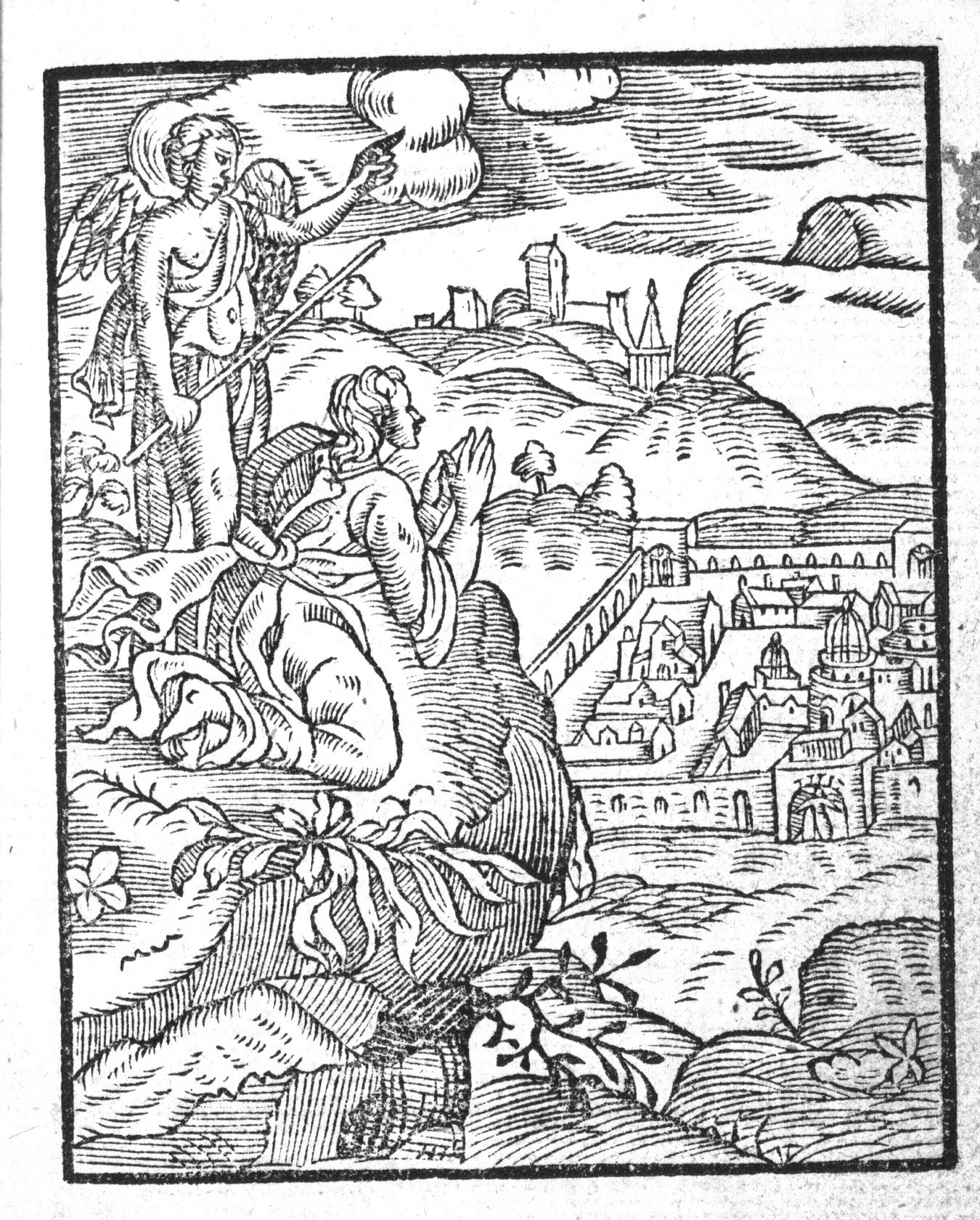
ITt was the time when rest the gift of Gods
Sweetely sliding into the eyes of men,
Doth drowne in the forgetfulnesse of slepe,
The carefull trauailestravailes of the painefull day:
Then did a ghost appeare before mine eyes
On that great riuersrivers banke that runnes by Rome,
And calling me then by my propre name,
He bade me vpwardeupwarde vntounto heauenheaven looke.
He cride to me, and loe (quod he) beholde,
What vnderunder this great Temple is containde,
Loe all is nought but flying vanitie.
So I knowing the worldes vnstedfastnesseunstedfastnesse,
Sith onely God surmountes the force of tyme,
In God alone do stay my confidence.
[Son. 2]
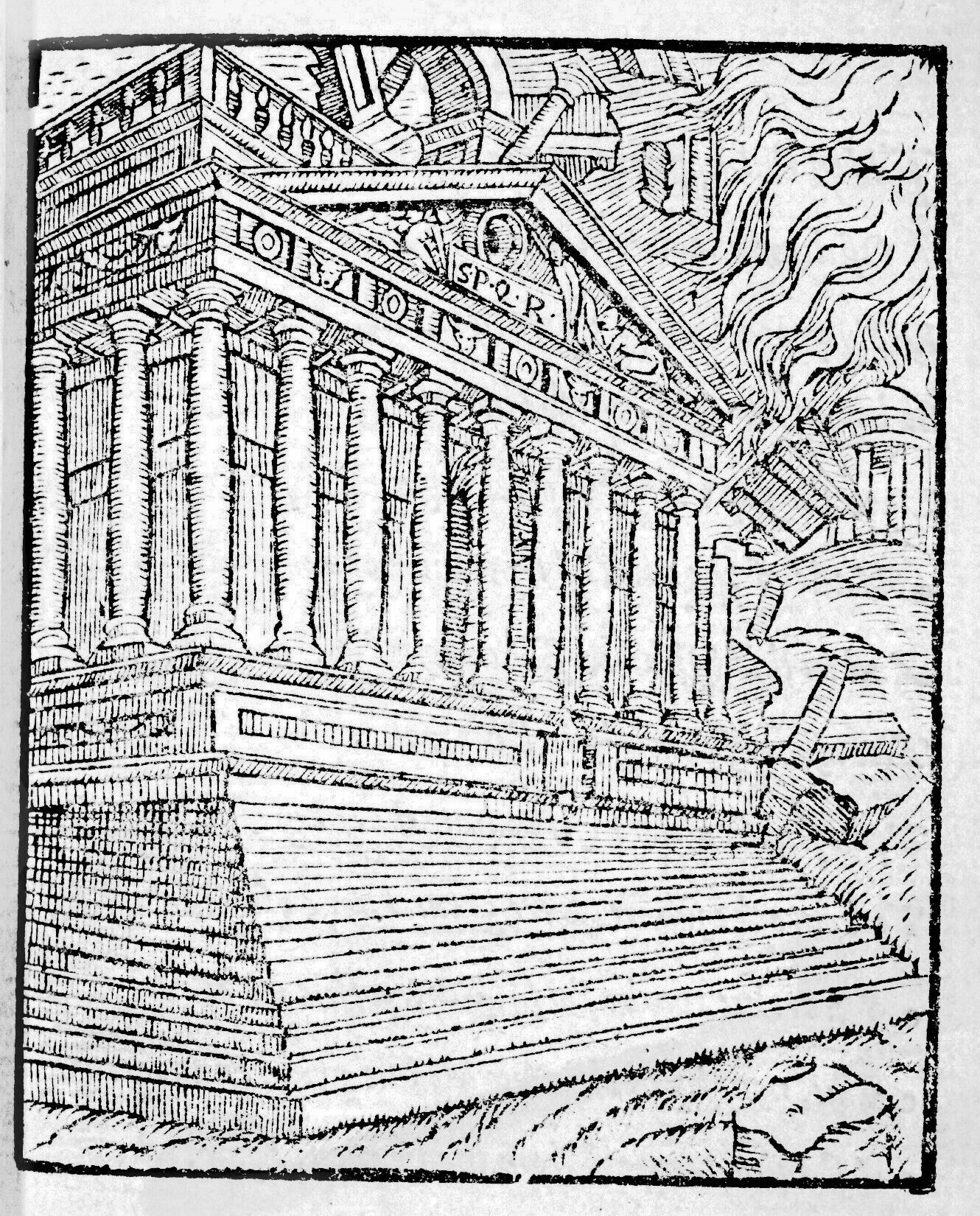
ONn hill, a frame an hundred cubites hie
I sawe, an hundred pillers eke about,
All of fine Diamant decking the front,
And fashiond were they all in Dorike wise.
Of bricke, ne yet of marble was the wall,
But shining Christall, which from top to base
Out of deepe vaute threw forth a thousand rayes
VponUpon an hundred steps of purest golde.
Golde was the parget: and the sielyng eke
Did shine all scaly with fine golden plates.
The floore was IaspisJaspis, and of Emeraude.
O worldes vainenesse. A sodein earthquake loe,
Shaking the hill eueneven from the bottome deepe,
Threwe downe this building to the lowest stone.
[Son. 3]
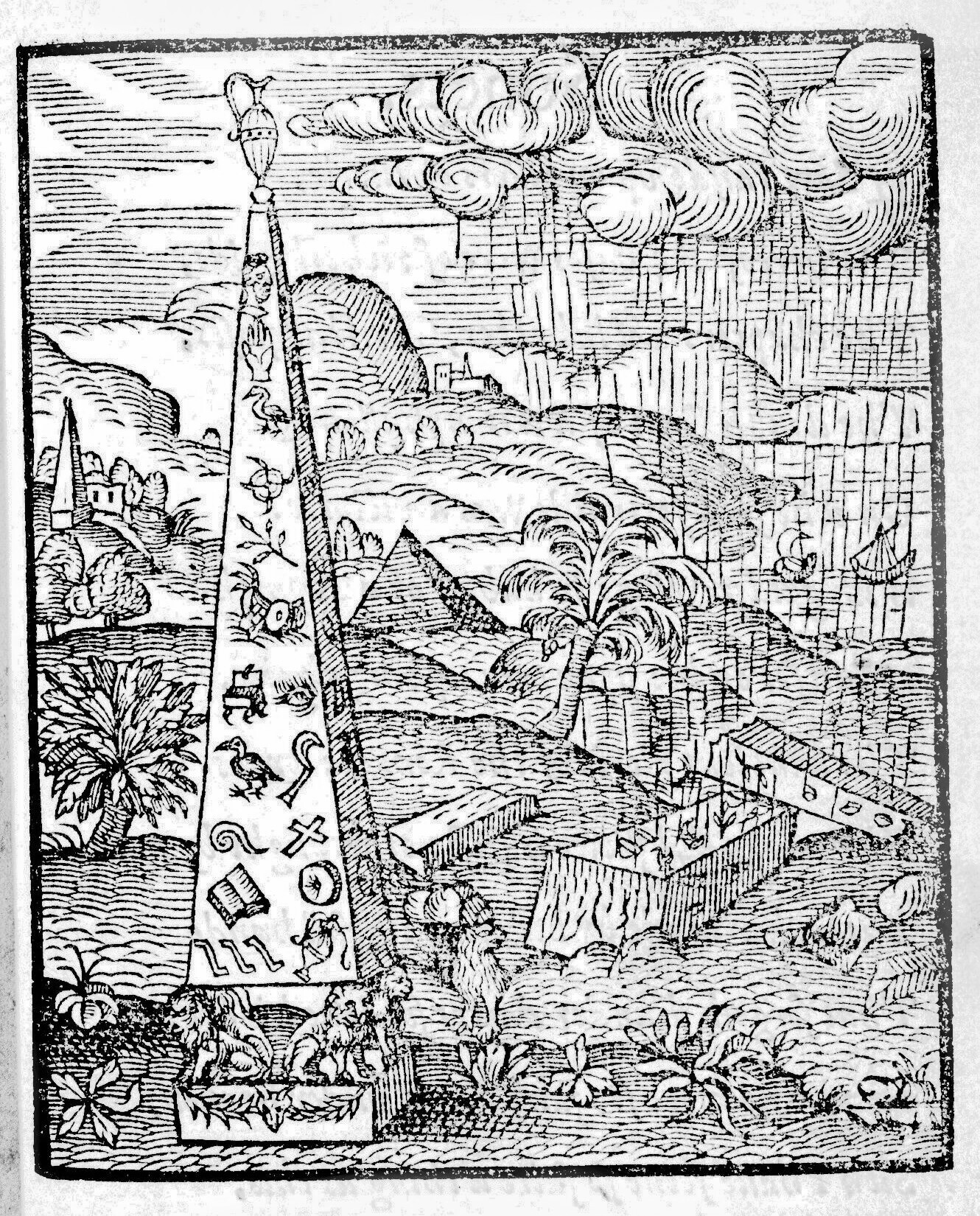
THenhen did appeare to me a sharped spire
Of diamant, ten feete eche way in square,
IustlyJustly proportionde vpup vntounto his height,
So hie as mought an Archer reache with sight.
VponUpon the top therof was set a pot
Made of the mettall that we honour most.
And in this golden vessell couched were
The ashes of a mightie Emperour.
VponUpon foure corners of the base there lay
To beare the frame, foure great Lions of golde.
A worthie tombe for such a worthie corps.
Alas, nought in this worlde but griefe endures.
A sodaine tempest from the heauenheaven, I saw,
With flushe stroke downe this noble monument.
[Son. 4]
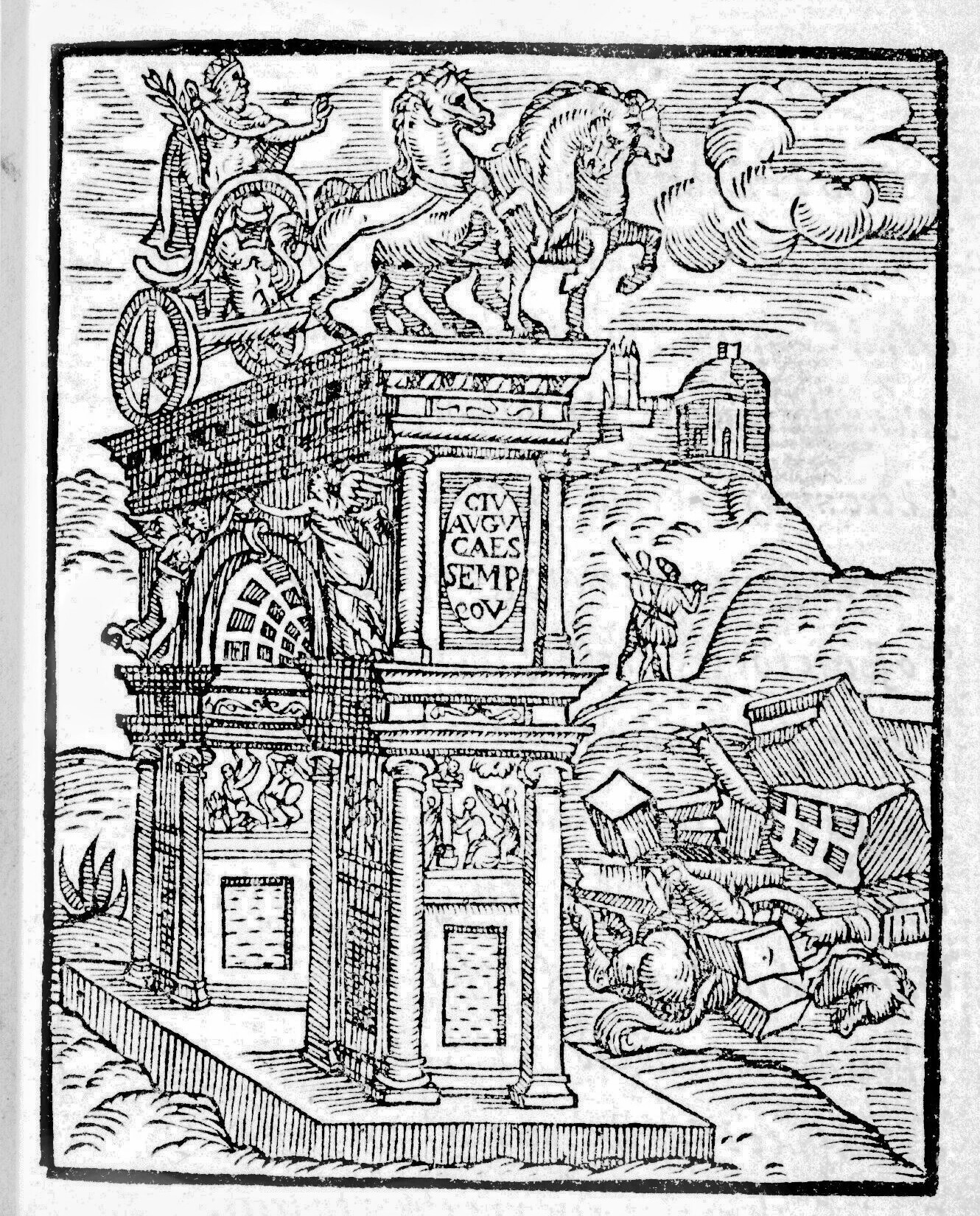
I Sawsaw raisde vpup on pillers of IuorieIvorie,
Whereof the bases were of richest golde,
The chapters Alabaster, Christall frises,
The double front of a triumphall arke.
On eche side portraide was a victorie,victorie.
With golden wings in habite of a Nymph,Nymph.
And set on hie vponupon triumphing chaire,
The auncient glorie of the Romane lordes.
The worke did shewe it selfe not wrought by man
But rather made by his owne skilfull hande
That forgeth thunder dartes for IoueJove his sire.
Let me no more see faire thing vnderunder heauenheaven,
Sith I hauehave seene so faire a thing as this,
With sodaine falling broken all to dust.
[Son. 5]
THenhen I behelde the faire Dodonian tree,
VponUpon seuenseven hilles throw forth his gladsome shade,shadc,
And Conquerers bedecked with his leauesleaves
Along the bankes of the Italian streame.
There many auncient Trophees were erect,
Many a spoile, and many goodly signes,
To shewe the greatnesse of the stately race,
That erst descended from the TroianTrojan bloud.
RauishtRavisht I was to see so rare a thing,
When barbarous villaines in disordred heape,
Outraged the honour of these noble bowes.
I hearde the tronke to grone vnderunder the wedge.
And since I saw the roote in hie disdaine
Sende forth againe a twinne of forked trees.
[Son. 6]
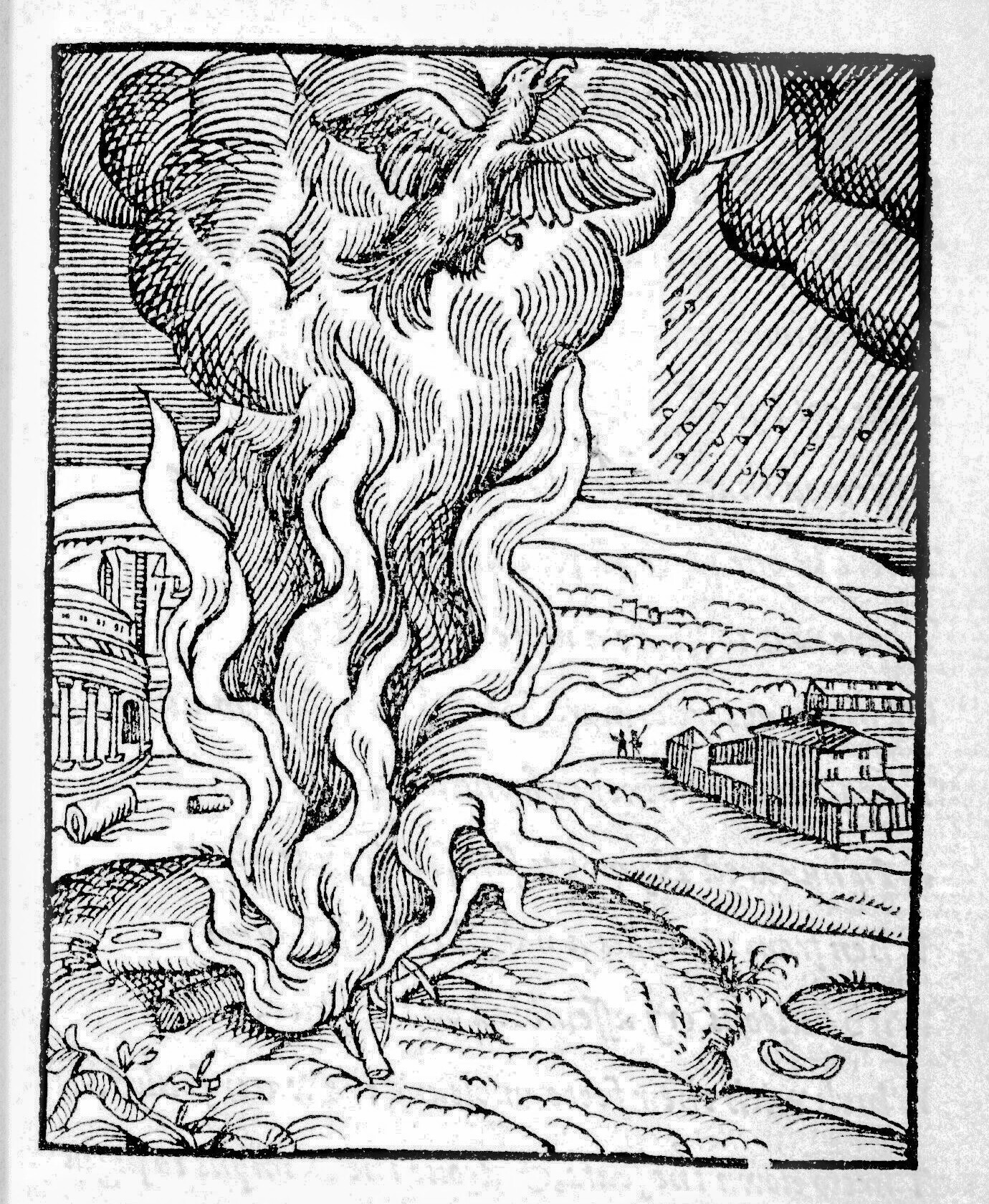
I Sawsaw the birde that dares beholde the Sunne,
With feeble flight venture to mount to heauenheaven,
By more and more she gan to trust hir wings,
Still folowing th’example of hir damme:
I saw hir rise, and with a larger flight
Surmount the toppes eueneven of the hiest hilles,
And pierce the cloudes, and with hir wings to reache
The place where is the temple of the Gods.Gods,
There was she lost, and sodenly I saw
Where tombling through the aire in lompe of fire,
All flaming downe she fell vponupon the plaine.
I saw hir bodie turned all to dust,
And saw the foule that shunnes the cherefull light
Out of hir ashes as a worme arise.
[Son. 7]
THenhen all astonned with this nightly ghost,
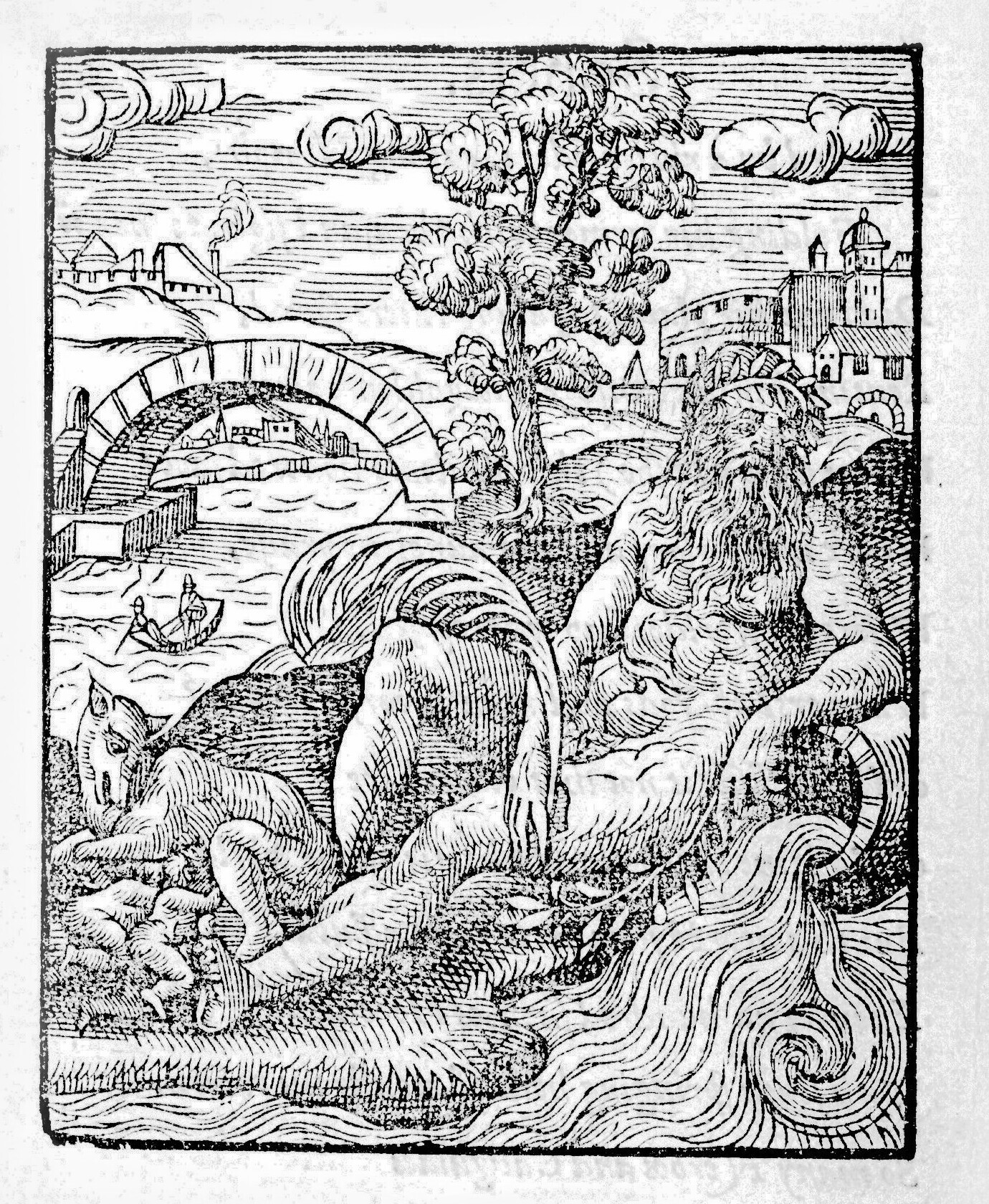
I saw an hideous body big and strong,
Long was his beard, and side did hang his hair,
A grisly forehed and Saturnelike face.
Leaning against the belly of a pot
He shed a water, whose outgushing streame
Ran flowing all along the creekie shoare
Where once the Troyan Duke with Turnus fought.
And at his feete a bitch Wolfe did giuegive sucke
To two yong babes. In his right hand he bare
The tree of peace, in left the conquering Palme,
His head was garnisht with the Laurel bow.
Then sodenly the Palme and OliueOlive fell,
And faire greene Laurel witherd vpup and dide.
[Son. 8]
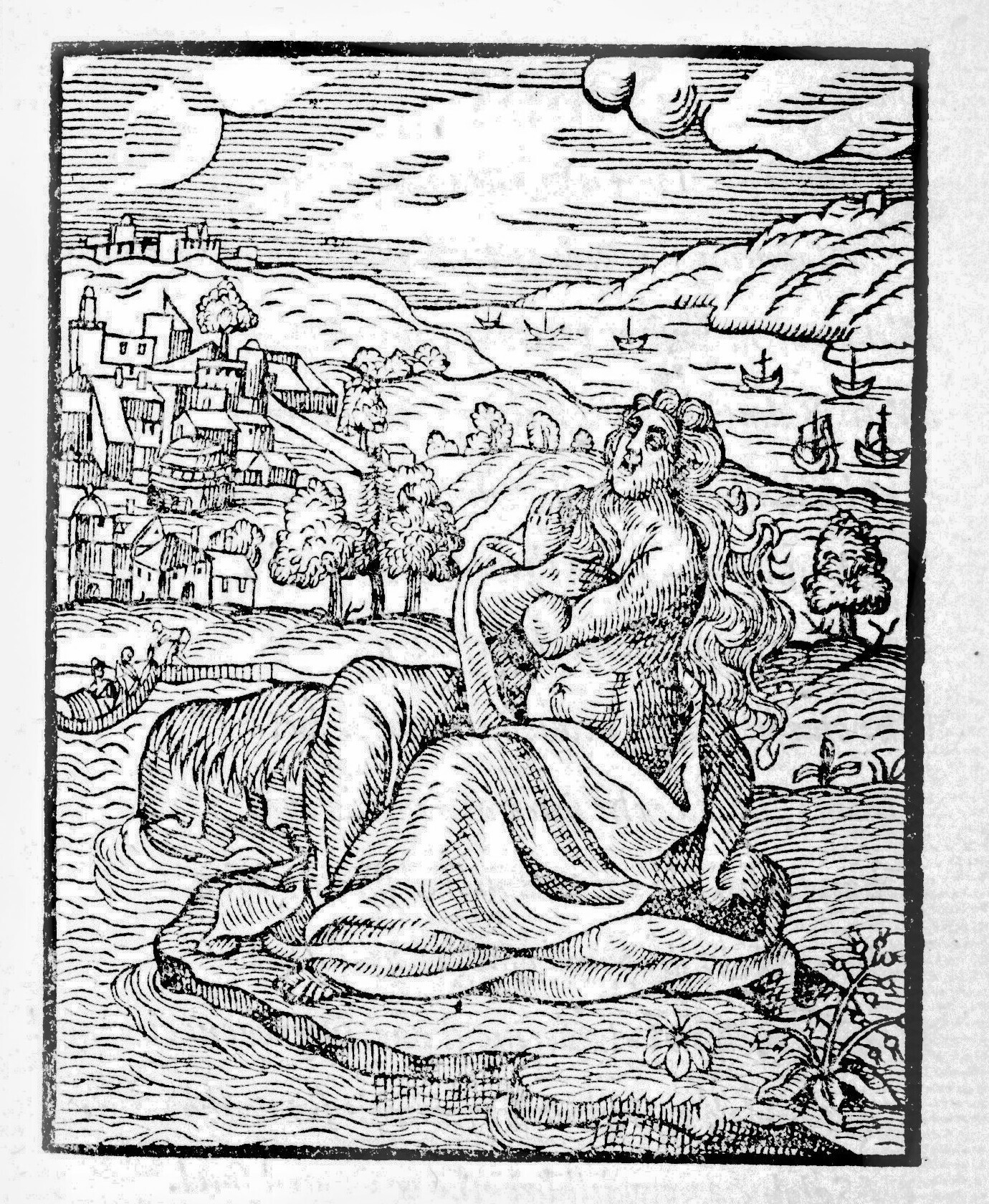
HArdard by a riuersrivers side, a wailing Nimphe,
Folding hir armes with thousand sighs to heauẽheauenheavẽheaven
Did tune hir plaint to falling riuersrivers sound,
Renting hir faire visage and golden haire,
Where is (quod she) this whilome honored face?
Where is thy glory and the auncient praise,
Where all worldes hap was reposed,
When erst of Gods and man I worshipt was?
Alas, suffisde it not that ciuilecivile bate
Made me the spoile and bootie of the world,
But this new Hydra mete to be assailde
EuenEven by an hundred such as Hercules,
With seuenseven springing heds of monstrous crimes,
So many Neroes and Caligulaes
Must still bring forth to rule this croked shore?shore.
[Son. 9]
VPUPVpUp a hill I saw a kindled flame,
Mounting like waueswaves with triple point to heauenheaven,
Which of incense of precious Ceder tree
With Balmelike odor did perfume the aire.
A bird all white, well fetherd on hir winges
Hereout did flie vpup to the throne of Gods,
And singing with most plesant melodie
She climbed vpup to heauenheaven in the smoke.
Of this faire fire the faire dispersed rayes
Threw forth abrode a thousand shining leames,
When sodain dropping of a golden shoure
Gan quench the glystering flame. O greuousgrevous chaunge!
That which erstwhile so pleasaunt scent did yelde,
Of Sulphure now did breathe corrupted smel.
[Son. 10]
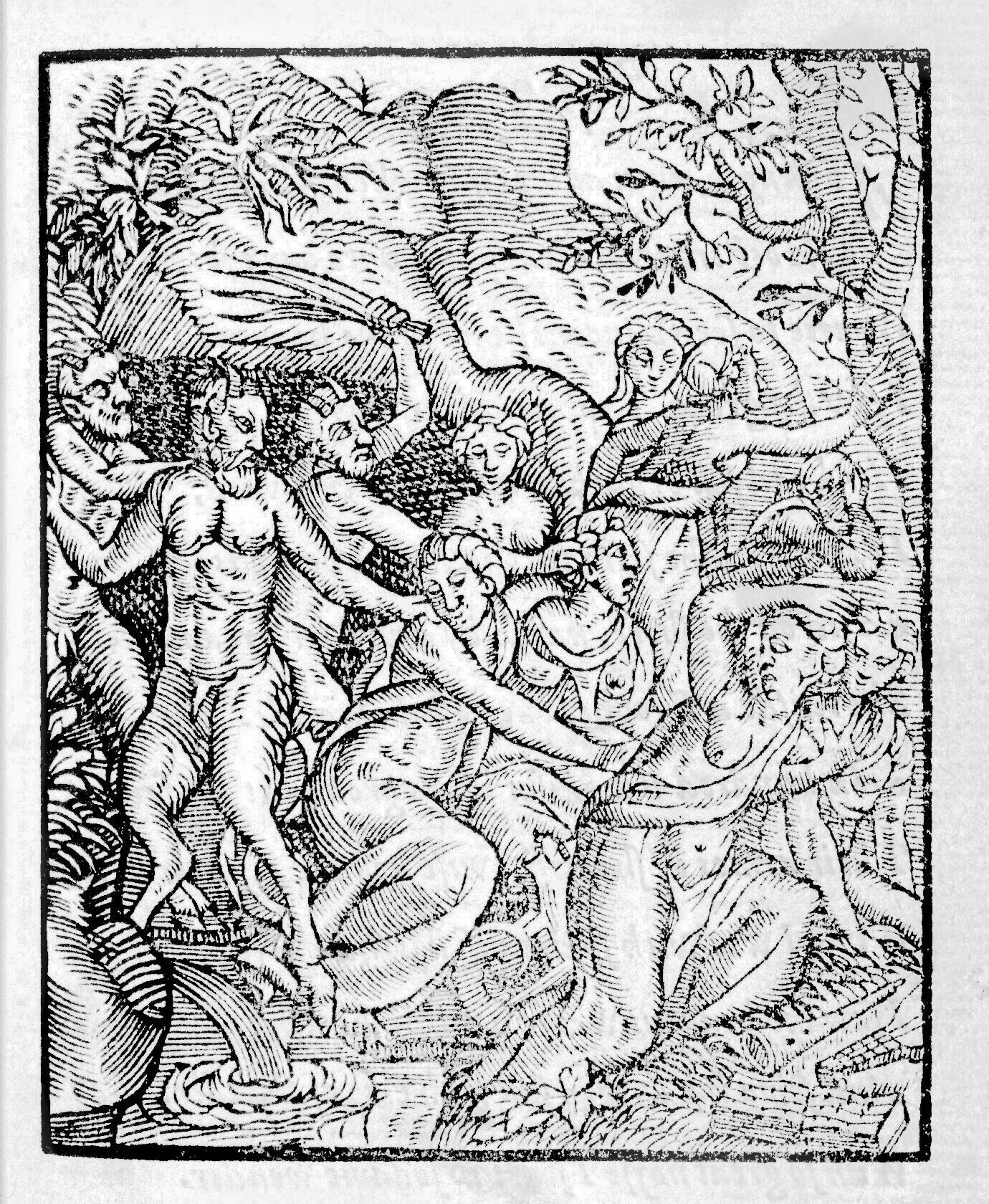
I Sawsaw a fresh spring rise out of a rocke,
Clere as Christall against the Sunny beames,
The bottome yellow like the shiningsh ning sand,land,
That golden Pactol driuesdrives vponupon the plaine.
It seemed that arte and nature striuedstrived to ioynejoyne
There in one place all pleasures of the eye.
There was to heare a noise alluring slepe
Of many accordes more swete than Mermaids song,
The seates and benches shone as IuorieIvorie,
An hundred Nymphes sate side by side about,
When from nie hilles a naked rout of Faunes
With hideous cry assembled on the place,
Which with their feete vncleaneuncleane the water fouled,
Threw down the seats, &and drouedrove the Nimphs to flight.
[Son. 11]
ATt length, eueneven at the time when Morpheus
Most truely doth appeare vntounto our eyes,
Wearie to see th’inconstance of the heauensheavens:
I saw the great Typhæus sister come,
Hir head full brauelybravely with a morian armed,
In maiestiemajestie she seemde to matche the Gods.
And on the shore, harde by a violent streame,
She raisde a Trophee ouerover all the worlde.
An hundred vanquisht kings gronde at hir feete,
Their armes in shamefull wise bounde at their backes.
While I was with so dreadfull sight afrayde,
I saw the heauensheavens warre against hir tho,
And seing hir striken fall with clap of thunder,
With so great noyse I start in sodaine wonder.
[Son. 12]
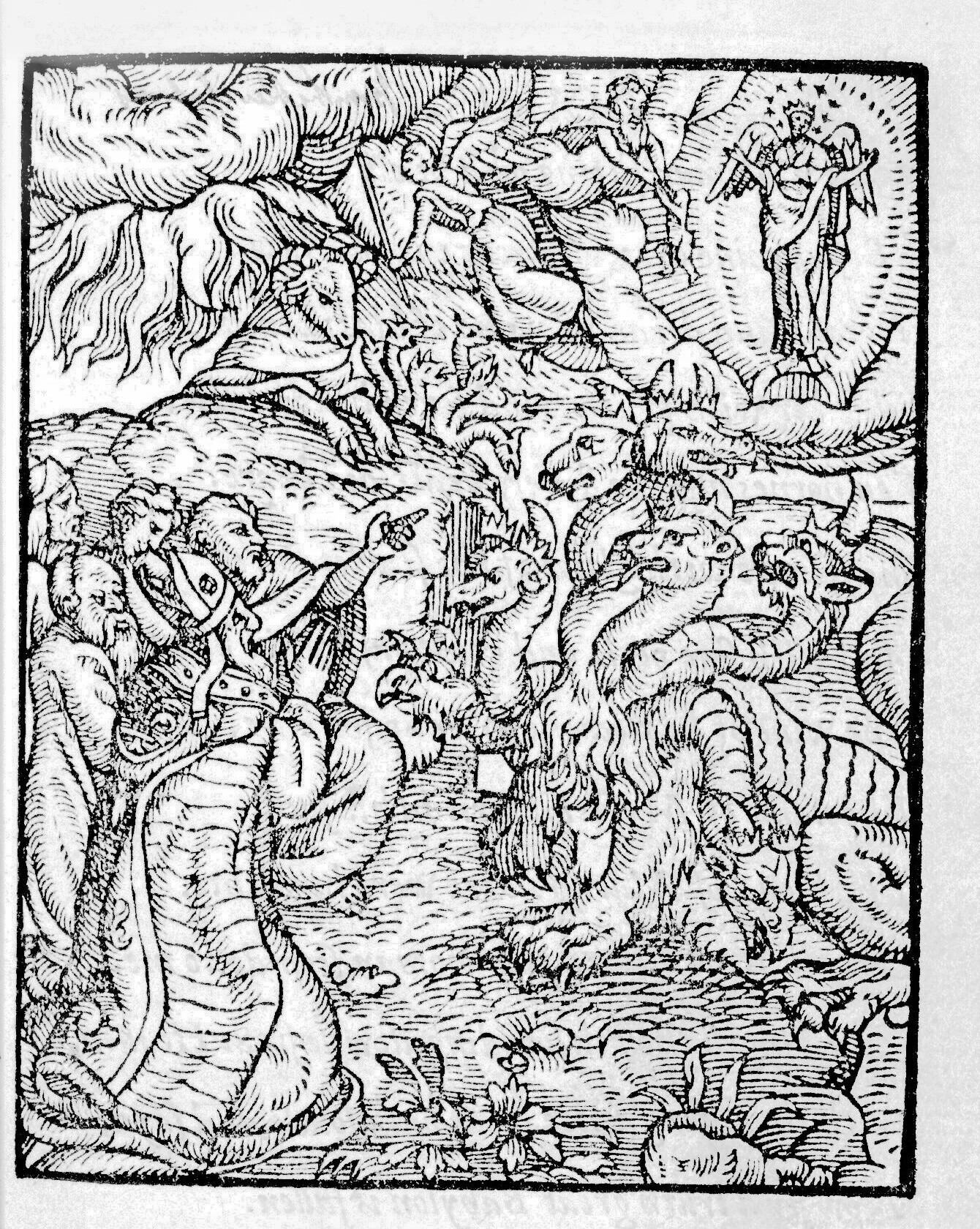
I Sawsaw an vglyugly beast come from the sea,
That seuenseven heads, ten crounes, ten hornes did beare,
HauingHaving theron the vile blaspheming name.
The cruell Leopard she resembled much:
Feete of a beare, a Lions throte she had.
The mightie Dragon gauegave to hir his power.
One of hir heads yet there I did espie,
Still freshly bleeding of a grieuousgrievous wounde.
One cride aloude:aloude. What one is like (quod he)
This honoured Dragon, or may him withstande?
And then came from the sea a sauagesavage beast,
With Dragons speche, and shewde his force by fire,
With wondrous signes to make all wights adore
The beast, in setting of hir image vpup.
[Son. 13]
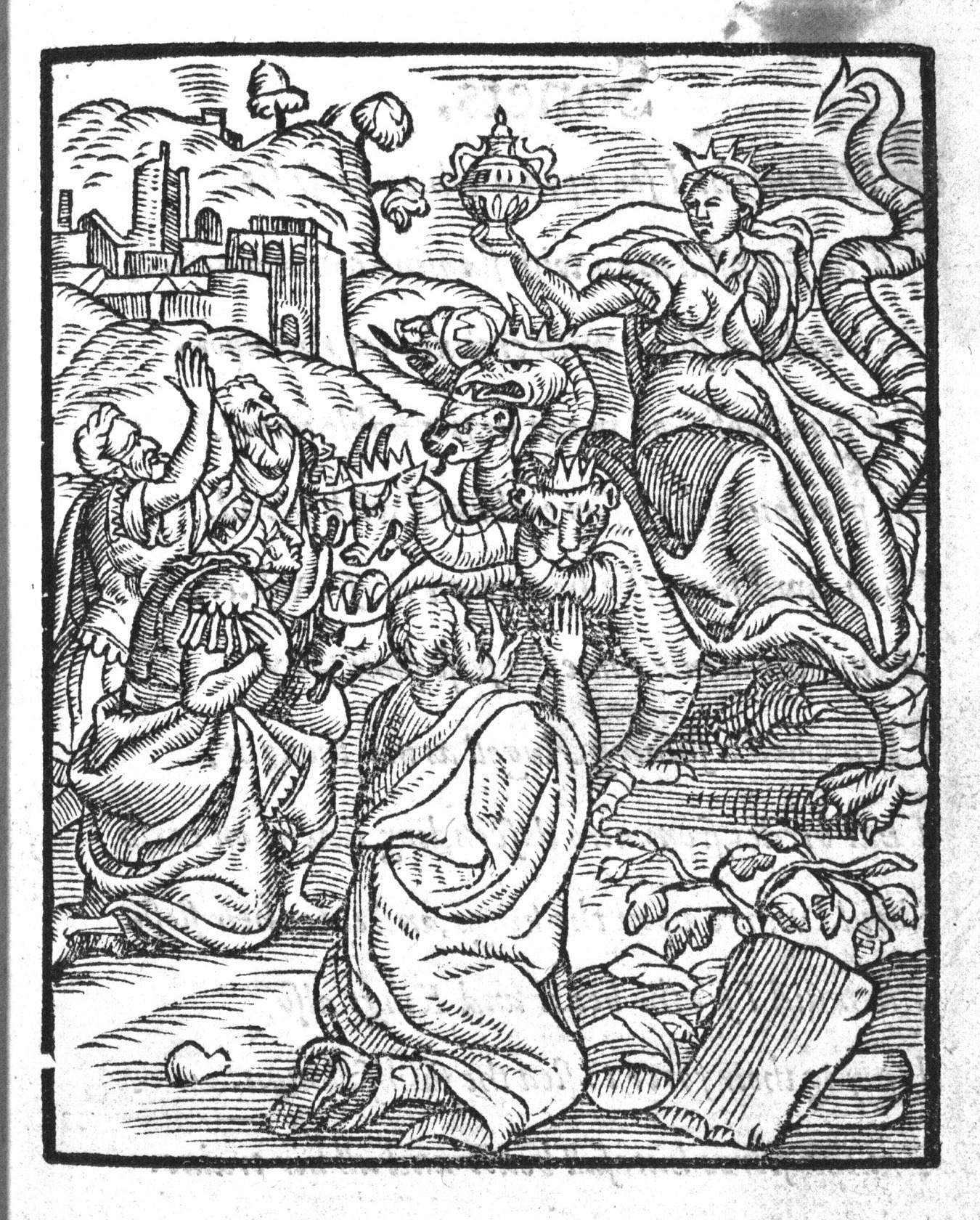
I Sawsaw a Woman sitting on a beast
Before mine eyes, of Orenge colour hew:
Horrour and dreadfull name of blasphemie
Filde hir with pride. And seuenseven heads I saw,
Ten hornes also the stately beast did beare.
She seemde with glorie of the scarlet faire,
And with fine perle and golde puft vpup in heart.
The wine of hooredome in a cup she bare.
The name of Mysterie writ in hir face.
The bloud of Martyrs dere were hir delite.
Most fierce and fell this woman seemde to me.
An Angell then descending downe from Heauen,Heaven,
With thondring voice cride out aloude, and sayd,
Now for a truth great Babylon is fallen.
[Son. 14]
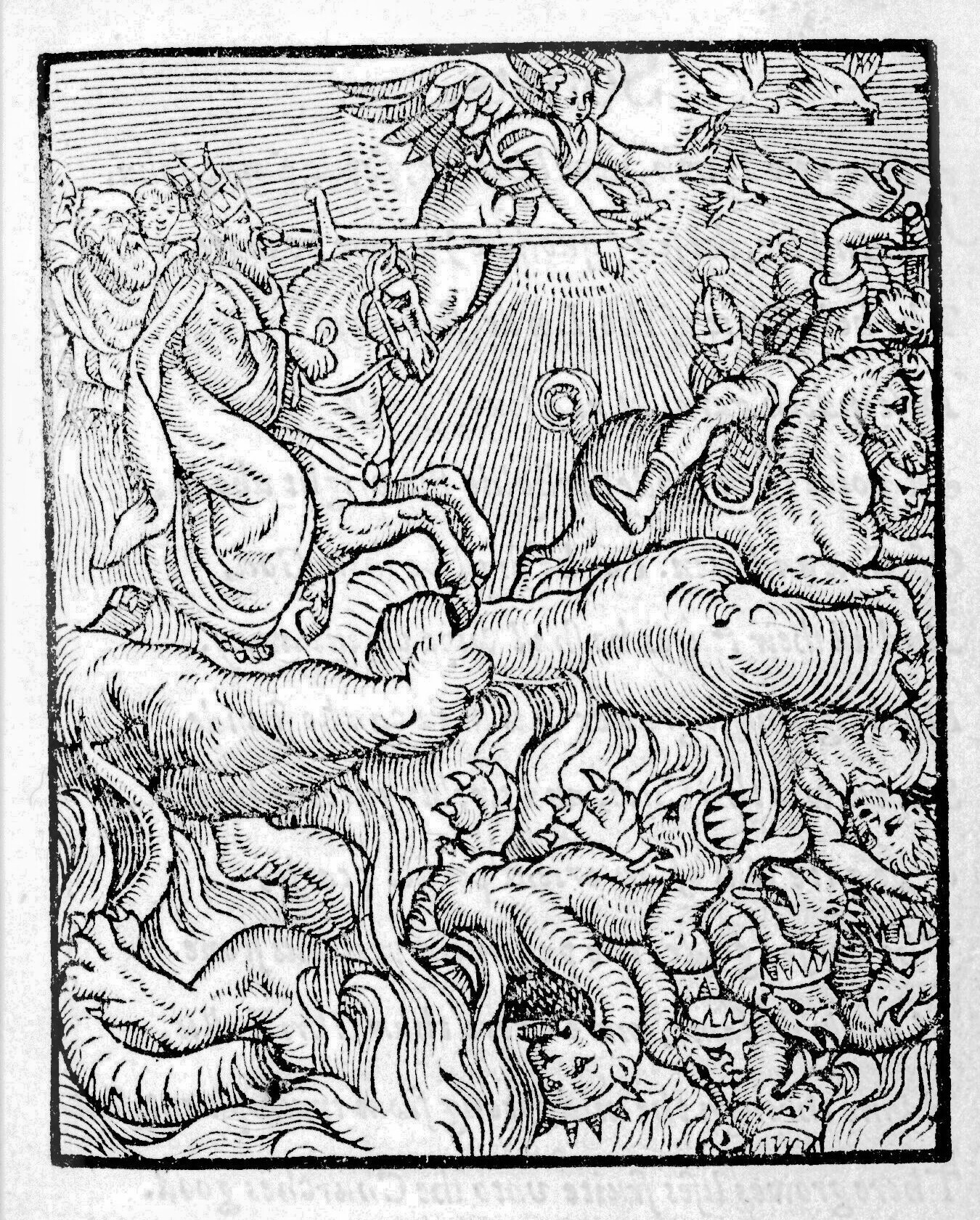
ThenHen might I see vponupon a white horse set
The faithfull man with flaming countenaunce,
His head did shine with crounes set therupon.
The worde of God made him a noble name.
His precious robe I saw embrued with bloud.
Then saw I from the heauenheaven on horses white,
A puissant armie come the selfe same way.
Then cried a shining Angell as me thought,
That birdes from aire descending downe on earth
Should warre vponupon the kings, and eate their flesh.
Then did I see the beast and Kings also
IoinyngJoinyng their force to slea the faithfull man.
But this fierce hatefull beast and all hir trainetraine.
Is pitilesse throwne downe in pit of fire.
[Son. 15]
I Sawsaw new Earth, new HeauenHeaven, sayde Saint IohnJohn.
And loe, the sea (quod he) is now no more.
The holy Citie of the Lorde, from hye
Descendeth garnisht as a louedloved spouse.
A voice then sayde, beholde the bright abode
Of God and men. For he shall be their God,
And all their teares he shall wipe cleane away.
Hir brightnesse greater was than can be founde,
Square was this Citie, and tweluetwelve gates it had.
Eche gate was of an orient perfect pearle,
The houses golde, the pauementpavement precious stone.
A liuelylively streame, more cleere than Christall is,
Ranne through the mid, sprong from triumphant seat.
There growes lifes fruite vntounto the Churches good.
13. Sith: since
14. stay: to hold fixed
1. frame: structure, building
3. Diamant: diamond
5. Of bricke, ne yet: neither of brick nor
6. Christall: crystal
9. parget: Ornamental work (usually in plaster) on walls
9. sielyng: ceiling
12. sodein: sudden
3. chapters: capitals, the top portion of a column
3. frises: friezes
4. arke: arch
6. habite: clothing
7. chaire: chariot
8. auncient: ancient
2. gladsome: pleasant
8. erst: originally
13. since: thereafter
1. astonned: stunned, amazed
4. Renting: rending
5. whilome: formerly, once upon a time
7. hap: chance
9. bate: discord
11. mete: deserving
10. leames: flashes
12. glystering: glittering
13. yelde: yield, give off
5. brauely: splendidly
7. harde by: very close at hand
9. gronde: groaned
11. with . . . afrayde: frightened by
12. tho: then, thereupon
11. fell: cruel
5. embrued: soaked, stained
7. puissant: powerful
12. slea: slay
4. garnisht: adorned
5.victorie,] vi[ct]orie. 1569
6.Nymph,] Nymph. 1569
2.shade,] [ſh]adc, 1569
8.Gods.] Gods, 1569
15.shore?] [ſh]ore. 1569
3.shining sand,] [ſh] ning land, 1569
9.aloude:] aloude. 1569
13.traine] traine. 1569
1.1The sequence of sonnets translates Du Bellay’s Songe, itself heavily indebted to Petrarch’s ‘Canzone of Visions’.
1.11: Du Bellay’s sequence begins with the apparition of a spirit who propounds the general lesson of the visions that will follow, that since all things beneath heaven are transitory, those who hope for permanence must vest that hope in the divine. The spirit’s admonition occupies the entire octave of Du Bellay’s poem, whereas, in Spenser’s rendering, the apparition speaks of the world’s inconstancy and, in the final three lines, the original speaker formulates the compensatory principle of confidence in God. The summary prologue and the demonstration of the speaker’s wisdom give the sequence a somewhat greater spiritual security than is offered in the preceding sequence. That said, this second sequence is also more sepulchral than the prior one: Spenser’s speaker is addressed by a ghost (un Demon, for Du Bellay) and the ensuing poems are haunted by the pathetic or monstrous vestiges of antiquity.
1.1 1.1-5: Recalling the occasion of the appearance of Hector’s ghost in Aen. 2.268-97; the ghost rouses the sleeping Aeneas, warning him to flee the burning city of Troy.
1.6 that great riuers: The Tiber’s.
1.7 my propre name: Du Bellay’s nom dont je me nomme (‘name by which I name myself’) makes even a stronger assertion of the intimacy of the name than does Spenser’s phrasing.
1.10 Temple: The idea that God dwells in a heavenly temple is a frequent biblical topos (see, e.g., Isa 6:1, Heb 8:1-6, and Rev 11:19). The heavens themselves are not directly compared to a temple in the canonical bible and no detailed speculation as to the architecture (and angelic personnel) of the heavenly temple was made until the Songs of the Sabbath Sacrifice (among the Dead Sea Scrolls) and the hekhalot literature of early Judaism.
1.11 nought . . . vanitie: Eccles 1:2 and 12:8.
2.1The second, third, and fourth sonnets focus on the destruction of monumental Roman culture. Van der Noot speaks of Rome as stuffed . . . wyth . . . all maner of riches, wherupon didde ensue all kinde of superfluitie and worldely pompousnesse (F5v-F6). His description suggests an abiding fascination with Roman sumptuousness: They adorned their Citie with all maner of sumptuous and costely buyldings, wyth all kindes of curious and cunning workes, as Theaters, Triumphall Arkes, Pyramedes, Columnes, Spires, and a greate number of graven Images, Statues, Medalles and Figures, made of divers and sundry kindes of stuffe, as Marble, Alablaster, Golde, Sylver, Copper, Pourphere, Emplaster, Brasse and other like mettall, some graven, and other some cast (F6).
2.1 cubites: A cubit is a measure of the distance from the elbow to the tip of the fingers. With the exception of the revised translation for Bellay, Spenser employs the term on only one other occasion, to measure the depth of the fountain in the Bower of Bliss (FQ II.xii.62); see comments on line 11 below.
2.4 Dorike wise: Doric manner. Vitruvius associates the Doric order in architecture with masculine valour (De Architectura I.ii.5). The inscription SPQR, in the tympanum of the temple in the facing illustration, specifies this as a Roman building: this abbreviation for Senatus Populusque Romanus (‘The Roman Senate and the Roman People’) was inscribed on Roman public buildings from the time of the Republic forward.
2.7 deepe vaute: A crypt. Whereas Spenser is translating ventre, a term inapplicable to lofty spaces, vault (Fr. voûte) can be used for any enclosed space surmounted with an arched ceiling, so Spenser is somewhat lightening his source.
2.10 golden plates: Cf. golden lamminae that cover the interior of the ‘house’ within the Holy of Holies (1 Kings 6:21), an ornamental feature not fully captured in the Geneva rendering.
2.11 Iaspis: Jasper. With the exception of the revised translation of this poem in Bellay, Spenser’s only other references to jasper and emerald are found in his descriptions of the Bower of Bliss: some of the grapes that hang over the second gate in the Bower appear like emeralds (FQ II.xii.54) and the fountain in the Bower is paved with jasper (FQ II.xii.62). Crystal (l. 6), jasper, and emerald are all part of the array of precious materials mentioned in the descriptions of heaven in Revelation 4 and 21. See 2540-6 and 2555-9.
2.12 earthquake: Cf. the destruction of the Temple alluded to in Matt 24:2 and the less specifically located earthquakes of 24:7.
3.1 sharped: Pointed. Spenser will use this again in an analogous architectural description in Rome 2.2, but the term is also used of Cupid’s arrow in Tottel’s Miscellany (1557).
3.3–3.4 3.3-4: Spenser may have had difficulty rendering Du Bellay here, or may have wished to elaborate the evocation of height in his source. The obelisk in Du Bellay’s poem is precisely as high as (justement mesuré, / Tant que) an archer—keen-eyed, as a professional necessity—can aim (prendre visee), whereas Spenser’s translation suggests both that the height of obelisk is somehow proportioned to its square base and that it is as high as an archer can see.
3.7 couched: In Du Bellay’s original, the ashes repose (reposoit) in the urn. Spenser has displaced the verb used of the lions, couchez, in line 9, and thereby has relinquished phrasing that suggests the heraldic character of the resting lions.
3.12 griefe: Cf. Du Bellay’s torment.
3.14 flushe: The reading ‘flushe’ in our copy text may be either an instance of foul case or of a misreading of manuscript copy, since ‘a’ and ‘u’ are easily confused in secretary hand, especially in Spenser’s.
4.5 victorie: Triumphal arches are customarily ornamented with images of Victory personified, carved in relief in the roughly triangular spaces above the curved portion of the archway, as in the woodcut illustration facing the poem.
4.11 his sire: Vulcan’s father. Son of Jove and Juno, Vulcan is blacksmith and armorer to the gods.
5.1Unrhymed like the other Sonets, the fifth of the Sonets offers especially good examples of Spenser’s effort to capture the character of rhyme in French, which is relatively unemphatic when compared to that of rhyme in English. The final syllables of lines 1, 3, and 4 are bound together by assonance, thus helping to mark the first quatrain as an independent unit. Spenser achieves an effect of mild closure by means of the internal rhyme of ‘disdain’ and ‘again’ in lines 13 and 14; he would later strengthen this effect in the revision for Complaints, where the two words are in terminal position, giving the Complaints version its final couplet.
5.1 Dodonian tree: An oak (and not the palms of van der Noot’s woodcut). Dodona was a city in northwest Greece, famous for its sacred oak and its oracle of Zeus. The reference initiates a pattern in the poem that represents the eminence of Rome as deriving from transplants of Eastern—Greek and Trojan—culture.
5.2 seuen hilles: glossed, albeit somewhat carelessly, in van der Noot’s Declaration (418-19).
5.3 bedecked with his leaues: A garland of oak leaves was the traditional symbolic reward of those who had saved a Roman citizen in battle.
5.4 Italian streame: The Tiber. Spenser does not here translate Du Bellay’s Ausonien, though he will restore the term in Complaints. (‘Ausonia’ was an archaic name for central and southern Italy.)
5.6 many goodly signes: For Du Bellay’s maint beau tesmoignage. ‘Signes’ fails to capture the retrospective character of tesmoignage, which might be rendered ‘trace’, but which carries a strong juridical cast, as in ‘witness’, ‘testimony’, or ‘evidence’.
5.7 race: From Lat. radix, root; often used to describe plant and animal species as well as human lineages. The human and nonhuman meanings are often linked metaphorically, as in Shakespeare, WT 4.4.95. The vegetative sense is activated here by the fact that the Dodonian tree is a metaphor for the Trojan people, transplanted and flourishing as Romans.
5.8 Troian: As with Italian (l. 4), Spenser adopts a more familiar designator of place than that in his source. Du Bellay’s Dardanien identifies Troy with Dardanus, mythical founder of Troy and son of Zeus and Elektra.
5.10 villaines: The term, originally meaning a person of low birth, had already begun to take on its modern moral connotations. Du Bellay’s paisans has no such connotations.
5.10 heape: For Du Bellay’s somewhat more orderly troppe (‘troupe’).
5.12 wedge: A possible translation of Du Bellay’s cognee (cognée in van der Noot’s Le Théatre), but an odd one, since the plain sense of congnee is ‘axe’. Spenser seems to be trying to capture the slow, persistent force of the wedge, possibly influenced by the connotations of gemir, accurately rendered as ‘grone’; indeed, the entire sonnet might be said to recall Virgil’s comparison of the final collapse of Troy to the groan and tumble of a mountain ash felled by rivalrous woodsmen (Aen., 2.626-31).
5.14 twinne . . . trees: Alluding either to the split between the Eastern and Western Churches or to the split within the western residue of the Roman Empire between the papacy and the Holy Roman Empire.
6.1 birde . . . Sunne: The eagle, as at FQ I.x.47.6; and see Isidore, Etymologies 12.7:10-11. The Eagle imperial, as van der Noot describes the bird of this sonnet (Declaration 420-21) seems to symbolize Rome in its ancient glory. Ps 103.5 attributes a capacity for self-renewal to the eagle, thus eliciting a potential link to the phoenix. (In the Natural History, 10.2-3, Pliny the Elder turns to a discussion of the varieties of eagle immediately after his discussion of the phoenix, which he dismisses as a merely legendary creature.) The link to the phoenix is rendered more complex at the conclusion of the sonnet, when an owl rises from the ashes of the dead eagle.
6.4 th’example . . . damme: Whereas the ancient naturalists from Aristotle forward emphasize how ruthlessly eagles test their young, Spenser and Du Bellay shift attention to the fledgling and to the rigorous imitation by which she rises to heroic, if fatal, achievement.
6.10 tombling: Aside from its associations with tomb, Spenser’s rendering of Du Bellay’s rouant (‘coiling’) establishes a link between the eagle and the ship of Epigr. 2, which crashes on hidden rocks when the sea is tombled up.
6.10 lompe: The strange translation of Du Bellay’s tourbillon is possibly traceable both to Spenser’s interest in an echoic relation to ‘tombling’ and to the traditional English rendering of Rom 9:21, where God’s providential creativity is likened to that of a potter who can ‘make of the same lompe one vessel to honour, and another unto dishonour’. In his effort to find a term for the whirlwind of fire, Spenser may have been influenced by the term for the whirling mass of clay on the potter’s wheel.
6.13 foule . . . light: The ominous and somewhat mysterious figure of the owl emerging from the eagle’s ashes seems to evoke either the Holy Roman Empire or the modern papacy.
6.14 as a worme: This literal translation (of Comme un vermet) appears to have the force preserved in the modern French idiom, nu comme un ver, naked as a worm; for the same idiom in Chaucer, see Rom., 454.
7.1 this nightly ghost: All versions of van der Noot’s Theatre omit the eighth sonnet of Songe, in which a monstrous seven-headed beast emerges from the foundations of an ancient ruin; after changing its shape a hundred times, the monster evaporates in the blast of a Scythian wind. In the ninth sonnet, Du Bellay again refers to the apparition as a monstre; that Spenser translates the term as ghost, and so captures the ghostly evanescence attributed to the monster in the omitted sonnet, suggests that he may have had recourse to a complete edition of Songe. For the omission of the eighth sonnet, see the Introduction.
7.3 7.2-8: This description of the spirit of the Tiber differs strikingly from Virgil’s far more benign description of the river god at Aen. 8.26-30. Van der Noot refers to the central figure as the great Statue, though the image as described and as depicted in the woodcut matches neither the celebrated Roman statue of the Tiber unearthed near Santa Maria sopra Minerva in 1512-3 nor the statue of the Tigris from the Quirinal that Michelangelo had refashioned as an image of the Tiber in the 1560s (after the composition of Du Bellay’s Songe).
7.3 side: The word can mean both ‘at length’ and ‘low-hanging’; Spenser is rendering flottans, ‘flowing’.
7.4 Saturnelike: Aged, because Saturn, as the father of Jove, was traditionally associated with an especially ancient divine regime. Saturn is also associated with melancholy temperament.
7.6 a water: Following his French original, une eau, quite closely.
7.7 creekie: Replete with creeks. Spenser’s use of this word to translate Du Bellay’s sinueux, ‘sinuous’ is the first recorded in OED. This may be the first manifestation of Spenser’s distinctive interest in tributary flows.
7.7 shoare: The battle between Aeneas (the Troyan Duke) and Turnus, narrated in Aeneid 12, takes place in fields along the Tiber west of Rome, near Laurentum.
7.9 7.9-10: In Livy’s version of the late 4th-century legend, Romulus and Remus, having been cast into the Tiber on orders of the tyrant Amulius, are left floating in a trough; when the overflowing river ebbs they are rescued and nursed by a thirsty she-wolf (Ab Urbe Condita, 1.4). Van der Noot argues that from the breasts of the wolf the twin founders of Rome sucked all manner of crueltie and beastlynesse ( 439). A statue of the Roman wolf nursing Romulus and Remus, famous in Spenser’s day and long thought to have been cast in the fifth century, was housed on the Capitoline Hill overlooking the Tiber.
7.12 bow: Bough; hence wreath, garland. Bow is an acceptable 16th-c spelling for bough; although bough usually indicates a more substantial limb than that which would be used for a garland, Spenser’s usage is comparable to Henryson’s ‘The bewis braid blomit abone my heid’ (The moral fabilis of Esope, 1570, F4v).
7.11 7.11-12: Wreaths of olive, palm, and laurel were awarded to Greek athletes and military commanders as tokens of victory, but the olive had special associations with peace, the palm with victory, and the laurel with artistic achievement. The fates of the three trees may together signify the transitory nature of achievement, yet insofar as the poem seems slightly to differentiate the fate of olive and palm from that of the laurel, the poem perhaps implies that a collapse of a regime of post-bellum peace leads to a withering of the arts.
8.3 tune: Translating Du Bellay’s accordoit. Cf. the rendering of Marot’s accordoient in Epigr. 4 as in accorde did tune.
8.5 this . . . face: By thus rendering Du Bellay’s ceste face (‘this aspect’ or ‘this face’), Spenser lightly suggests that the lost visage is the nymph’s own, as if the removal of this whilome honored face were not an especially lamentable product of some larger historical decay but were, instead the effect of the nymph’s own grief. This quickened disfigurement is refracted and further heightened in lines 10-12, where the nymph imagines modern Rome as a hydra each of whose seven heads should be cut off.
8.6 praise: In the 16th-c, praise can mean ‘the activity of praising’, ‘the products of that activity’, and ‘praiseworthiness’; Spenser frequently uses the word in circumstances in which the latter sense is primary (cf. Am 5.9 and FQ, II.v.26.2). But all three senses are relevant here: the Roman culture of praising, the store of Roman self-congratulation, and the achievements and virtues that were the objects of that praise have all disappeared. A similar, if not identical set of meanings attaches to the word that Spenser is translating here, los, which can mean both ‘the activity of praising’ and ‘fame, renown’; in Du Bellay’s poem, the latter sense seems to be primary.
8.10–8.12 8.10-12: The new Hydra recalls the seven-headed Beast from the Sea of Rev 13, yet whereas the Beast in Revelation is identifiable as the seven-hilled Rome (and is so identified in the glosses to the Geneva Bible of 1560), the new Hydra, presumably associated with the papacy or the Roman church, seems paradoxically a threat to the imperial Roman nymph herself. The paradox, that one figure of Rome should threaten another, is central to Du Bellay’s Roman poems.
8.12 Hercules: To slaughter the hydra, said to grow multiple new heads with each decapitation, was the second of Hercules’ twelve labours.
8.14 Neroes and Caligulaes: The two first-century Roman emperors serve here as types of criminally violent monarchy. The glosses to Rev 13:3 of the 1560 Geneva Bible refer to Nero as the emperor ‘who moved the first persecution againste the churche’.
8.15 bring forth: In Spenser’s source, the new Hydra is said to sire the Neroes and Caligulaes on the nymph; Spenser has muted the insinuation of rape.
8.15 croked shore?: Recalling the creekie shoare (10) of the previous sonnet. The emended punctuation consolidates the unambiguously interrogative force of Du Bellay’s construction—N’estoit-ce pas (‘was it not?’)—which is slightly effaced by the mispunctuation in the French version of the Theatre, punctuation reproduced in the English edition.
9.1–9.2 flame . . . with triple point: Perhaps alluding to the triple structure of the papal tiara—an allusion that would be enhanced by the reference to incense in 9.3—and meant to imply the grandiose aspirations of the Roman church.
9.3–9.4 9:3-4: Confusingly, the lines preserve Du Bellay’s word-order.
9.11 golden shoure: The story of Jove’s impregnation, in the form of a shower of gold, of the imprisoned Danae was allegorized as an account of the corrupting power of gold at least as early as the first century C.E.; see Horace, Odes 3.16.
10.1The tone and tactics of the opening of the poem and woodcut are conspicuously at odds. The illustration, which captures the rout of the poem’s final lines, is populous and busy, whereas the sonnet unfolds quietly, at a steady pace. The first quatrain simply describes the welling spring, the second the harmony that supplements the shining pleasantness of the spring. The mention of mermaids in 8 is the first hint of animation, and they obtrude only figuratively on the scene; line 9 introduces seates and benches, the first mark that the spring is meant to accommodate human or humanoid presence. Only at line 10 does the setting accommodate something of the woodcut’s crowd, and even then the hundred Nymphes are presented in orderly array—side by side about.
10.3 10.3-4: The river Pactolus in Lydia was famously rich in electrum, a naturally occurring alloy of gold and silver. Ovid transmits an etiological myth: when Midas, on Bacchus’ instructions, washed himself in the Pactolus to rid himself of the curse of the golden touch, the riverbed turned hard and yellow (Met. 11.137-45).
10.5 10.5-6: The evaluative comparison of Art (i.e., the exercise or products of human education, design, or craft) and Nature (i.e. the wild, the given, the non-human, the unwilled) is traditional; the two principles are usually understood to be in competition. Spenser makes characteristically distinctive—albeit not unique—contributions to the tradition, both instanced here: he especially interests himself in (often competitive) collaborations between Nature and Art and he often imagines their encounter as especially productive of pleasure.
10.8 accordes: Harmony. Like ‘harmony’ or ‘concord’, accord can have both musical and socio-political senses.
10.8 Mermaids: Spenser is translating d’une Serene [sic, a misprint for Sirene]. The conflation of mermaid and siren is ancient and, because the terms could be used interchangeably, the use of mermaid here probably should not be taken as a suppression of the threat associated with the allure of the siren’s song; cf. FQ II.xii.17.9.
10.12 assembled: A direct translation of the French s’assembla the usual connotations of which, like those of its English cognate, entail no hint of disorder.
11.1–11.2 11.1-2: Omitting two poems from Du Bellay’s sequence, van der Noot proceeds to the last of Du Bellay’s visions, set at dawn. The belief invoked here, that dreams at dawn are true, was sufficiently commonplace in antiquity that Artemidorus goes out of his way to debunk it in chapter 7 of Book 1 of his Oneirocritica, the first systematic treatise on dream interpretation.
11.1 Morpheus: Although sometimes treated as the god of sleep, Morpheus is usually taken as the god of dreams (especially when specified as the son of Somnus, god of sleep). Morpheus frequently deceives by assuming human shape (Ovid Met. 11.633ff.).
11.4

Typhæus sister: Although Hesiod distinguishes Typhœus and Typhaon, making Typhœus the latter’s father, they were frequently conflated in antiquity -- as Typhoeus, Typhos, Typhaon, or Typhon: all are monstrous and belligerent. Hesiod’s Typhœus is one of the Giants who revolted against the Olympians (Theog 820-38). Neither Typhaon nor Typhœus had a famous sister, but the poem and the woodcut seem to identify the sister as a personification of Rome as both imperial conqueror (ll. 9-10) and warlike foe of heaven (l. 6).

In a confusion possibly related to the conflation of Typhœus and Typhaon the commentary on this poem refers to the central figure as ‘Typheus daughter’. For Spenser, the figure of Typhœus will continue to invite bizarre genealogical imaginings: in FQ III.vii he will describe how Typhœus raped his own mother Earth and so sired Argante and Ollyphant, twins whose incestuous relations begin in utero: The belligerent and lecherous Argante is both Typhœus’ sister and his daughter.

11.5 morian: I.e., morion; a type of visorless brimmed helmet.
11.13 striken . . . thunder: fall, struck by a clap of thunder
11.14 start: In Spenser’s source, the shift in tense is less jarring: unlike the other poems in the sequence, Du Bellay’s final sonnet is cast in the present tense, whereas Spenser postpones the shift to the present until the moment of waking.
12.1 12.1-8: The octave of the twelfth sonnet is based on the first two-and-a-half verses of Rev 13.
12.2 12.2-5: The beast combines attributes of the four creatures from the sea that appear to Daniel in Dan 7:2-7. In his discussion of the sonnet, van der Noot will follow the 1560 Geneva glosses to Rev 2, which associates the leopard, bear, and lion with the Macedonians, the Persians, and the Chaldeans; see below 673-9. Van der Noot variously describes the beast as signifying the congregation of the wicked and proude hypocrites and as meaning the odible, fals, & damnable errors & pestiferous inspirations of the divel ( 594-5 and 602-3). (In his ensuing discussion, he takes pains to distinguish the beast of Rev 13, which he associates with the priestly hierarchy of the Roman Church, from the dragon of Rev 12, which he associates with Satan himself.)
12.3 the vile blaspheming name: See Decl 650-8.
12.6 Dragon: Of the dragon of Rev 12 and 13, the Geneva glossator comments (at 13:2) ‘that is, the devil.’
12.8 12.8: ‘The infallible word of God (which be the Scriptures) hath given him this wound’ ( 865-6). In Rev 13:3 one of the heads of the beast is said to have sustained an apparently mortal wound, but the wound is then said to have healed, a detail captured in the Dutch -- maer is weer om genesen (‘is healed once more’) -- but dropped in the French and English versions.
12.9 One cride: At Rev 13:4, a multitude of worshippers offers up this reverent question.
12.11 12.11-14: The last four lines of the sonnet are based loosely on Rev 13:11-14, which narrates the appearance of a second beast which sets up an idolatrous cult of the first. ‘All those that worshyp the Dragon, worship the beast also: for as those whiche honour Christ, honor hys father also, in lyke maner all those whiche adore Antechrist, that is to say, consent and holde of his traditions, masses, and ordinaunces, all those (I saye) worship the divel, of whom they have receyved all his wickednesses’ ( 837-41).
12.11 from the sea: At Rev 13:11, a second beast arises, this time from the land. Although the woodcut plainly distinguishes the origins of the two beasts, Spenser departs from the biblical source here by faithfully translating his French original (de Mer, ‘from the sea’), which mistranslates its Dutch original (wt de eerde, ‘from the earth’).
12.14 setting . . . vp: 1) erecting, 2) exalting. The phrase operates with similar ambiguity in van der Noot’s commentary where he denounces the cultishness of the prelates and bishops of the Roman Church: they proceed further to the forbidding of mariage, meate, egges, butter: in lyke manner images, and crucifixes were sette vp, woorkyng thereby false miracles ( 565-8).
12.14 hir: I.e., her, the first beast’s.
13.1 13.1-10: The first ten lines of the sonnet are based on Rev 17:3-6. ‘The beast signifieth the ancient Rome: the Woman that sitteth thereon, the newe Rome whiche is the Papistrie, whose crueltie & blood sheding is declared by skarlat’ (1560 Geneva gloss to Rev 17:3).
13.2 Orenge: Spenser has mistranslated migrainne, the term for a cloth dyed to a not-very-intense scarlet.
13.12–13.14 13.12-14: Based on Rev 18:1-2.
14.1 14: The third of the apocalyptic sonnets is based on Rev 19:11-20. Van der Noot offers a sustained gloss on the poem at 1904-2341.
14.8–14.9 14.8-9: The apparent padding—as me thought and descending downe—actually reproduces similar features in the French source.
15.1 15: Although Spenser would revise the translations from Du Bellay and Petrarch for Complaints, he never reworked the apocalyptic sonnets; yet he would adapt this rendering of John’s final vision in Revelation for Red Crosse’s vision at the Mount of Holy Contemplation, FQ I.x.55-7. As the New Jerusalem of these sonnets is meant to displace vainglorious Babylon and Rome in the esteem of men, so Red Crosse will recognize the milder error of his over-estimation of Cleopolis, the dwelling place of the Faerie Queene herself (FQ I.x.58).
15.1 15.1-7: Based on Rev 21:1-4.
15.1 new: At 2369-75 Van der Noot draws attention to the figurative force of the term even as he insists that the new Jerusalem is the Church.
15.4 spouse: In a marginal gloss at 2375, as part of his discussion of the newness of the New Jerusalem, van der Noot draws attention to his source in Ephesians 5 for the analogy of the Church as a bride; he indicates that the newness of the Jerusalem-Church is like the figurative renewal of a betrothed woman as she is ‘trimmed for hir husbande, for she is purified and made newe againe.’
15.8 15.8-14: The last half of the sonnet derives its matter from several verses in Rev 21 and 22: the divine radiance from 21:11; the square city plan of the New Jerusalem, 21:16; its gates of pearl, 21:21; and the crystalline river of life, 22:1-2.
15.9 Square: ‘Whatsoever is foure square, abideth firme and unmoveable, and is not subject to rolling or unstablenesse’, 2447-8.
15.9 twelue gates: For the twelve foundations of the city as the twelve apostles, see 2509-13.
15.14 vnto the Churches good: Whereas in the biblical original, the leaves of the tree of life are said to heal the nations, Noot’s sonnets suggest that the fruit of the tree is instead meant to improve the state of the church.
Building display . . .
Re-selecting textual changes . . .

Introduction

The toggles above every page allow you to determine both the degree and the kind of editorial intervention present in the text as you read it. They control, as well, the display of secondary materials—collational notes, glosses, and links to commentary.

Textual Changes

The vagaries of early modern printing often required that lines or words be broken. Toggling Modern Lineation on will reunite divided words and set errant words in their lines.

Off: That a large share it hewd out of the rest, (blest.And glauncing downe his shield, from blame him fairely (FQ I.ii.18.8-9)On: That a large share it hewd out of the rest,And glauncing downe his shield, from blame him fairely blest.

Toggling Expansions on will undo certain early modern abbreviations.

Off: Sweet slõbring deaw, the which to sleep them biddes:(FQ I.i.36.4)On: Sweet slombring deaw, the which to sleep them biddes:

Toggling Modern Characters on will convert u, v, i, y, and vv to v, u, j, i, and w. (N.B. the editors have silently replaced ſ with s, expanded most ligatures, and adjusted spacing according contemporary norms.)

Off: And all the world in their subiection held,Till that infernall feend with foule vprore(FQ I.i.5.6-7)On: And all the world in their subjection held,Till that infernall feend with foule uprore

Toggling Lexical Modernizations on will conform certain words to contemporary orthographic standards.

Off: But wander too and fro in waies vnknowne(FQ I.i.10.5)On: But wander to and fro in waies vnknowne.

Toggling Emendations on will correct obvious errors in the edition on which we base our text and modernize its most unfamiliar features.

Most lothsom, filthie, foule, and full of vile disdaine(FQ I.i.14.9)14.9. Most lothsom] this edn.;Mostlothsom 1590

(The text of 1590 reads Mostlothsom, while the editors’ emendation reads Most lothsom.)

Apparatus

Toggling Collation Notes on will highlight words that differ among printings.

And shall thee well rewarde to shew the place,(FQ I.i.31.5)5. thee] 1590; you 15961609

(The text of 1590 reads thee, while the texts of 1596 and 1609 read you.)

Toggling Commentary Links on will show links to the editors’ commentary.

Toggling Line Numbers on will show the number of the line within each stanza.

Toggling Stanza Numbers on will show the number of the stanza within each canto.

Toggling Glosses on will show the definitions of unfamiliar words or phrases.

To my long approoved and singular good frende, Master G.H.(Letters I.1)1. long aprooved: tried and true,found trustworthy over along period
v2026-4-14_13:20